
A Diaspora View of Africa
The missing concern for Africa’s refugees

By Gregory Simpkins
We live in a time of great upheaval worldwide, and according to the United Nations High Commission for Refugees (UNHCR), there has never been as many refugees and internally displaced persons (IDPs) in the world as now. The United Nations registered about 29.4 million refugees and 57.3 million IDPs in 2022.
The numbers for both have been increasing over the last decade. Especially the internally displaced persons worldwide has been heavily increasing recently, with a sharp increase in the years after the outbreak of the Syrian Civil War in 2011.
In 2021, Ethiopia was the country in the world with the highest number of IDPs. One person is forcibly displaced approximately every two seconds, according to UNHCR calculations. So, consider how many thousands will be newly displaced once you finish reading this blog post.
UNHCR statistics show that 1 percent of the world’s population is among the displaced. About half of the world’s displaced are children, and 25 percent are young women, with an additional 4 percent being pregnant women.
This population would be problematic to deal with alone, but an estimated 85 percent of refugees are seen in developing countries, which have their own problems without an influx of foreigners requiring shelter and humanitarian assistance and often causing social problems in the new country of residence.
Many of us look at Africa as a place of numerous communities – villages to towns to cities, and we hail the community attachment that spawned the saying: “It takes a village to raise a child.” However, the current refugee crisis has destroyed communities and scattered residents across countries and borders.
On a continent with a delicate ethnic balance in many areas, which has led to serious discontent. For example, when I worked for the U.S. House Subcommittee on Africa, I looked into the refugee problem in South Africa that has seen thousands of people from across Africa flee to South Africa for what they believed would be a better life, but South Africa itself has yet to solve the problem of the development of Black people in its own land, long denied opportunities and finding themselves at a distinct disadvantage to incoming immigrants. This has sparked violent, xenophobic responses in South Africa, but it is not the only place where new residents have inadvertently provoked negative responses.
Refugees in camps, but not so easily out
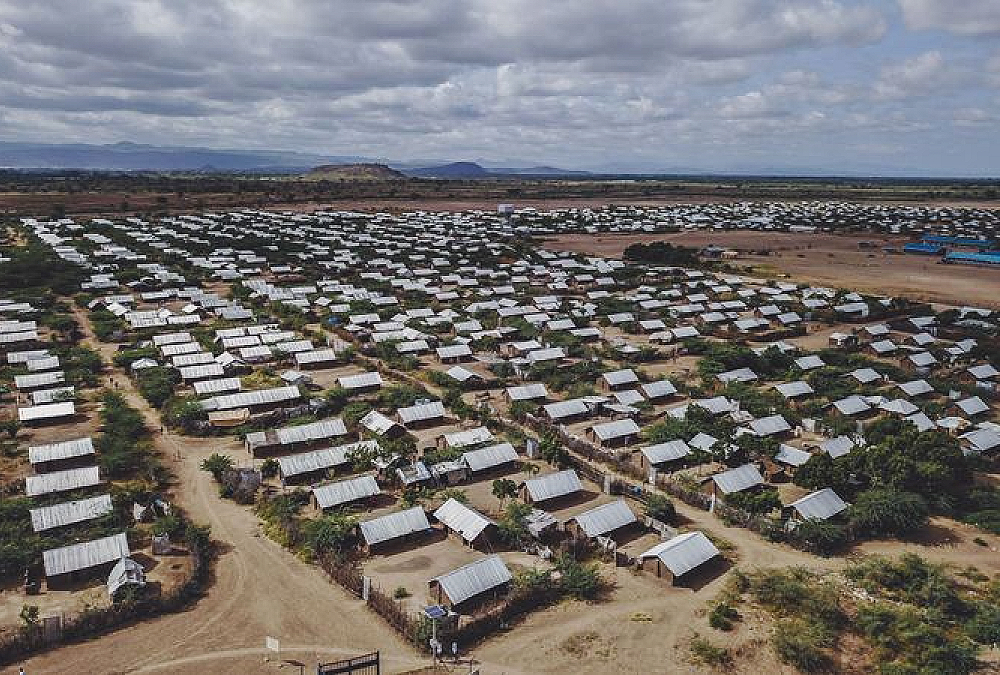
Of the top 10 refugee camps in the world, Kenya hosts the 4 largest. One of them, the Kakuma camp, consistently being the world’s largest with a population of 184,550.
That means Kakuma has nearly twice the population of what we consider to be the minimum for a small city in the United States. It was established in 1992, and despite much discussion of closing the camp and relocating its residents, it remains a problem for the Government of Kenya and its citizens.
Kakuma is yet another example of how charity toward unfortunate people can change to social conflict. Neighboring Somalia has been in some stage of upheaval since the establishment of the Somali Democratic Republic in 1969. Over the years since, many Somalis, including shopkeepers and other professionals, have fled the growing chaos, most often to Kenya’s four leading refugee camps. Thus, there are Somalis living in Kenya who were born there and have never seen their native land. Their reduced interest in leaving a stable Kenya for an unstable Somalia is but one issue.
| Country | IDPs | Refugees and Asylum seekers | Total | Percentage of Country’s population displaced |
| Sudan DR Congo Somalia South Sudan Nigeria Ethiopia Burkina Faso CAR Cameroon Mozambique Mali Eritrea Chad Niger Burundi |
6,011,010 6,101,300 4,395,000 2,229,657 3,578,996 3,143,255 2,062,534 485,825 1,066.254 834,304 375,539 N/A 381,289 358,185 8,177 |
1,292,949 1,039,793 739,298 2,321,994 403,887 279,412 73,941 753,324 141,108 8,685 220,695 587,301 17,216 23,743 333,794 |
7,303,959 7,141,093 5,134,298 4,551,651 3,982,883 3,422,667 2,136,475 1,239,149 1,207,362 842,989 596,243 587,301 398,505 381,928 341,971 |
16 7 29 42 2 3 9 22 4 3 3 16 2 1 3 |
Total Displaced in Africa: 40,398,156
Like the situation with Zimbabweans in South Africa, the more educated, well-to-do immigrants from Somalia, many of them shopkeepers, out-earn their Kenyan neighbors. In fact, it has been an irritant to Kenyans at various levels that some Somali refugees actually employ Kenyans. What makes this more galling for Kenyans is that as refugees, these Somalis have access to better education and other social services than citizens have. Certainly, Somali refugees, forced from their country through no fault of their own, need help, but what would you think if you were a law-abiding Kenyan citizen watching foreigners get better treatment than you were? Some poor people in the United States are now facing the same situation.
This circumstance takes on an even more problematic tone for South Sudanese refugees in Uganda. Ugandan President Yoweri Museveni, in the spirit of helping neighbors from South Sudan, not only facilitated social services but also the building of semi-autonomous communities, such as Bidi Bidi, which at one time housed more than 270,000 residents. This has many Ugandans concerned about South Sudanese gaining a say over the management of Ugandan territory.
Meanwhile, in South Sudan, Yida camp sprouted up organically during the Second Sudanese Civil War. Due to concerns over occupants’ safety and security, the South Sudanese government and UNHCR have encouraged refugees to resettle at the nearby Ajuong Thok refugee camp, an official camp managed by the government and UNHCR, but many Yida inhabitants have resisted relocation, and the settlement’s population continues to swell. Given the lack of governance at Yida and its proximity to the border with Sudan, it should come as no surprise that the camp has been plagued by dangers.
Aerial bombardment by the Sudanese Air Force Antonov planes destroyed food stores, ruined fields and made it impossible to cultivate and plant. Alongside this terror from the skies, everyone talked of the terrible toll of hunger in Sudan’s Southern Kordofan Province, the source of many of the refugees. During a visit to Yida, I saw efforts to feed not only the refugees, but also provide food and other supplies for the suffering inside Sudan, which made Yida even more of a target of the Sudanese military.
The Government of Tanzania has housed the Katumba settlement since 1992, when millions of Burundians fled ethnic violence in their country. More than a decade ago, realizing that an overwhelming number of Burundians had been born in Tanzania and faced an ongoing ethnic danger in Burundi, the Tanzania government offered more than 200,000 Burundian refugees the choice between repatriation or naturalization. Of course, more than three-quarters chose to become Tanzanian citizens.
The Sahrawi refugee camps in Tindouf, Algeria, are a collection of four refugee camps set up in the Tindouf Province in Algeria, in 1975–76 for refugees from Western Sahara fleeing from Moroccan forces, who advanced through that land during the Western Sahara War. With most of the original refugees still living in the camps, the situation is among the most protracted in the world. Governed by the Polisario Front, the camps are divided into five districts named after towns in Western Sahara; Laayoune (El-Aaiún), Awserd, Smara, Dakhla and more recently Cape Bojador.
The Sahrawi camps are the starkest examples of humanitarian assistance being never-ending without some action by government, as in Tanzania, to accept refugees as citizens. There seems to be insufficient international political will to effectively end the crises that force the flood of refugees, and crises on the continent are only increasing.
After nearly a decade of insecurity in Mali and Niger, violence began spreading into neighboring Burkina Faso in mid-2018 – affecting the entire country. Burkina Faso quickly became the epicenter of the region’s rapidly deteriorating displacement and humanitarian crises. Clashes between armed groups – mostly affiliated with al Qaeda and ISIS – and national security forces, as well as attacks on civilians, are feeding revenge-reprisal cycles. These dynamics are also increasing distrust both between communities and between citizens and the government.
Today, among Burkina Faso’s population of 20 million people, rampant insecurity has left 3.5 million people in need of humanitarian assistance and forced 1.2 million people out of their homes. The number of displaced people in the country has more than doubled compared to early 2020. Burkina Faso also hosts close to 20,000 refugees and asylum seekers from the wider region. With violence intensifying daily, aid organizations face constant challenges in reaching people in need.
Human life must be considered equally valuable whether it belongs to someone wealthy or someone desperate enough for a good life to risk their safety on the sea, over deserts or in countries where they may be held in refugee camps for indefinite periods.
During one of my visits to examine humanitarian assistance while working for Congress, a UNHCR official lamented that the international community is good about getting refugee camps up and running, but terrible about phasing them out. Given the intercommunal and ethnic problems sparked by longstanding refugee camps, it is in the interest of the international community and African governments to find lasting solutions to the crises that cause such rampant refugee activity. Sahrawi refugee camps notwithstanding, refugee housing cannot last indefinitely.
An ignored safety crisis for African refugees
Another issue is the apparent lack of care about the conditions African refugees face as they traverse dangerous international waters to get to what they think will be the “Promised Land” as opposed to non-Africans, especially wealthy white people killed at sea. In a June 23 article The Africa Report compared the situation with wealthy people who died on the experimental submarine Titan seeking the remnants of the luxury liner Titanic to the deaths of between 400 and 750 people who boarded a 30-meter fishing trawler in Libya – 100 of whom were children who were kept below deck.
A little less than two hours after its descent, the news service reported, the Titan lost contact with its mothership, triggering a five-day multinational search. Canada, the United States, Britain and France offered resources: C-17 transport planes, patrol planes, surface ships, aquatic drones, two remotely-operated vehicles (ROVs) and dozens of support personnel.
Meanwhile, the boat carrying the Africa refugees capsized in the early morning hours in international waters, about 80 kilometers (50 miles) from the coastal town of Pylos, within the Greek search-and-rescue area. A reported 104 people survived, 78 were confirmed dead and hundreds are missing. Greek officials, who have come under much scrutiny for their treatment of migrants, reportedly delayed assistance.
Unlike the international news coverage and effort to rescue the Titan, much of the search-and-rescue for the refugee trawler came from the crew of a privately owned superyacht, the Mayan Queen, which happened to be sailing nearby, as well as the International Rescue Committee, a nongovernmental humanitarian organization.
Human life must be considered equally valuable whether it belongs to someone wealthy or someone desperate enough for a good life to risk their safety on the sea, over deserts or in countries where they may be held in refugee camps for indefinite periods. We don’t have to wait for anyone to tell us this is a humanitarian crisis. It is and has been for decades, but the time to effectively address this crisis has to come now before many more lives are lost.
Gregory Simpkins, a longtime specialist in African policy development, is the Principal of 21st Century Solutions. He consults with organizations on African policy issues generally, especially in relating to the U.S. Government. He further acts as a consultant to the African Merchants Association, where he advises the Association in its efforts to stimulate an increase in trade between several hundred African Diaspora small and medium enterprises and their African partners.
