
A Diaspora View of Africa
West Africa faces ‘Catastrophic Challenge’

By Gregory Simpkins
For nearly half a century, the Economic Community of West African States (ECOWAS), established with the Treaty of Lagos in 1975, has endeavored to create a borderless region where member states could provide their combined population access to the region’s abundant resources. It has been a major transportation and trade center in Africa. But with the Alliance of Sahel States (AES) created this year, this economic and political power is severely threatened.
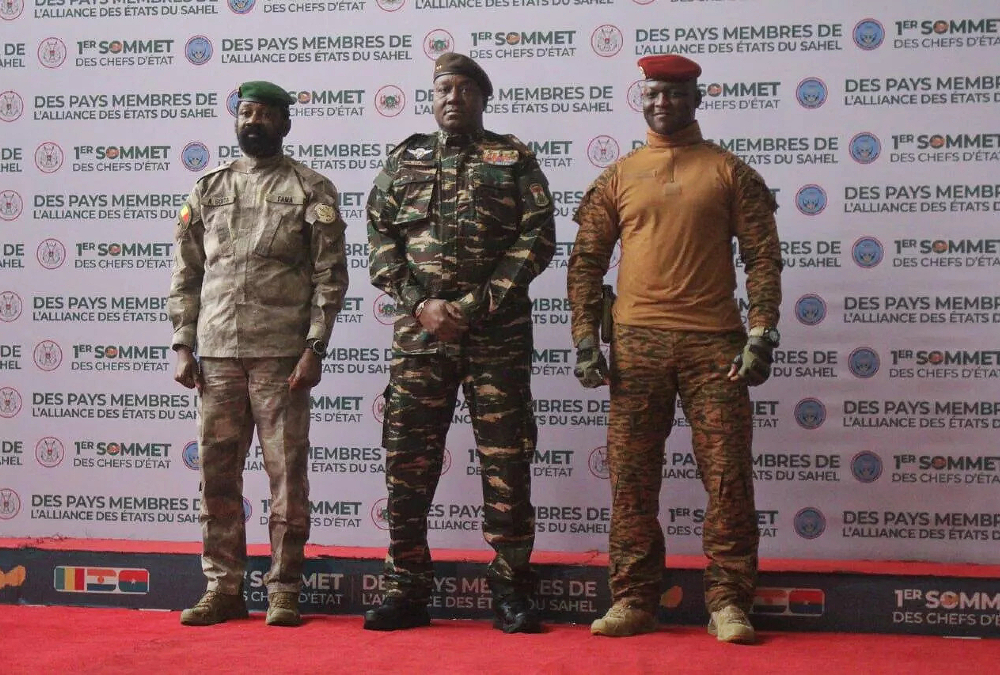
The military juntas in Burkina Faso, Mali and Niger earlier this month fulfilled the promise made in January of this year to leave the regional economic community for their own confederation. Opposition to French neocolonialism and Western pressure in response to their coups and choices to ally with Russia and China, as well as threatened ECOWAS military action, spurred the defiant decision to exit the longstanding regional bloc.
The head of the ECOWAS commission, Omar Alieu Touray, said in an July 8 article in The Guardian that the withdrawal risked “political isolation,” the loss of millions of dollars in funding, and the hampering of freedom of movement – a reference to the unrestricted movement allowed within the bloc since its formation in 1975.
“Our region is facing the risk of disintegration,” he warned in Abuja, the Nigerian capital.
ECOWAS has previously sent troops to intervene militarily during civil wars and transition stalemates in member states. It is working to set up a standing regional force of between 1,500 and 5,000 soldiers, which reports estimate would cost about £2 billion (US$2.6 billion) annually. This was a direction the junta leaders were not prepared to accept, much less contribute to. In March, the three states agreed to set up a joint military force to tackle security threats across their territories.
Meeting a day prior to the ECOWAS conference that had planned to appeal to the three states to reconsider their threat to leave the regional bloc, their announcement seemed designed as a further public rebuke to ECOWAS. According to a July 6 Reuters report, the falling-out is linked to the ECOWAS decision to respond to the trio’s coups with stringent sanctions and its unrealized threat to use force to restore constitutional rule in Niger last year.
Niger, Mali and Burkina Faso accuse the regional bloc of abandoning its founding ideals and giving too little support against the Islamist insurgencies that have killed thousands of people and displaced more than 3 million more.
“Our peoples have irrevocably turned their backs on ECOWAS,” the head of Niger’s military junta, General Abdourahmane Tiani said in a speech:
“It is up to us today to make the AES Confederation an alternative to any artificial regional group by building…a community free from the control of foreign powers.”
In what has been described by the powerful speech at the closing of the AES summit, Burkina Faso’s military leader Ibrahim Traoré said:
The “imperialists see Africa as an empire of slaves” and that they believe that “Africans belong to them, our lands belong to them, our subsoils belong to them. Niger’s uranium lights up Europe, but its own streets remain dark. This has to change.”
At the summit, agreements were made to allow for the free movement of people and goods, to create a stabilization fund in place of dependence upon the International Monetary Fund (IMF) and to develop an investment bank rather than rely upon the World Bank.
Challenges with the ECOWAS exit
It remains unclear how closely the AES will harmonize political, economic and defense policies as it struggles to contain a decade-old battle with Islamist insurgents and grow economies that are among the world’s poorest, according to Reuters.
Moreover, there remains the question of why three landlocked countries, among the poorest in the world, would leave an organization established to foster free movement of people, goods and capital across the region, considering the potential consequences.
In February 2024, the UN Development Programme (UNDP) released the Sahel Human Development Report 2023, which noted the immense wealth of the region that exists simultaneously with the poverty of its people. These countries are blessed with reserves of gold and uranium, lithium and diamonds, but it is largely Western multinational mining companies that have been reaping the profits, including through illicit accounting practices, according to a July 8 2024 article in the Peoples Dispatch.
The UNDP report notes that the Sahel has “one of the world’s highest solar production capacities – 13.9 billion kWh/y compared to the total global consumption of 20 billion kilowatts per hour per year (KWh/y),” while the World Economic Forum notes that the region is capable of earning hundreds of billions of dollars from the export of health foods produced in the Great Green Wall that runs from Senegal to Ethiopia (such as balanites, baobab, moringa, and shea). These are untapped potentials for the people of the region.
While the three Sahelian nations had their reasons for leaving ECOWAS, only time will tell if their planning is sufficient to succeed in the fight against extremist elements, provide enough transit opportunities for their citizens and allow a level of trade that will enable economic development.
In a series of articles in The Conversation on July 8 and 14, multiple problems were described due to the exit of the three countries from ECOWAS. In the July 8 edition, the publication cited Olivier Walther, Associate Professor of Geography at the University of Florida and an affiliated researcher at the UF Sahel Research Group, who laid out the devastating consequences for the regional economy of border closures between the Sahelian states and coastal countries of West Africa.
Since 1975, ECOWAS and its sister organization the West African Economic and Monetary Union (known by its French acronym, UEMOA) have implemented numerous policies aimed at improving how West African countries trade with each other and how they are connected to the world. Yet, progress towards regional integration has been slow, Walther told the publication. Intra-regional trade remains well below the levels of other regions and the West African economies still rely a lot on informal activities.
The limited results achieved in regional integration mean that there is a mismatch between regionalism as it should be on paper and as it is experienced on a daily basis. Despite the many agreements signed between West African countries to foster integration, West Africa is one of the world’s most expensive regions in which to do business.
Mobility
Political elites bear a great part of the blame for this, according to Walther. In a political system that relies on interpersonal relations, regional integration goes against the informal arrangements that politicians have established with wealthy traders. These networks have encouraged the development of informal trade between West African countries and prevented the implementation of trade facilitation initiatives. Much of the trade between Benin, Niger and Nigeria, for example, relies on informal networks that connect traders in border regions to state elites in the capital cities.
In a July 10 article, The Conversation cites Franzisca Zanker, Senior Research Fellow at the Arnold Bergstraesser Institute; Amanda Bisong, PhD candidate at the Vrije Universiteit Amsterdam, and Leonie Jegen, PhD candidate at the University of Amsterdam, argue that the three countries have much to lose if their departure from ECOWAS curtails mobility. They say the exit from ECOWAS has thrown up questions about how the trio will navigate regional mobility in future.
The three AES countries are connected in a web of mobility. Notably, Niger, seen as a key transit country for refugees and other migrants on their way to Europe, received major funds and support from the European Union to prevent onward migration to Libya and beyond.
One central measure was Loi 2015-36, the researchers explained, a law that punished people transporting migrants with fines and prison sentences. The law was mostly developed by external actors and had detrimental effects on the local economy. It also made migration journeys across the Sahara desert even more dangerous. In November 2023, the law, which arguable violated the principles of free movement under ECOWAS, was repealed by the Nigerien coup leaders.
Mali is another major transit country in the region, as well as a country of origin for regional migration. It has a complicated history of migration cooperation with Europe.
Of less relevance to Europe, but more for regional dynamics, Burkina Faso is at the center for regional migration, often seasonal. Labor migration supports Côte d’Ivoire’s cocoa industry.
The researchers say that informal mobility has always existed along with formal mobility governance. Official border crossing points are often not used, despite the legal requirement to do so. Thus, leaving ECOWAS may increase corruption and problems of harassment at formal border crossings as well as increased use of mobility facilitators, or “passeurs.” These are people who negotiate passage through formal border crossings and organize journeys along other routes.
Aside from trade and mobility, there is the question of mutual defense against the extremist groups operating in the Sahel and West Africa. In a June 27 issue of Breaking Defense, US Africa Command Commander Gen. Michael Langley said that as US and French troops have withdrawn from Africa’s Sahel, the area has become “less safe” and has seen an increased number of extremist groups.
“Because of the expanded numbers across a number of factions or extremist organizations, whether we are talking about JNIM [Jama’at Nusrat al-Islam wal Muslimeen] or ISIS, Boko Haram [Islamic sectarian movement] is still there. So it has increased across the region, and now is at the cusp of affecting coastal West Africa,” Langley said.
He added that these organizations “thrive in the areas of instability, such as weak governance, which lay themselves vulnerable for ungoverned populations of regions across an entire coast of West Africa.”
While the three Sahelian nations had their reasons for leaving ECOWAS, only time will tell if their planning is sufficient to succeed in the fight against extremist elements, provide enough transit opportunities for their citizens and allow a level of trade that will enable economic development.
Gregory Simpkins, a longtime specialist in African policy development, is the Principal of 21st Century Solutions. He consults with organizations on African policy issues generally, especially in relating to the U.S. Government. He further acts as a consultant to the African Merchants Association, where he advises the Association in its efforts to stimulate an increase in trade between several hundred African Diaspora small and medium enterprises and their African partners.
