
A Diaspora View of Africa
African leaders and International conferences

By Gregory Simpkins
The pan-African publication African Arguments asked a very pertinent question in its September 10 issue: When will African leaders resist the neocolonial summons?
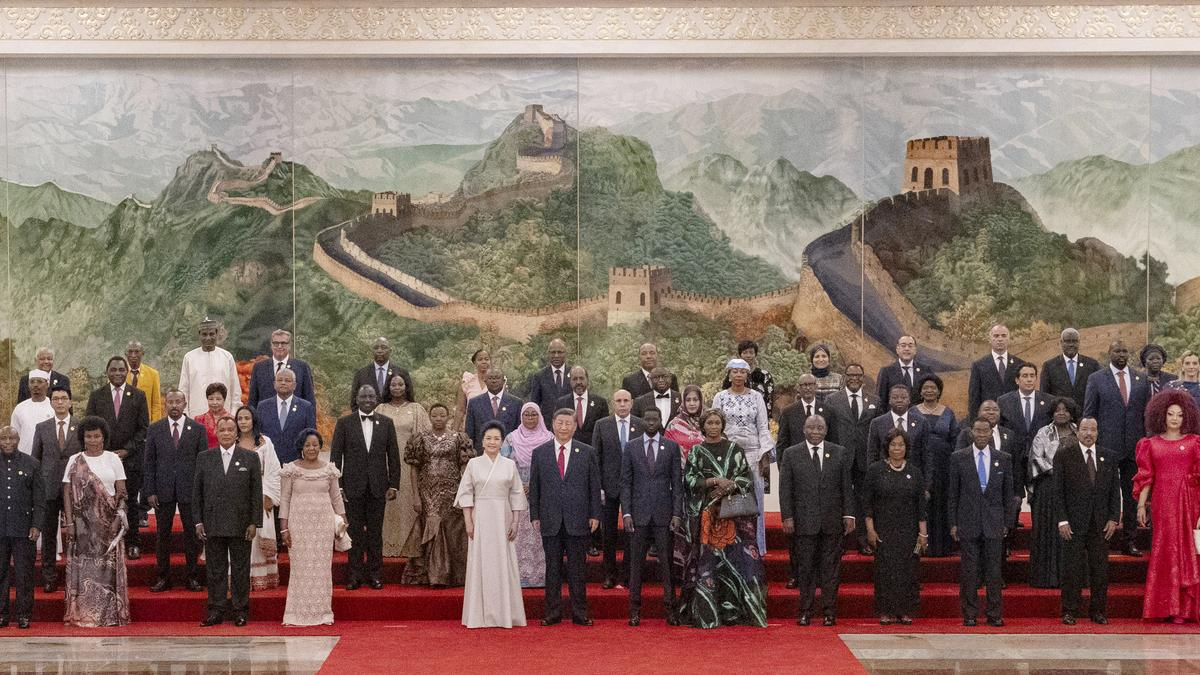
The just ended Forum on China-Africa Cooperation (FOCAC) has become the latest in a resurgence of gatherings by global powers to win friends and influence Africans, for the usual asymmetric and lopsided deals, the article stated. FOCAC was established in 2000 as a uni-multilateral partnership platform between China and 53 African states (all African states except Eswatini, which maintains diplomatic relations with Taiwan).
Chinese President Xi Jinping used the September 4-6 forum to strengthen trade and military ties with African countries – promising almost US$51 billion in financing to African countries over the next three years, and pledging to put them at the forefront of a global “renewable energy revolution”.
The Chinese leader also promised to help create at least one million jobs for Africa and US$141 million in grants for military assistance, saying Beijing would provide training for 6,000 military personnel and 1,000 police and law enforcement officers from Africa. This is significant. Since its re-engagement with Africa at the turn of the century, Beijing has studiously avoided engaging African states on military and security matters, wary of muscling in on what is perceived as Western territory.
However, in a joint statement, Xi and the 50 African leaders present agreed to work together to build an “equal” and “orderly multipolar world” and “universally beneficial and inclusive economic globalization”. This supports China’s goals in that regard. How it will work or Africa remains to be seen.
China has long been a leader in infrastructure projects on the continent, albeit posing a danger of “debt trap” when governments cannot repay loans.
Kwame Nkrumah, a founding father of independent Africa, once said: ‘The black man is capable of managing his own affairs’. Unfortunately, this call for self-reliance has not been fully taken up by African governments, who seem content with attending foreign convened conferences to hear what outside powers can offer them.
Other international conferences focusing on Africa include the Tokyo International Conference of African Development (TICAD), which was launched in 1993 by the government of Japan, to promote Africa’s development, peace and security, through the strengthening of relations in multilateral cooperation and partnership.
In the course of nearly 30 years, TICAD has evolved into a major global forum for mobilizing and sustaining international support for Africa’s development under the principles of African “ownership” and international “partnership.”
As a founding co-organizer of TICAD, the United Nations Development Program (UNDP) is committed to the success of TICAD. The TICAD process reflects UNDP’s foundational belief that sustainable development can only happen with the full participation of a range of partners, including governments, regional and international organization, non-governmental organizations, the private sector, and civil society.
I am most familiar with the African Growth and Opportunity (AGOA), Act Forums, having worked on them since their inception in 2000. They are divided into government ministerials, private sector and civil society fora.
Unfortunately, unlike other forums focusing on African development, the AGOA fora usually do not include the presence of the American president and increasingly, not African government leaders, largely for that reason. Some U.S. government officials have expressed frustration that more African countries have not taken advantage of the 6,400 items they can export to the United States duty-free and quota-free, but this stance ignores factors that contribute to the failure of African countries to take full advantage of AGOA.
Despite the trade program coming up on the quarter century mark, it is still not as well understood on the continent as one would expect. This is partly due to the continual shifts in African officials tasked with figuring out utilization of AGOA. Also, in Africa governments and private sectors do not work together as they often do in the United States, and U.S. officials seem not to take this into account.
Developing Self-reliance
Kwame Nkrumah, a founding father of independent Africa, once said: ‘The black man is capable of managing his own affairs’. Unfortunately, this call for self-reliance has not been fully taken up by African governments, who seem content with attending foreign convened conferences to hear what outside powers can offer them. This ignores the agency that African governments have by virtue of their vital resources and growing youth and middle-class populations.
In this age of vital resources to power the 21st century economy, Africa has significant leverage. African nations contribute significant amounts of petroleum, diamonds, cobalt, lithium, uranium, chromium and other key materials to the global economy.
In recent decades, minerals such as tin, tantalum, tungsten and gold – also known as conflict minerals or 3TG – became increasingly sought after commodities for their use in electronic equipment such as cell phones, computers and fluorescent light bulbs. Tin is often used to coat other metals to prevent their corrosion and to create alloys.
Tantalum stores electricity and is used in alloys for its strength. Tungsten is typically used in tools, cell phones and high-temperature situations, and also is used in alloys for its strength. Gold, which most notably used in jewelry and decorative products, also has industrial uses because of it is malleable, is not highly corrosive and is highly conducive to electricity and heat.
The modern world needed these materials, and a scramble has occurred in Africa to obtain them – legally or not. Exploitation of these elements in East Africa has led to conflicts involving the Democratic Republic of the Congo (DR Congo), Rwanda, Burundi and Uganda.
More recently, minerals known as rare earth elements have come to prominence as much-desired materials. They are 17 nearly indistinguishable, silvery-white soft heavy metals used in electrical and electronic components, lasers, glass, magnetic materials and industrial processes. They have become indispensable for renewable energy equipment.
With the leverage Africa has and the growing international interest in their resources and markets, one hopes African governments will create their own forums and enlist international support for the solutions they present.
Given the abundance of critical materials in Africa, why aren’t these nations convening conferences and inviting donor governments, international organizations and international financial institutions to Africa to hear their plans for the continent’s development? The creation of the New Partnership for Africa’s Development (NEPAD) in 2001 was designed to encourage African solutions to African challenges without relying exclusively on foreign aid. That goal is still in development.
In an encouraging recent advance, Chinese electric-vehicle manufacturers Neta Auto and Xpeng Motors are ramping up their push into Africa, shifting their overseas strategies amid trade frictions with Europe.
Neta, a brand developed by EV startup Hozon New Energy Automobile, opened a flagship store in Kenya in late June. The dealership is Neta’s first in Africa.
Neta plans to enter 20 African countries in the next two years. It aims to open 100 dealerships and sell more than 20,000 units in the region within three years.
Kenya “serves as a gateway to Southern, Central, and Eastern Africa,” Neta said in a news release.
Founding a competitive, large-scale African EV manufacturer would be a critical step to bringing the EV revolution to Africa. Importantly, this would give agency to African people and prevent further reliance on international imports. Some start-ups like Ampersand in Rwanda, or Roam (Obipus) in Kenya have started working in specific niches (motorcycles and bus conversions, respectively), but to date, no large-scale African EV manufacturer exists, although China is said to be investigating the manufacture of EV batteries on the continent.
With the leverage Africa has and the growing international interest in their resources and markets, one hopes African governments will create their own forums and enlist international support for the solutions they present.
Gregory Simpkins, a longtime specialist in African policy development, is the Principal of 21st Century Solutions. He consults with organizations on African policy issues generally, especially in relating to the U.S. Government. He further acts as a consultant to the African Merchants Association, where he advises the Association in its efforts to stimulate an increase in trade between several hundred African Diaspora small and medium enterprises and their African partners.
