
Opinion
The Lifeline of Africa’s Diaspora: Why Remittances Matter More Than Ever


By Des H Rikhotso
In an era of global uncertainty, one financial flow remains remarkably resilient – remittances. Across Africa, these cross-border transfers from diaspora communities are no longer just a supplementary income stream; they have become a cornerstone of economic stability, social mobility, and macroeconomic resilience.
Nowhere is this more evident than in West Africa, which in 2024 dominated the continent’s remittance landscape with striking authority.
According to the latest data, six of Africa’s top 15 remittance-receiving nations hail from West Africa. Senegal leads the regional pack with a remittance index score of 77, followed closely by Nigeria at 72 and Ghana at 69.
These figures are more than statistical footnotes – they reflect a profound economic reality: for millions of households, money sent home from relatives abroad is the difference between vulnerability and viability.
Remittances in West Africa do far more than plug budget gaps. They act as a critical shock absorber during periods of domestic economic turbulence.
In Nigeria – Africa’s largest economy but one frequently buffeted by currency volatility and fiscal strain – diaspora inflows have repeatedly cushioned the blow of downturns, stabilizing household consumption when formal safety nets fall short. Similarly, in Senegal, where formal employment opportunities remain limited, remittances fuel entrepreneurship, finance children’s education, and cover essential healthcare costs.
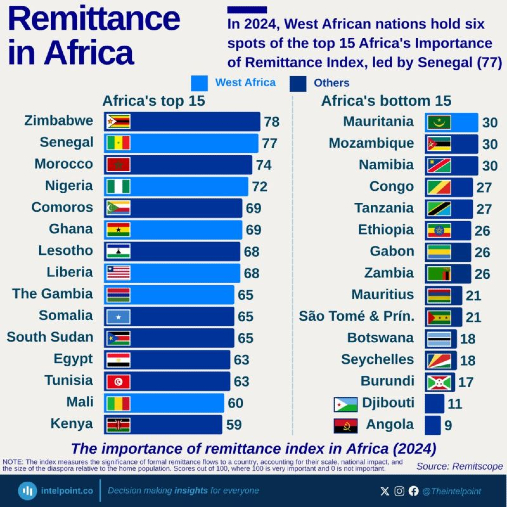
From Household Resilience to National Stability
Beyond the household level, these inflows play a macroeconomic role that is too often underappreciated. By bolstering foreign exchange reserves and reducing current account deficits, remittances enhance national financial resilience.
In Ghana, for instance, consistent diaspora contributions have helped mitigate pressures on the cedi and supported balance-of-payments stability during periods of external stress.
Yet despite their transformative impact, remittance channels remain hampered by high transaction costs, regulatory bottlenecks, and limited financial inclusion. The World Bank estimates that Africans still pay some of the highest remittance fees globally – averaging over 8 percent – siphoning billions away from families who need every dollar.
Digital innovation, regulatory harmonisation, and public-private partnerships offer promising pathways to reduce these frictions and unlock even greater developmental returns.
As African governments seek sustainable growth models in a fragmented global economy, they would do well to recognise remittances not as charity, but as strategic capital. The diaspora is not merely sending money home – it is investing in Africa’s future.
Policymakers must respond with frameworks that maximise the economic multiplier of these flows, turning a lifeline into a launchpad.
Des H Rikhotso (PgDip-BA, MBL) is a seasoned C-suite Multi-Industry business executive with 25+ years of Business Leadership Experience across the South, East and Western Sub-Sahara Africa Region. Based in Kampala, Uganda he serves as East Africa Region Business Executive, driving Business Strategic Growth and Operational Excellence – contributing his Leadership Voice and Clarity to the Region. Des has held Business Leadership roles at BMW Group Africa, Volkswagen Group Africa, Peugeot Motors South Africa, Toyota/Lexus South Africa, Nissan Group of Africa, G.U.D Holdings (Africa Exports Operations Division) and The HDR Group of Companies. He holds Under-Graduate and Post-Graduate business degrees from the University of the Western Cape, Wits University (Wits Business School) and the University of South Africa.
