
Opinion
Rethinking Food Sustainability in Africa: Mechanization and Innovation as Game-Changers

By Jean Claude Niyomugabo
Africa stands at a pivotal crossroads. With a rapidly growing population, climate volatility, and persistent post-harvest losses, the continent’s food systems are under immense strain.
Yet within this challenge lies one of the most transformative opportunities of our time: reimagining African agriculture through sustainable, smart mechanization.
True food sustainability in Africa will not be achieved by returning to the past—but by embracing innovation that respects both ecological limits and human dignity. Four foundational pillars are essential: sustainable farming practices, climate-resilient crop systems, modern irrigation infrastructure, and, critically, enhanced post-harvest logistics to slash the staggering 30 – 40 percent of food lost between farm and market.
But none of these can reach their full potential without one game-changing enabler: appropriate, scalable mechanization.
For decades, mechanization in Africa has been mischaracterized as merely importing large tractors – a one-size-fits-all solution ill-suited for smallholder farms that dominate the continent’s agricultural landscape. The reality is far more nuanced – and far more promising.
Mechanization is not just about machines; it’s about productivity, profitability, and restoring dignity to farming – especially for the millions of young people who currently view agriculture as a last resort.
Precision Agriculture Takes Flight
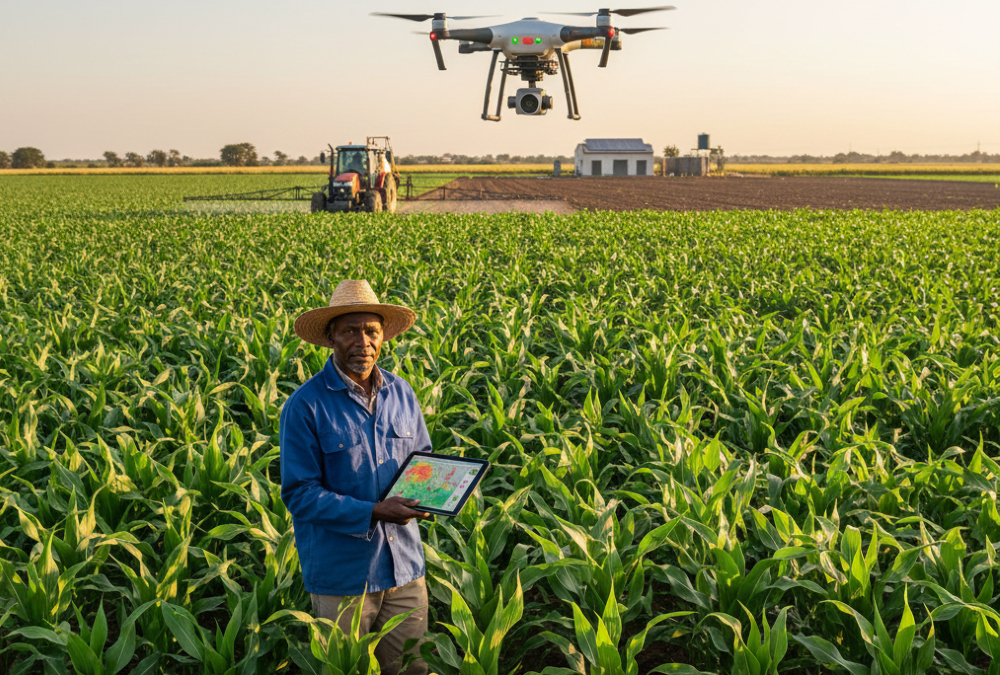
Enter the era of precision agriculture, where digital tools and smart machinery are quietly revolutionizing food production. Among the most impactful innovations? Agricultural drones.
Far from being mere gadgets, drones are becoming indispensable allies for smallholder farmers in Nigeria, Kenya, Ghana, and beyond. Equipped with multispectral sensors and AI-driven analytics, these flying platforms enable real-time monitoring of crop health, soil moisture, and pest infestations – delivering insights that were once the exclusive domain of industrial agribusinesses.
In Nigeria, rice farmers using drone-based spraying have reported up to 30 percent reductions in chemical inputs – cutting costs while minimizing environmental harm. In Kenya, drone-enabled mapping is helping cooperatives optimize irrigation layouts and land use, boosting yields without expanding cultivated area.
The result? Higher incomes, lower drudgery, and faster response times to emerging threats like fall armyworm or drought stress.
Critically, this technology is democratizing access. Drone-as-a-service startups are emerging across the continent, allowing even the smallest farms to rent aerial intelligence by the acre – no upfront capital required.
This model bypasses traditional barriers to mechanization and aligns perfectly with Africa’s mobile-first, platform-driven economic evolution.
Beyond Drones: A New Ecosystem of Smart Tools
Yet drones are just one piece of a broader mechanization mosaic. Two-wheel tractors, solar-powered irrigation pumps, digital marketplaces, and mobile extension services all form part of an integrated ecosystem that can make farming efficient, sustainable, and attractive to the next generation.
The stakes could not be higher. By 2050, Africa will be home to over 2.5 billion people – nearly a quarter of the global population.
Feeding them will require more than goodwill; it demands strategic investment in agri-tech infrastructure, supportive policies, and farmer-centered design.
Policymakers, development partners, and private investors must move beyond outdated paradigms. Subsidizing diesel-guzzling machinery or ignoring smallholders’ needs will only deepen inefficiencies.
Instead, they should champion modular, affordable, and data-enabled tools that scale with farmers’ realities.
Farming as a Beacon – Not a Burden
Africa’s agricultural future isn’t about bigger engines – it’s about smarter decisions, powered by data, driven by dignity, and rooted in sustainability. When a young farmer in Kaduna or Kisumu can manage a 10-hectare plot with precision tools that conserve water, reduce waste, and connect her directly to markets, we will know the transformation has truly begun.
The path to food security runs through innovation – not exhaustion. Let’s build an Africa where farming is not a burden, but a beacon of opportunity.
Jean Claude Niyomugabo is an entrepreneur and digital communication specialist with a strong passion for Africa’s development. He is dedicated to harnessing the power of social media to drive positive change and enhance livelihoods. With diverse interests and a strategic approach to digital engagement, he strives to create meaningful impact through innovation and connectivity.
