
Opinion
A New Factory Is Not Yet an Industry
Machinery creates capacity. Suppliers, skills, maintenance, finance and customers determine whether that capacity becomes a viable business – and the foundation for further industrial development.

By Raymond Chimhandamba
The ribbon is cut. The machinery gleams. Officials celebrate investment, employment and the prospect of replacing imports. These are achievements worth recognizing. Building a factory requires conviction, capital and considerable effort.
But the ceremony cannot tell us whether the factory will obtain suitable materials consistently, control production losses, retain its technical team or collect payment quickly enough to finance the next order.
Those questions become urgent after the guests leave.
Dangote’s tomato-processing venture in Kano offers a telling example. In May 2016, its managing director reported that production had been suspended because fresh tomatoes were unavailable following a destructive pest outbreak. The investment faced a supply problem beyond the factory gate.
A Reuters report in 2017 described continuing difficulties obtaining the quality and quantity required. Trained workers remained on the payroll while the plant stood idle. Even an investor with Dangote’s resources and industrial experience could encounter a gap between installing processing capacity and establishing dependable supply.
The lesson deserves attention without dismissing the ambition. A factory participates in a system of businesses, people and incentives. Its commercial performance depends on how well that system works.
Technology Must Become Operating Capability
My experience in absorbent-hygiene manufacturing has repeatedly reinforced the importance of the team behind the equipment. A company can buy a sophisticated baby diaper production line and still lose money if the team cannot manage the process, maintain quality and control waste.
Sanitary pads and diapers combine materials whose placement, tension, bonding and absorbency must work together. A line running at impressive speed may also be producing expensive rejects. Output must be measured in saleable products, with an understanding of what it costs to produce them.
For a new entrant building capability progressively, I often favor beginning with sanitary pads, moving into baby diapers and approaching adult diapers once the team has accumulated sufficient experience. A simple way to visualize the increasing material requirement is to imagine how many sanitary pads could fit within the outline of a baby diaper, and then how many baby diapers could fit within an adult diaper. Although their construction differs, the comparison makes the scale clear: as products become larger, each rejected unit carries a greater raw-material cost. Mastering process control and waste management at each stage prepares the team for the next. At commercial production volumes, those differences in material consumption and waste can translate into millions of dollars over time.
The underlying consideration is the cost of mistakes. Larger absorbent products generally contain more material per unit. Poor control can therefore turn rejects into substantial losses. Product complexity, line speed and reject rates also matter. Investors should understand the financial consequences of the learning curve before approving the equipment.
Glass manufacturing offers another perspective from my previous industry experience. Technical capability takes time to develop, while capital commitments can be substantial. When assessing the purchase of an existing plant, the equipment list is only part of the evaluation.
Who understands the process? How much expertise rests with expatriate specialists, and how much has become embedded locally? Which people will remain after the sale? How many of the key plant experts will stay after the sale to make sure that the plants will continue doing what it is doing today. Some gaps will not be easy to close as the expertise is already scarce even on a global level.
These questions concern continuity of knowledge, not just equipment. Buying a functioning plant does not guarantee you acquire the capabilities that keep it running. Retention, succession, and practical knowledge are important components of what you are actually paying for.
Suppliers Need a Commercial Pathway
A factory may initially import most of its specialized inputs and still create valuable employment, skills and production. Localization becomes stronger as viable supplier relationships develop around it.
Consider a hygiene manufacturer. Corrugated cartons, transport and selected packaging services might offer earlier opportunities for local sourcing than specialized absorbent polymers or particular nonwoven materials. Yet even apparently straightforward supplies must meet requirements for strength, dimensions, consistency and delivery.
A poorly made carton can compromise handling. Inconsistent film can disrupt production. A cheaper material may increase rejects or customer complaints enough to erase the purchasing saving.
The question is which suppliers can meet industrial requirements, what support they need and whether sufficient recurring business exists to justify investment.
South Africa’s automotive sector illustrates this process. In 2024, Toyota Tsusho Africa and Ogihara Thailand announced a joint venture to manufacture automotive press parts for Toyota South Africa Motors. The arrangement connected specialist manufacturing knowledge with an identified industrial customer and a plan to increase local procurement.
That is a more concrete proposition than simply inviting businesses to establish themselves near a factory. Supplier development requires specifications, qualification, credible volumes and a workable commercial relationship. Suppliers may also need finance for tooling and equipment before their first approved delivery.
A factory helps develop an industry when its purchasing requirements become opportunities that other businesses can realistically serve.
Maintenance Protects the Investment
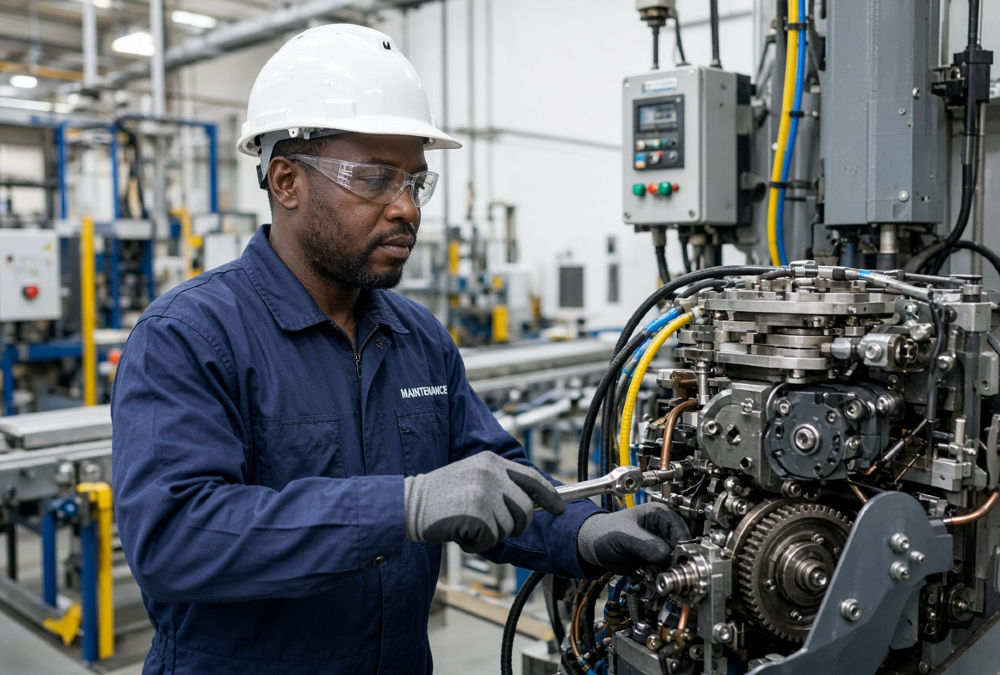
Industrial capacity includes the ability to restore production when something fails.
A bearing, sensor or drive may represent a tiny fraction of a production line’s purchase price. Its failure can nevertheless stop the entire operation. The relevant cost includes lost output, idle labor, emergency freight and customers whose orders cannot be fulfilled.
Maintenance planning should begin during equipment selection. Which components are readily available? Which require proprietary support? Are technical drawings, software backups and diagnostic access included? What training will enable local technicians to distinguish a mechanical fault from a controls problem?
Remote support can be valuable, but someone still needs to inspect the machine and carry out the repair. A video call cannot replace every practical skill.
Spare-parts decisions also need judgment. Holding every possible component is expensive. Holding none exposes the business to avoidable downtime. A critical-spares plan should consider failure consequences, delivery times and alternative sources.
There is an industrial opportunity here beyond individual factories. Several plants may collectively support a specialist service business, a regional parts inventory, motor repairs or precision machining that one plant could not sustain alone.
Such services require their own equipment, skilled people and customers. They deserve consideration within industrial-development strategies because they protect the productivity of investments already made.
Machinery Finance Does Not Complete the Funding
A project can secure funding for its building and equipment while remaining short of the cash required to operate.
Raw materials may require advance payment. Imports take time to arrive. Inventory must be held before production, and finished goods may remain in warehouses before distributors take delivery. Customers can then require credit. Meanwhile, wages, power bills and financing obligations continue.
In project planning, I want the raw-material requirements for at least the first year understood and estimated, together with the financing needed to sustain production. That does not mean every factory should purchase or physically store twelve months of inputs. The cash requirement depends on procurement lead times, supplier terms, inventory levels and customer payment periods.
The distinction matters. Annual purchasing expenditure and the amount of working capital needed at any moment are different figures. Both belong in the financial model, including allowances for commissioning losses, delayed sales and slower collections.
Growth can intensify the problem. More orders require more materials and production spending before the additional revenue becomes cash. A growing factory can therefore face a liquidity squeeze even when its products are selling successfully.
Investors and lenders should assess whether the business can finance its actual operating cycle, rather than assuming that commissioning completes the funding requirement.
Customers Must Qualify the Product
Population, consumption growth, and imports help identify market opportunities. They do not establish a customer base for a particular factory.
For industrial materials, the route from an interested buyer to recurring orders may include trials, audits, specification checks, and production testing. Certain hygiene, medical, packaging, and other demanding applications involve lengthy qualification processes. The schedule varies by product and customer, but the financial consequences are real.
A new nonwovens producer may manufacture material that looks suitable while still needing to demonstrate consistent performance on a customer’s converting equipment. Initial samples are a beginning. Repeatability across commercial batches is another test.
The financial model must accommodate that interval. Producing trial material, supporting customer tests, and carrying operating costs before approval all consume cash. Revenue assumptions should reflect how purchasing decisions actually occur.
Consumer products present related challenges. A distributor needs acceptable margins, reliable supply, and a reason to introduce another brand. A household evaluates affordability, performance, and availability. The manufacturer must serve both.
Uber’s withdrawal from Nigeria and Uganda in September 2026 offers a brief parallel beyond manufacturing. The company did not disclose detailed reasons for its decision. We should therefore avoid claiming it simply misread population figures. The broader commercial question remains useful: can a price customers are willing to pay sustain the drivers, assets, and service standards needed to deliver?
For factories, that calculation includes production costs, distribution, retailer margins, and customer credit. A large market offers possibilities. A viable business must establish the terms on which those possibilities become profitable sales.
The First Factory Can Make the Next One Easier
These considerations should encourage better investment preparation, not discourage pioneering projects. Few first movers encounter a complete industrial ecosystem waiting for them.
A successful factory can help build one. It trains operators, generates purchasing demand and creates opportunities for technical services. Suppliers learn to meet specifications. Experienced people develop other businesses. Nearby manufacturers gain access to capabilities that were previously unavailable.
That progression needs deliberate effort. Buyers must offer credible opportunities. Training must develop practical competence. Technical partnerships must leave knowledge behind. Shared services need enough demand to survive.
For OEMs, the opportunity extends beyond delivering equipment to helping customers build sustainable operating capability. For DFIs, an investment’s developmental value includes the relationships and skills it can strengthen. Governments can support those connections through practical training, testing services and infrastructure shaped around industrial requirements.
The ribbon-cutting ceremony marks a real achievement. What follows determines whether the investment remains an isolated asset or helps establish something larger.
A new factory creates capacity. An industry develops when that capacity can operate reliably, sell competitively and make further production possible. That is the work that continues after the ribbon has been cut.
Raymond Chimhandamba is a Johannesburg-based consultant, writer, and speaker specializing in African industrial development, manufacturing value chains, and investment opportunities. He is director of Handas Consulting and founder of Kunakisa Recycling, with expertise in market entry, manufacturing localization, due diligence, absorbent hygiene products, nonwovens, recycling, and the commercial use of agricultural waste. He has contributed more than 40 articles to Nonwovens Industry Magazine and writes for International Fiber Journal. He has also spoken at international industry events organized by INDA and EDANA. Raymond is currently writing Asymmetric Africa, a book examining overlooked opportunities in African markets.
