
Opinion
China vs. U.S. in Africa: The Real Contest for the 21st Century’s Most Crucial Arena

By Dishant Shah
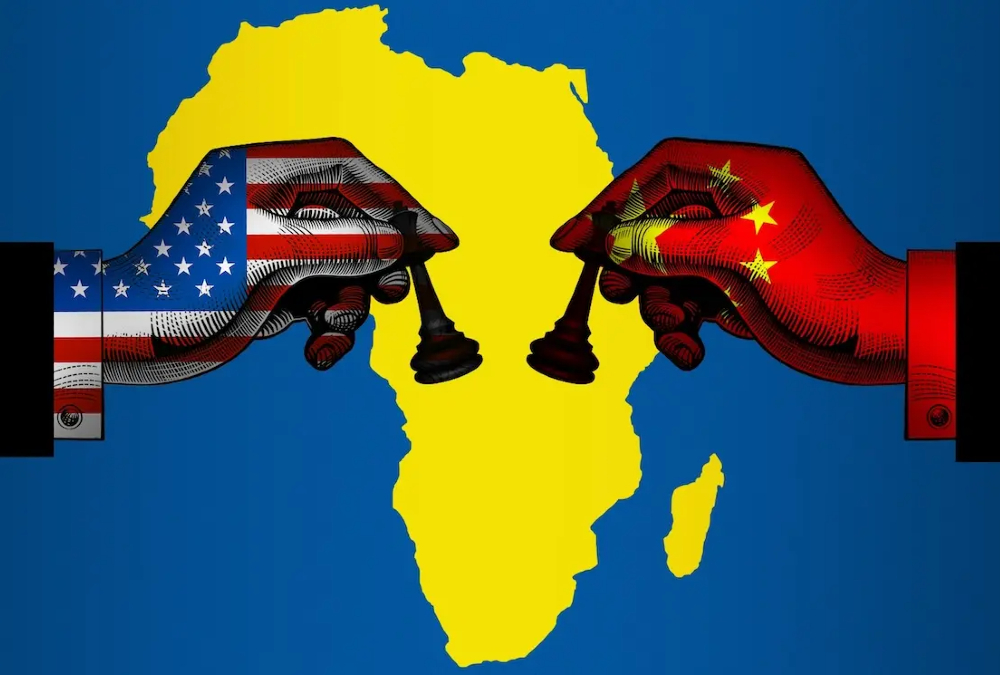
When pundits speak of the 21st century’s great power rivalry, they fixate on the Pacific – Taiwan, the South China Sea, semiconductor supply chains. But the true battleground for global influence isn’t maritime chokepoints.
It’s on the African continent. And the numbers don’t lie.
In 2024, China’s trade with Africa reached a staggering US$322 billion. The United States? A mere US$72 billion.
Even more telling: China’s new financial commitments for 2025 alone total US$22.7 billion – more than 16 times the combined US$1.4 billion pledged by the U.S. International Development Finance Corporation (DFC) and USAID.
But beyond the ledger sheets lies a deeper strategic divergence – one that will determine not just who invests in Africa, but who defines its future.
China: Building the Foundations of Tomorrow
Beijing doesn’t just fund projects – it builds ecosystems.
From the US$32.7 billion green hydrogen initiative in Morocco to the revitalization of the historic TAZARA railway linking Tanzania and Zambia, China is embedding itself into the physical arteries of African development. Its footprint spans ports, power grids, highways, and digital infrastructure.
Huawei has rolled out 5G networks across 35 African nations. Nuclear cooperation is advancing in Ghana. Solar farms are rising from Kenya to Egypt.
China’s playbook is simple, effective, and patient: Build first, ask questions later. Infrastructure isn’t an afterthought – it’s the foundation of sovereignty, industrialization, and long-term leverage.
For African leaders hungry for concrete results, this is irresistible.
The U.S.: Guarding the Gates, Not Building the Road
Washington’s approach is fundamentally different – and far more conditional.
U.S. engagement centers on security partnerships, critical minerals, and digital governance. The Lobito Corridor rail project in Angola and the Democratic Republic of Congo aims to unlock cobalt and copper for electric vehicle supply chains – not just for African growth, but for American competitiveness. The US$700 million investment in Côte d’Ivoire’s digital economy comes with strings attached: data privacy standards, anti-corruption benchmarks, and cybersecurity training modeled on Western norms.
America’s strategy isn’t about building roads – it’s about securing control over the data flowing on them, the minerals beneath them, and the institutions governing them.
It’s a vision rooted in rules, transparency, and geopolitical alignment. But for many African governments weary of conditional aid and moralizing lectures, it often feels less like partnership and more like surveillance.
The Core Conflict: Model vs. Mandate
This isn’t merely a competition for market share or diplomatic influence. It’s a contest over the very architecture of development.
- China offers capital without conditions: Fast construction, no political audits, no human rights checklists.
- The U.S. offers tools with constraints: Digital democracy, transparent procurement, environmental safeguards – but only if you play by their rules.
One builds the stage. The other demands a script.
Africa is not a passive spectator. It is the most dynamic, fastest-growing region on Earth – with 60 percent of its population under 25, abundant natural resources, and rising urban centers poised to become global economic hubs.
Every road built, every fiber-optic cable laid, every energy grid expanded is a vote for a particular vision of the future.
Will Africa’s future be shaped by infrastructure-led industrialization, as championed by Beijing? Or by digital-first, security-conscious modernization, as envisioned in Washington?
The answer won’t come from Beijing or D.C. It will come from Accra, Nairobi, Lagos, and Addis Ababa.
Africa’s Moment: From Pawn to Player
For too long, Africa has been treated as a prize to be divided – a resource reservoir, a battlefield for proxies, a recipient of charity or coercion. But today, African nations hold unprecedented leverage.
They can demand better terms from Beijing: local content requirements, technology transfer, debt sustainability guarantees. They can insist Washington deliver real investment – not just promises tied to regime change or military basing rights.
The most astute African leaders aren’t choosing between China and the U.S. They are playing them against each other.
Ethiopia negotiated dual financing for its industrial parks. Kenya secured both Chinese loans for its standard-gauge railway and U.S. support for its fintech revolution.
Rwanda leverages Silicon Valley partnerships while welcoming Chinese telecom infrastructure.
This is not appeasement. This is agency.
The Real Question Isn’t Who Wins – It’s Whether Africa Can Win
The greatest risk isn’t Chinese dominance or American neglect. It’s African passivity.
If African nations allow themselves to be reduced to mere conduits for foreign capital – or worse, pawns in a geopolitical chess match – they will remain perpetually dependent.
But if they harness this rivalry to build sovereign capacity – to craft their own development models, enforce fair contracts, and demand accountability from all partners – they won’t just benefit from the competition. They will lead it.
The 21st century won’t be decided in Washington or Beijing. It will be forged in African cities, powered by African ingenuity, and defined by African choices.
The world is watching. So should we.
Dishant Shah is a partner at Legion Exim, a company specializing in facilitating the export of high-quality engineering products directly sourced from manufacturers in India to Africa. His areas of expertise include new business development and business management.
