
Opinion
Africa’s Youth Boom Is the World’s Greatest Economic Opportunity – And the World Isn’t Ready


By Edson Mpyisi
Africa is not waiting for its future – it is living it.
As Coordinator of the Enable Youth Program at the African Development Bank (AfDB), I have spent years translating data into narrative.
But nothing has struck me as forcefully as the demographic reality now unfolding across the continent: Africa’s youth are not merely the next generation. They are the engine of today’s economic, technological, and social transformation.
Last year, I set out to verify a widely circulated global fertility rate map. Using the World Bank’s World Development Indicators, I reconstructed the map myself. The result was unmistakable.
Red zones – where fertility rates fall below 2.1, the threshold for population stability – dominate Europe, East Asia, and North America.
Green – the color of growth – is concentrated almost entirely in Africa, where the average woman bears 3.9 children.
This isn’t a trend. It’s a tectonic shift.
Consider the numbers:
- Africa’s median age is 19. In Europe, it’s 45.
- By 2050, the continent will be home to 830 million people under 25 – more than the entire population of the United States today (World Economic Forum).
- Over 60 percent of Africa’s population is under 25.
- A burgeoning middle class of 313 million – and growing – is fueling demand across sectors (AfDB).
- By 2030, the continent could generate 230 million digital jobs (World Bank).
- One in five working-age Africans is already an entrepreneur or runs a micro, small, or medium enterprise (Brookings Institution).
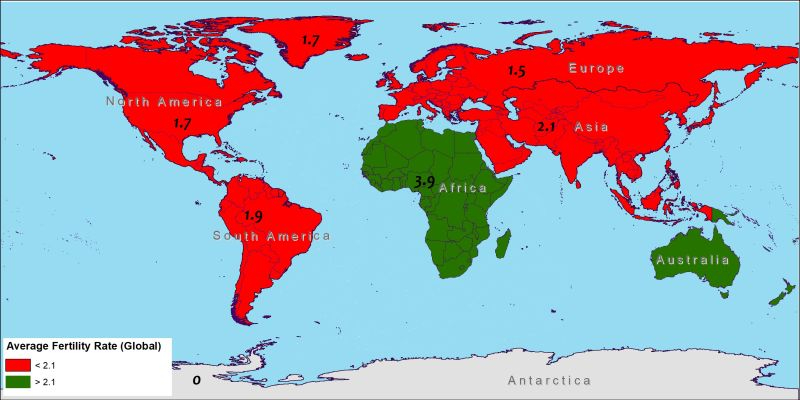
Map showing high fertility in Africa versus aging populations in North American, Europe and Asia.
The $2.5 Trillion Consumer Revolution Already Has a Name – Africa’s Youth
These are not projections. They are present-tense realities.
Yet too often, global policymakers treat Africa’s youth bulge as a looming risk – a “demographic time bomb.” That framing is not only outdated; it is dangerous.
It ignores the fact that youth are not a problem to be managed, but a force to be unleashed.
Demographics are not destiny – but they are opportunity. And opportunity demands investment.
Africa’s youth cannot thrive on hope alone. They need:
- Universal access to quality education – not just primary, but STEM, vocational, and digital literacy.
- Skills ecosystems aligned with the jobs of tomorrow: AI, green energy, fintech, agri-tech.
- Infrastructure – from broadband networks to reliable power and transport – that connects talent to markets.
- Inclusive governance that empowers young people not as beneficiaries, but as co-designers of policy.
We must move beyond donor-driven agendas and outdated development models. The time has come for Africa to define its own benchmarks.

Africa’s population pyramid: median age 19 vs. Europe’s 45.
A Call for African Development Goals
Perhaps it is also time for Africa to define its own African Development Goals (ADGs) – homegrown, context-specific targets that complement the UN’s SDGs but speak directly to Africa’s realities and aspirations.
These ADGs would center youth, innovation, and inclusive growth on African terms: measuring job creation for young people, digital inclusion rates, youth-led innovation hubs, and entrepreneurship survival rates – not just school enrollment.
Imagine a continent that measures success not by how many children are in classrooms, but by how many are launching startups, building apps, or leading clean energy cooperatives.
This is not idealism. It is economic logic.
The world’s aging economies are scrambling to reverse population decline. Japan, Italy, South Korea – they are offering cash incentives to have children.
Africa, by contrast, is awash in human capital. The question isn’t whether Africa can harness this potential.
The central question is this: Will African governments and institutions seize the opportunity to harness Africa’s demographic dividends, or will they remain on the sidelines?
The answer will determine whether the continent emerges as the 21st century’s most dynamic economy – or continues, unjustly, as a footnote in global narratives of scarcity.
This is not a call for charity, but for genuine partnership.
Invest in African youth, and you invest in the world’s next workforce. Support African innovation, and you power the next wave of global digital disruption.
Empower African entrepreneurs, and you empower a new consumer class that will redefine markets from Lagos to Luanda to Lusaka.
The map doesn’t lie. The data doesn’t exaggerate. Africa’s youth are here – and they are ready.
The world must decide: Will we meet them – or miss them?
Edson Mpyisi is the Chief Financial Economist and Coordinator of the ENABLE Youth Program at the African Development Bank. The program aims to empower youth as agripreneurs by offering agricultural and business training, mentorship, placements in agribusinesses, and facilitating access to finance for youth-led agribusiness ventures.
