
Opinion
Africa’s Greatest Untapped Financing Isn’t Abroad – It’s Right Here

By Wavinya Makai
For decades, Africa’s development narrative has been drafted in foreign ministries and multilateral boardrooms. The plot hinges on foreign direct investment, concessional loans, and aid flows – external lifelines that, while useful, have cast a long shadow over a far more potent truth: the continent’s greatest pool of untapped capital isn’t waiting to arrive.
It’s already here – and leaving in droves.
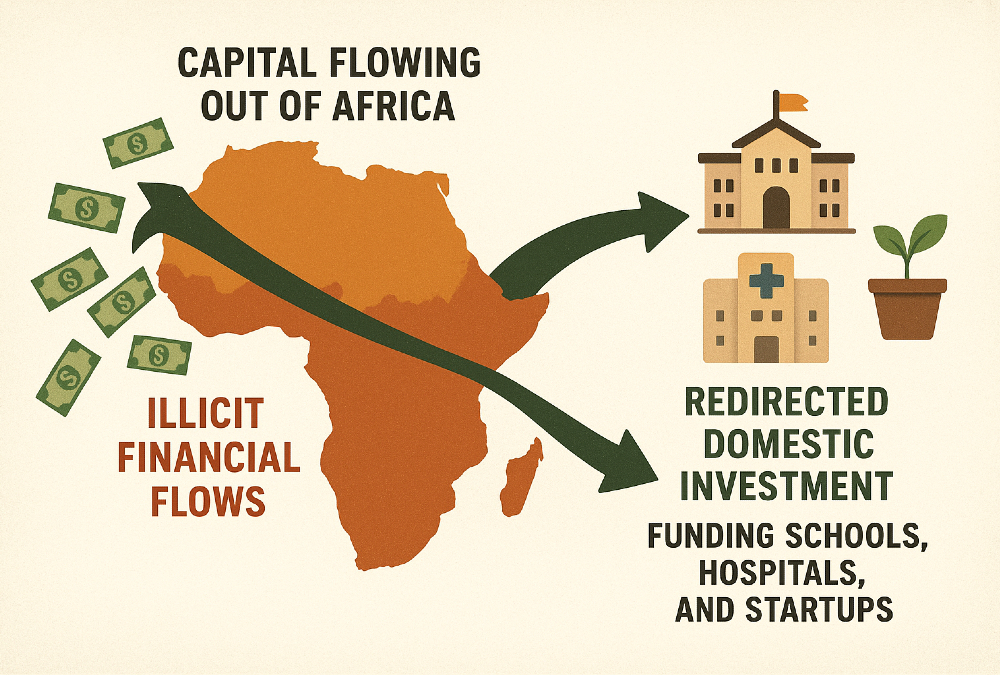
According to the African Development Bank, Africa hemorrhages an estimated US$587 billion annually through capital flight. That outflow exceeds three times the total volume of incoming external finance.
This isn’t merely a fiscal leak; it’s a systemic reversal of potential. The numbers tell a sobering story:
- US$275 billion vanishes in artificially shifted corporate profits,
- US$148 billion disappears through corruption and graft,
- US$90 billion slips away via illicit financial flows.
Redirect even a modest share of this capital, and Africa could electrify its cities, equip its classrooms, and bankroll a generation of innovators. The resources aren’t missing – they are misrouted.
And yet, Africans already demonstrate a powerful willingness to invest at home. Remittances, now reliably topping US$100 billion a year, flow steadily even during global downturns.
They are not handouts but acts of trust – proof that when given the right channels, Africans will fund their own future. The challenge is no longer one of intent, but of architecture.
Stop the Drain, Not Just the Deficit
The first order of business is staunching the outflow. Illicit financial flows thrive in environments where opacity meets weak enforcement.
Closing this gap demands more than rhetoric: it requires digitized customs systems, public beneficial ownership registries, and regional task forces with real prosecutorial teeth. African governments must treat capital flight not as an unfortunate externality, but as a strategic emergency.
Equally critical is ensuring that multinationals pay what they owe. Too many firms continue to exploit outdated tax treaties and transfer-pricing loopholes to book African profits in low-tax jurisdictions.
The result? Value extracted on the continent is reinvested elsewhere.
Reforming domestic tax codes – and harmonizing them across regional blocs like ECOWAS and SADC – is no longer optional. It’s economic self-defense.
Build Capital Markets That Keep Wealth at Home
Stopping the leak is necessary, but insufficient. Africa must also build financial plumbing robust enough to retain and multiply its own wealth.
This means deepening domestic capital markets, expanding access to pension and sovereign wealth funds, and creating investment-grade instruments that appeal to both local savers and the African diaspora – whose annual remittance-linked investment potential exceeds US$3 billion.
The African Continental Free Trade Area (AfCFTA) offers a powerful scaffold for this transformation. By reducing non-tariff barriers and aligning regulatory standards, AfCFTA can catalyze cross-border investment vehicles that channel liquidity into infrastructure, agribusiness, and green energy.
The goal is not autarky, but financial sovereignty: the ability to deploy African capital, on African terms, for African priorities.
At its core, this is the promise of Agenda 2063 – not a nostalgic vision, but a practical blueprint for self-reliance.
The capital exists. The talent exists. What’s missing is the institutional courage to redesign a system that has long treated African money as disposable.
The era of waiting for salvation from abroad is over. Africa’s next development chapter won’t be financed in Davos or Brussels.
It will be funded from within – by Africans, for Africa.
Wavinya Makai is a Kenyan author, development strategist, and Pan-African scholar specializing in African economic sovereignty. Her work focuses on youth development, unemployment, and education reforms that cultivate innovators. She is the author of Capital Violence: The Economic War on African Dignity and holds a Master of Philosophy in Development Studies from the University of Cambridge. Makai has been featured as a development analyst on Citizen TV Kenya and is a frequent speaker on leadership and human rights.
