
Opinion
Africa’s Farms Need Artificial Intelligence – and They Need It Now
As the continent’s population races toward 2.5 billion, outdated agricultural systems are no longer a policy inconvenience. They are an existential threat. AI offers a credible path forward – but only if African governments and investors are serious about delivering it equitably.

By Jean Claude Niyomugabo
By 2050, Africa will be home to 2.5 billion people. That single demographic fact should be enough to concentrate minds in every ministry of agriculture, every development bank boardroom, and every technology investment committee on the planet.
Feeding a population of that scale – one that will be younger, more urban-adjacent, and more economically demanding than any in Africa’s history – will require nothing less than a wholesale transformation of how the continent grows, manages, and distributes food.
The challenge is not merely one of scale. Africa’s farmers already operate under a brutal convergence of pressures: chronic water scarcity, accelerating climate volatility, soil degradation driven by decades of overuse, persistent pest and disease threats, and severely limited market access.
Smallholders – who account for the majority of the continent’s agricultural output – absorb these shocks largely without institutional support, precision tools, or reliable data. The result is a structural vulnerability that no amount of goodwill or incremental policy tinkering has managed to resolve.
Artificial intelligence will not solve all of this. But to dismiss its potential would be a serious mistake.
From Data to Decisions
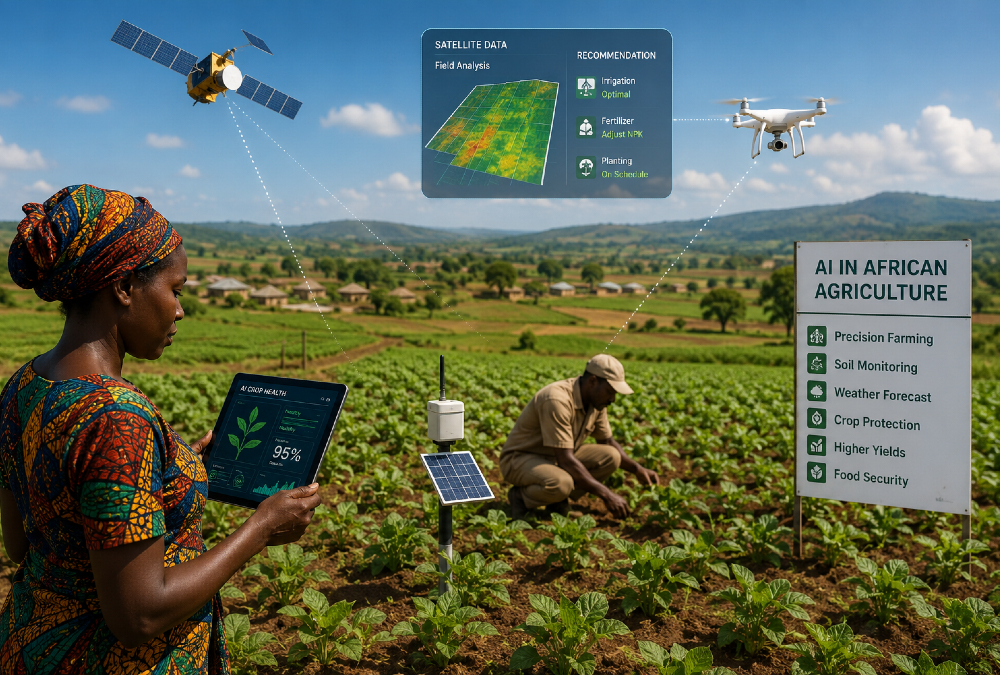
The core promise of AI in agriculture is deceptively simple: turning raw data into actionable decisions, faster and more accurately than any human system can manage at scale. Satellite imagery, soil sensors, drone surveillance, and weather modeling already generate enormous volumes of agronomic data.
What AI brings is the capacity to make that data useful – in real time, at the field level, and in forms that farmers can act upon.
Predictive weather modeling can alert farmers days in advance of harmful conditions, enabling irrigation adjustments or early harvesting decisions that protect yields. Computer vision systems mounted on drones can detect the early signatures of disease or pest infestation before they spread across a crop – the difference between a manageable intervention and a catastrophic loss.
Soil health mapping, combined with AI-driven fertilizer recommendations, can reduce input costs substantially while improving output, a combination that matters enormously for farmers operating on thin margins.
Precision agriculture, once the exclusive preserve of large commercial operations in North America and Europe, is increasingly within reach for African contexts. The infrastructure requirements are shrinking.
The cost of sensors is falling. The sophistication of mobile-based AI tools is rising. What was, a decade ago, a futuristic proposition is today a practical policy question: not whether AI can help African farmers, but how quickly and equitably it can be deployed.
Empowerment, Not Replacement
A reasonable concern, and one worth addressing directly, is that AI-driven automation will displace agricultural labor in economies where farming remains a primary source of rural employment. This concern misreads both the technology and the context.
African agriculture does not suffer from a surfeit of labor efficiency. It suffers from a deficit of information, access, and risk management capability.
AI tools – particularly those delivered via mobile platforms – address exactly these deficits. A smallholder in rural Kenya who receives an AI-generated advisory on optimal planting timing, or an alert that a pest outbreak has been detected two kilometers away, is not being replaced.
She is being equipped. The technology amplifies human judgment; it does not substitute for it.
Beyond individual farmers, AI creates systemic improvements in market connectivity. Platforms that match farmers with buyers, aggregate supply data to reduce price volatility, and provide transparent market pricing are already operating across the continent.
AI enhances their effectiveness – predicting demand patterns, optimizing logistics, and enabling smallholders to negotiate from a more informed position than ever before.
The Policy Dividend
The benefits of AI in agriculture are not confined to individual farms. At the national level, governments gain a qualitatively different capacity to plan, monitor, and respond.
AI-driven analysis of satellite data can identify emerging drought conditions weeks before they become crises, enabling pre-positioned food aid or irrigation investments. Crop yield forecasting, when done well, strengthens food policy and reduces costly dependence on food imports.
Supply-side intelligence helps ministries of trade understand what domestic production can realistically support.
Several African governments are already demonstrating what early adoption looks like. South Africa has integrated AI tools into precision farming programs targeting water use efficiency in its wine and fruit sectors.
Kenya has deployed AI-assisted pest surveillance through its national pest management systems, with particular attention to the locust outbreaks that devastated East African farmland in 2020. Nigeria has seen a proliferation of agricultural technology platforms – among them Hello Tractor, which connects smallholders with mechanization services via mobile interface.
Rwanda is piloting AI-driven irrigation scheduling in its horticulture sector as part of broader smart agriculture ambitions.
These are not proofs of concept. They are proofs of possibility. The question is whether they remain isolated examples or become the foundation of continental agricultural transformation.
The Access Imperative
Here is where optimism must be disciplined by realism. The benefits of AI will not distribute themselves. Without deliberate policy intervention, the pattern that has characterized previous agricultural technology waves will repeat itself: early adoption by better-resourced commercial operations, widening productivity gaps, and smallholders left further behind.
For AI to fulfill its potential in African agriculture, three conditions must be met.
- First, the technology must be affordable – not only in terms of device cost, but in terms of data plans, maintenance, and the training required to use it effectively.
- Second, it must be adapted to smallholder contexts. Tools designed for thousand-hectare operations in the American Midwest require significant re-engineering before they are useful to a farmer managing two hectares in Malawi.
- Third, and most practically difficult, it must reach rural communities where connectivity is weak or nonexistent. Offline-capable AI tools, low-bandwidth agricultural advisory services, and community-level digital hubs are not optional features – they are prerequisites for equitable impact.
Governments, multilateral development institutions, and private investors all have roles to play in meeting these conditions. Subsidized data access for agricultural platforms, public investment in rural digital infrastructure, and regulatory frameworks that attract responsible AI investment without allowing extractive data practices – these are the unglamorous but essential building blocks of an AI-enabled agricultural transition.
The Leapfrog Argument
Africa has a history – celebrated in development economics – of leapfrogging legacy infrastructure. Mobile banking flourished on the continent precisely because there were no entrenched retail banking networks to protect.
Renewable energy is gaining ground faster than in many developed economies partly because there is less fossil fuel infrastructure to displace. The same logic applies here.
Africa does not need to replicate the slow, capital-intensive, petrochemical-dependent agricultural modernization that characterized twentieth-century farming in the Global North. It can move directly to data-driven, precision-managed, climate-adaptive systems – if the enabling conditions are in place.
This is not utopian thinking. It is a strategic observation about timing and opportunity.
The alternative is stark. Without a step-change in agricultural productivity, the gap between food demand and domestic supply will widen. Import dependence will grow. Rural poverty will deepen. And the demographic dividend that makes Africa’s economic future so compelling in theory will curdle into a demographic crisis in practice.
A Bridge That Must Be Built
Food security is not a development aspiration. It is a foundational condition for political stability, public health, and economic growth.
Farming must evolve – not because of abstract notions of progress, but because the farmers who feed this continent deserve systems that give their labor a fair return and their families a secure future.
AI is not a silver bullet. It is a powerful tool that, deployed thoughtfully and equitably, can help Africa grow enough food for its people, reduce its vulnerability to climate shocks, and build an agricultural sector that competes credibly on the global stage.
The bridge exists. The only question is whether Africa’s governments, its private sector, and its international partners have the will to build it – and the wisdom to ensure it reaches every side of the river.
Jean Claude Niyomugabo is an entrepreneur and digital communication specialist with a strong passion for Africa’s development. He is dedicated to harnessing the power of social media to drive positive change and enhance livelihoods. With diverse interests and a strategic approach to digital engagement, he strives to create meaningful impact through innovation and connectivity.
