
Opinion
Africa’s $35 Billion Opportunity: Why Local Production is the Key to Prosperity

By Jean Claude Niyomugabo
Africa spends over US$35 billion annually importing food – much of it crops that could thrive on its own soil. This staggering figure isn’t just a budget line item; it’s a missed opportunity for economic transformation, food sovereignty, and youth empowerment.
Consider this: the continent holds 65 percent of the world’s uncultivated arable land, according to the World Bank. With the right investments, Africa doesn’t just have the potential to feed its 1.4 billion people – it can become a leading global food exporter.
Yet today, nations across the continent import staples like wheat, rice, and processed foods while underutilizing indigenous, climate-resilient crops such as sorghum, millet, and cassava. This dependency became painfully evident when Russia’s invasion of Ukraine disrupted global wheat supplies, triggering sharp food price spikes and pushing millions of African households into insecurity.
The problem isn’t a lack of land or agricultural potential – it’s a chronic underinvestment in agriculture. Poor rural infrastructure, limited access to storage and irrigation, fragmented markets, and outdated policies have kept productivity low and post-harvest losses high.
The result? A continent rich in natural resources remains vulnerable to global supply shocks.
From Vulnerability to Resilience: Local Solutions Are Working
But the tide is turning.
Forward-looking nations are proving that change is possible. Nigeria, once heavily reliant on rice imports, has slashed its foreign purchases through targeted investments in local production and processing.
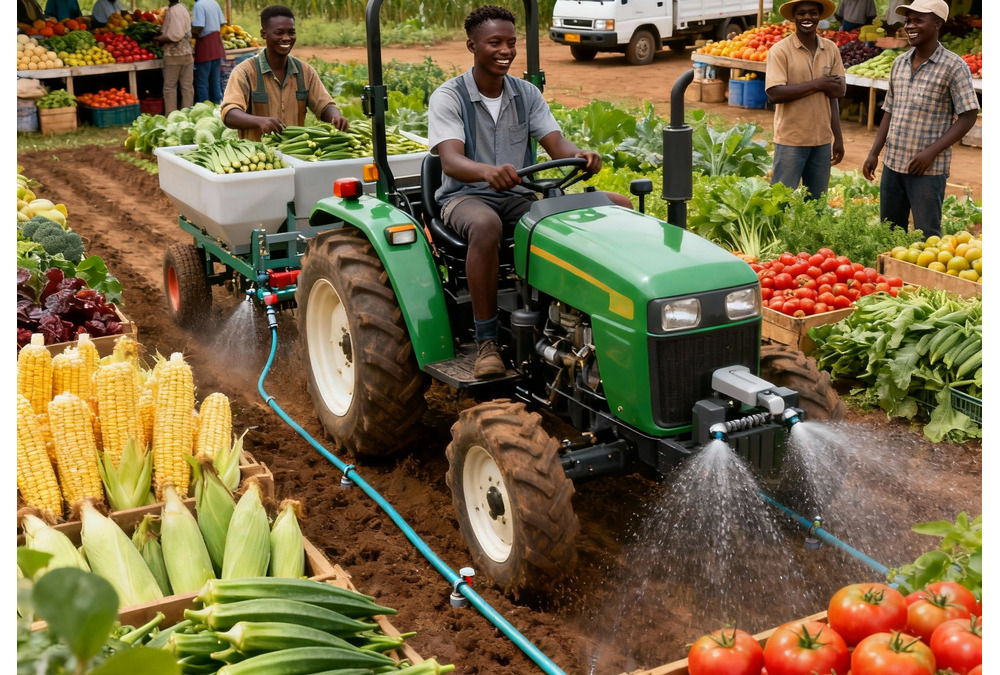
In East Africa, smallholder farmers are boosting yields of maize and beans thanks to expanded irrigation and climate-smart techniques. These aren’t isolated success stories – they are blueprints for continental transformation.
Unlocking Africa’s agricultural potential delivers far more than full plates. It creates millions of jobs – not just in farming, but across the entire agri-value chain: logistics, food processing, packaging, agri-tech, and export services.
For Africa’s youth – 70 percent of whom are under 30 – agriculture is no longer a “last resort” or retirement pastime. It’s a dynamic, tech-driven sector where innovation meets opportunity.
From drone-enabled precision farming to mobile platforms connecting farmers to markets, young agri-entrepreneurs are building profitable businesses and reshaping perceptions of what it means to work the land.
Cultivating Prosperity: Agriculture as an Engine of Economic Growth
Critically, keeping food dollars at home strengthens entire economies. Every dollar saved on imports can fund schools, clinics, and roads.
Every ton of locally grown grain reinforces national resilience. And every policy that empowers smallholder farmers – especially women, who make up nearly half the agricultural workforce – fuels inclusive growth.
The path forward is clear: Invest in African agriculture – not as charity, but as strategic economic policy.
Prioritize infrastructure: cold storage, rural roads, and irrigation systems. Support research into high-yield, drought-tolerant seed varieties.
Integrate digital tools to connect farmers to finance, data, and markets. And above all, shift mindsets – recognizing farming not as subsistence labor, but as a viable, modern, and profitable profession.
Africa stands at a crossroads. It can continue sending billions overseas for food it can grow itself – or it can cultivate prosperity from the ground up.
The soil is ready. The technology exists. The youth are eager.
Now, more than ever, the time to grow Africa’s future is now.
Jean Claude Niyomugabo is an entrepreneur and digital communication specialist with a strong passion for Africa’s development. He is dedicated to harnessing the power of social media to drive positive change and enhance livelihoods. With diverse interests and a strategic approach to digital engagement, he strives to create meaningful impact through innovation and connectivity.
