
Opinion
African Industrialization: Why Export-Driven Production Is Undermining Food Security

By Balbir Singh
At global forums – from Davos to Addis Ababa – policymakers and development advisors repeat a familiar mantra: Africa must industrialize and boost local production to earn foreign exchange and achieve economic sovereignty. On the surface, the logic seems sound.
But beneath this consensus lies a dangerous myth – one that is deepening food insecurity, inflating domestic prices, and distorting priorities across the continent.
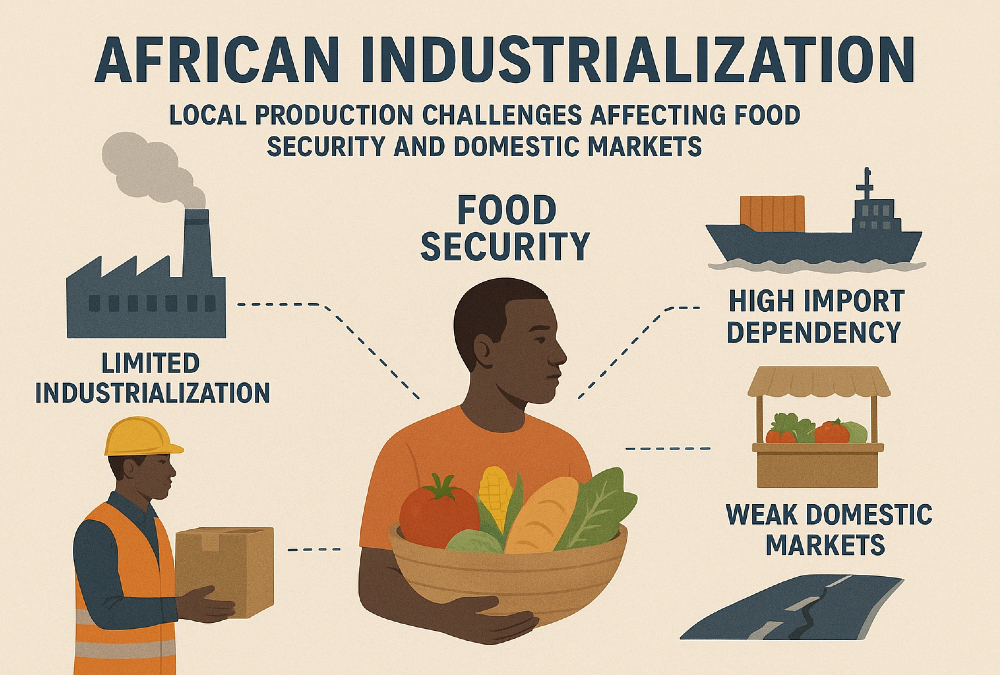
The truth is this: industrialization and agricultural production in Africa are not failing because they are absent. They are failing because they are misdirected.
The Export Obsession Is Backfiring
Consider fertilizer. Egypt, Algeria, and Nigeria – three of Africa’s top fertilizer producers – are paradoxically among the continent’s most food-insecure nations.
Why? Because domestic producers prioritize exports for hard currency over supplying local farmers.
In Nigeria, for instance, locally produced urea often sells at 60 percent above global market rates. Import bans – justified as “protecting local industry” – eliminate alternatives for farmers, who then face scarcity, inflated input costs, or both.
The result? Reduced agricultural output, higher food prices, and greater reliance on food imports.
The same pattern repeats across sectors: cement, sugar, iron, and steel. In producer countries, these goods routinely cost two to three times their international equivalents.
Cartels form, supply tightens, and domestic consumers – especially smallholder farmers and low-income households – bear the brunt. Industrial capacity, rather than enabling self-reliance, has become a vehicle for rent-seeking and forex hoarding.
The Myth of “Production Equals Prosperity”
Africa is a leading global producer of cash crops – coffee, cocoa, cashew, sesame, tea, and soybeans. Yet many of these same countries struggle to feed their own populations.
While they export high-value commodities, they import basic staples like rice, wheat, and maize at four times the value of their exports. This isn’t development; it’s dependency disguised as productivity.
The lesson isn’t that production is bad – it’s that what you produce and for whom matters more than volume alone. India’s so-called Green Revolution offers a cautionary tale. In the 1970s and ’80s, the country achieved cereal self-sufficiency by diverting land from pulses and oilseeds to wheat and rice.
But this “success” came at a cost: India became the world’s largest importer of edible oils and legumes. Only in the 1990s, when policy shifted to support balanced crop diversity and domestic nutritional needs, did food security truly deepen.
China and India today enforce strict rules: no export of critical food, fertilizer, or construction inputs until domestic demand is fully met. Africa should take note.
Reframing Industrial Policy for Domestic Resilience
The core flaw in Africa’s current approach is the conflation of industrialization with export orientation. True economic sovereignty begins not with how much a country sells abroad, but with whether its own people can access essential goods at fair prices.
Industrial policy must be reoriented around three principles:
- Local-first production: Industries – whether fertilizer plants or agro-processors – must guarantee affordable, reliable supply to domestic users before exporting.
- Strategic import flexibility: Blanket bans on imports often shield inefficient local monopolies. Temporary, targeted imports can stabilize prices and prevent artificial scarcity.
- Food sovereignty over forex fetishism: Until a nation can feed itself, prioritizing export earnings over staple production is economically reckless and socially unjust.
Industrialization Without Inclusion Is Illusion
There is no inherent virtue in “local production” if it doesn’t serve local people. Building factories or expanding cash-crop acreage means little when farmers can’t afford fertilizer or citizens can’t buy bread.
Africa’s path to genuine industrialization lies not in chasing foreign exchange, but in anchoring production to domestic needs, equity, and resilience.
Until then, the continent’s industrial agenda will remain a mirage – shimmering with promise, but leaving its people thirstier than before.
Balbir (Shekhawat) Singh, PhD, is a results-driven agribusiness techno-commercial professional with over 18 years of experience in sales, marketing, agronomy, product management, farming, commodity trading, and agri-inputs (fertilizers, seeds, agrochemicals). Passionate about advancing sustainable farming, he currently serves as Director General/CEO of Sodesep SA-Fertilizer Abuja, Nigeria. He has worked across emerging markets including India, Uganda, Kenya, Cameroon, Tanzania, Indonesia, and Nigeria.
