
Opinion
Africa Doesn’t Need Silicon Valley Clones. It Needs Startups Built for Its Own Chaos
The continent’s most valuable companies aren’t avoiding Africa’s hardest problems – they are turning them into business models.

By Naomi Mutuku
For two decades, the templates for “innovation” have traveled from Palo Alto to Lagos largely unchanged: build the app first, find the market later, and assume that good ideas simply need cleaner infrastructure to scale. Africa keeps proving that assumption wrong.
The continent’s defining characteristics – fragmented markets, vast informal economies, patchy power grids, and limited access to traditional banking – are routinely described as obstacles. They would be better described as a blueprint.
The startups thriving across Sub-Saharan Africa today aren’t succeeding despite these realities. They are succeeding because of them.
The Scale of the Opportunity
The numbers explain why this matters far beyond Africa’s borders:
- More than 80 percent of employment in Sub-Saharan Africa sits within the informal economy – a vast, largely undigitized engine of commerce that traditional financial institutions have long overlooked.
- Roughly 600 million Africans still lack reliable access to electricity, leaving energy as one of the continent’s largest unmet markets.
- By 2050, Africa’s population is projected to reach 2.5 billion people, forming what will become the world’s largest workforce and one of its largest consumer markets.
Founders who treat these figures as warning signs are missing the point entirely. The smartest entrepreneurs treat them as the addressable market.
Constraints Are the Innovation
Africa’s breakout companies share a single instinct: build for the system as it actually exists, not the one venture capitalists wish existed.
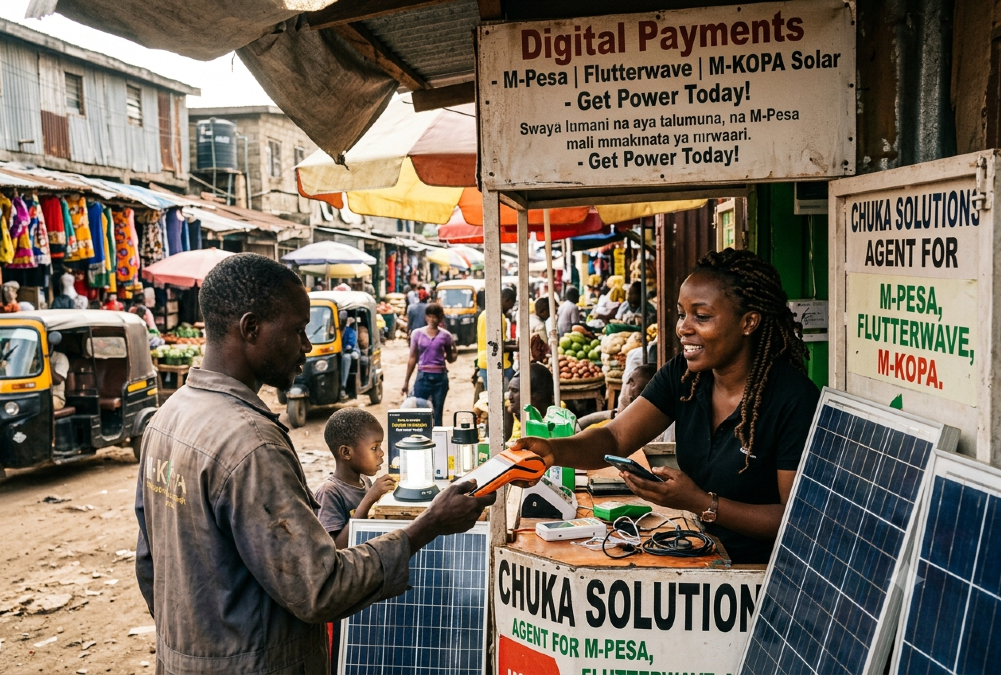
In Kenya, M-Pesa didn’t wait for widespread bank access before building a financial system – it built the financial system the country actually needed, turning mobile phones into bank branches for millions who had never held an account. M-KOPA followed the same logic with hardware, using pay-as-you-go financing to bring solar power and smartphones to households that conventional lenders had written off as too risky to serve.
In Nigeria, Flutterwave tackled one of the continent’s most stubborn barriers to commerce: moving money across borders and currencies without friction or excessive cost. Moniepoint went further into the gaps banks ignored altogether, building financial infrastructure for small businesses and informal merchants – and now processes billions of dollars in transactions every month.
In South Africa, Yoco rebuilt card payments from the ground up for small businesses that traditional banks considered unprofitable, putting digital payment tools directly into the hands of thousands of SMEs.
In Uganda, SafeBoda turned a motorcycle-taxi app into a full-fledged super app, layering payments and financial services onto the transport networks that actually move people through African cities.
In Tanzania, NALA built a mobile money platform that simplifies domestic and cross-border payments, serving the millions of Africans who regularly send money across national lines and have long paid a premium for the privilege.
None of these companies waited for better roads, friendlier regulation, or mature financial systems to materialize. They designed for the continent in front of them – and built durable, billion-dollar businesses as a result.
The Next Unicorn Won’t Look Like Silicon Valley
This is the lesson too many founders and investors still resist: Africa does not reward those who try to import solutions wholesale and hope the local context adapts to fit them. It rewards those who understand the context first and design backward from it.
The next African unicorn will not be the startup that copies a Silicon Valley playbook and hopes for the best. It will be the one that understands Africa’s markets, informal economies, and infrastructure gaps more intimately than any competitor – and turns that understanding into a structural advantage no outsider can easily replicate.
Complexity, in other words, isn’t the tax Africa’s entrepreneurs pay for operating there. It’s the moat.
What would you build? If you had to design a startup around one of Africa’s hardest constraints – energy access, informal trade, cross-border payments, or something else entirely – what would it look like?
Naomi Mutuku is a trade and investment expert specializing in helping global companies enter Kenya and broader African markets. She focuses on reducing risk, accelerating market entry, and fostering sustainable growth. Based in Nairobi, Naomi is a regular commentator on Africa’s dynamic business landscape and is passionate about the continent’s growth potential. She can be reached via email at: [email protected]
