
Opinion
Zambia: Southern Africa’s Beating Heart of Resilience and Opportunity

By Des H Rikhotso
Nestled in the heart of southern Africa, Zambia is not the continent’s loudest voice – but it may be one of its most compelling. With no coastline, limited infrastructure, and decades of economic volatility, this landlocked nation has defied expectations by emerging as a rare beacon of democratic stability amid regional turbulence.
And now, against all odds, it’s poised for renewal.
A Nation Defined by Contradictions
Zambia spans 752,600 square kilometers – roughly the size of France and Spain combined – and is home to 20.2 million people. Its nominal GDP of US$29.5 billion places it among Africa’s smaller economies; per capita income hovers at just US$1,435.
The Human Development Index (0.595) reflects “medium” development, while a Gini coefficient of 51.5 underscores stark inequality – a chasm between mining wealth and rural poverty.
Yet these statistics tell only half the story.
Zambia’s true power lies not in its balance sheets, but in its resilience. In 2024, copper production surged by 12 percent – a dramatic rebound after years of decline driven by global demand, renewed foreign investment, and pragmatic policy reforms under President Hakainde Hichilema.
For a country where copper accounts for over 70 percent of export earnings, this isn’t just growth – it’s redemption.
Geography as Destiny
Strategically positioned and bordered by eight nations – including Angola, Tanzania, Zimbabwe, and the Democratic Republic of Congo – Zambia serves as a vital transit corridor for Southern Africa. But its geography is more than logistical; it’s sublime.
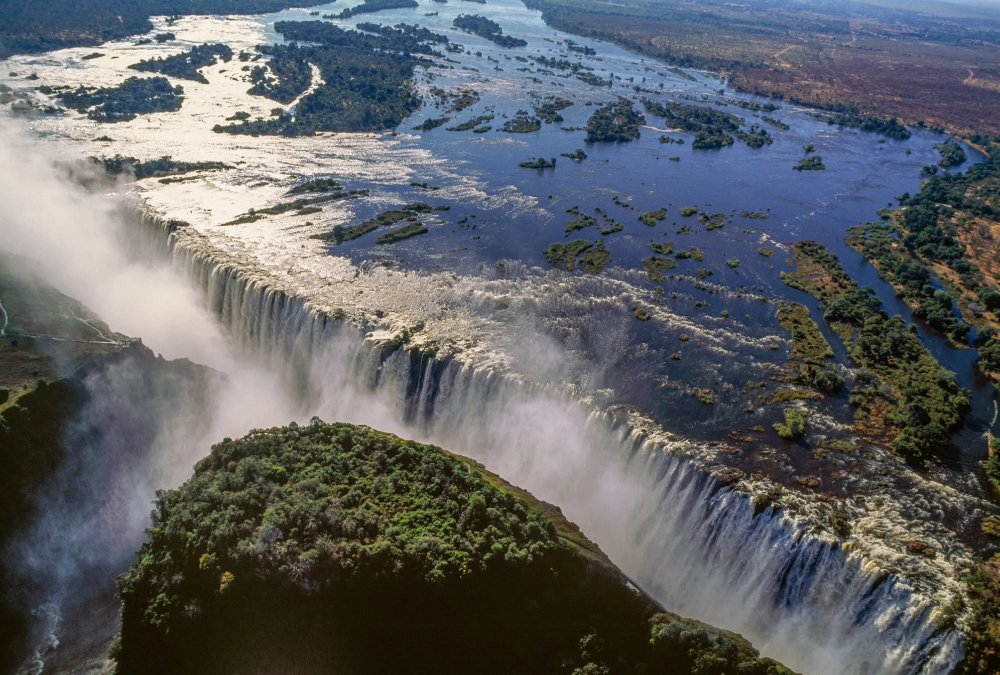
The Zambezi River carves through ancient plateaus before plunging over Victoria Falls – the world’s largest sheet of falling water, a UNESCO World Heritage Site that draws half a million visitors annually. Beyond the falls lie national parks teeming with elephants, lions, and wild dogs; vast wetlands like the Bangweulu Swamps; and some of Africa’s last unspoiled wildernesses.
This natural bounty should be a catalyst for sustainable tourism and climate-resilient development. Yet too often, it remains an untapped asset – vulnerable to mismanagement, underfunded conservation, and the creeping impacts of droughts intensified by climate change.
Culture That Connects
While English is the language of government and business, over 70 indigenous languages pulse through daily life: Bemba in the north, Tonga in the south, Nyanja in the urban centers. This linguistic mosaic mirrors a society rich in tradition – where drumming echoes through village squares, intricate beadwork tells ancestral stories, and Sunday church choirs rival any global gospel ensemble.
Christianity dominates religious practice, but traditional beliefs remain deeply woven into community identity. Zambia’s music scene – blending Afro-jazz, hip-hop, and tribal rhythms – is quietly influencing the continent.
Artists like Wambali Mkandawire and bands such as Zed have gained international acclaim without ever needing a global label.
Democracy in Action
Perhaps Zambia’s most remarkable feature is its political maturity.
Since gaining independence from Britain in 1964, the country has undergone five peaceful transfers of power through competitive multi-party elections—an extraordinary record in a region plagued by coups and constitutional manipulation. The 2021 election, which brought President Hichilema to office after five prior defeats, was hailed by observers as one of Africa’s freest and fairest.
Hichilema, a billionaire businessman turned reformer, has prioritized fiscal discipline, debt restructuring, anti-corruption drives, and energy sector modernization. His administration’s “Economic Recovery Plan” has already attracted over US$1.5 billion in new investment since 2022 – not because Zambia is easy, but because it’s credible.
Why Zambia Matters Now More Than Ever
In an era when headlines scream about conflict, authoritarianism, and economic collapse across Africa, Zambia offers something rarer: proof that progress is possible without fanfare.
It is not a model of perfection. It still grapples with power shortages, youth unemployment, and the legacy of resource dependency.
But it demonstrates that governance, not just geography, determines destiny.
Zambia reminds us that Africa’s future won’t be written solely by its megacities or mineral booms – but by nations that choose institutional integrity over short-term gain, cultural pride over homogenization, and quiet perseverance over loud posturing.
The Question We Should Be Asking
Which aspect of Zambia fascinates you most?
- Its nature?
– from the thunder of Victoria Falls to the silent savannas of Kafue National Park - Its history?
– a legacy of anti-colonial resistance and peaceful democratic transitions - Its economy?
– a copper-dependent nation betting big on reform, not just extraction - Its culture?
– where music, dance, and multilingual heritage bind communities across generations
The answer may reveal more about you than it does about Zambia.
But one thing is certain: if Africa’s next chapter is to be defined by hope rather than hardship, Zambia is already writing its lines – with humility, grit, and grace.
Des H Rikhotso (PgDip-BA, MBL) is a seasoned C-suite Multi-Industry business executive with 25+ years of Business Leadership Experience across the South, East and Western Sub-Sahara Africa Region. Based in Kampala, Uganda he serves as East Africa Region Business Executive, driving Business Strategic Growth and Operational Excellence – contributing his Leadership Voice and Clarity to the Region. Des has held Business Leadership roles at BMW Group Africa, Volkswagen Group Africa, Peugeot Motors South Africa, Toyota/Lexus South Africa, Nissan Group of Africa, G.U.D Holdings (Africa Exports Operations Division) and The HDR Group of Companies. He holds Under-Graduate and Post-Graduate business degrees from the University of the Western Cape, Wits University (Wits Business School) and the University of South Africa.
