
Opinion
Will Africa Miss Out on the AI Revolution?

By Farouk Mark Mukiibi
Africa is watching the global AI revolution with a mix of hope and hype. From Lagos to Nairobi, policymakers and entrepreneurs speak of artificial intelligence as the great equalizer – a shortcut to leapfrog outdated infrastructure and ignite inclusive economic transformation.
But beneath the optimism lies a sobering truth: AI doesn’t hate Africa – it simply doesn’t know it.
And what AI doesn’t understand, it misrepresents.
This isn’t about exclusion. It’s about misinclusion.
Africa is increasingly visible in global datasets, yet persistently misunderstood in algorithmic logic. Every prompt entered into a large language model is, in effect, a negotiation – between African realities and foreign-trained assumptions.
The danger isn’t being left behind; it’s being indexed incorrectly, rendered legible only through lenses that distort more than they clarify.
To correct this, Africa must build what I call Minimum Viable Relationships (MVR) – intentional bridges between local knowledge systems and global AI architectures. Before models can represent us accurately, they must relate to us meaningfully.
AI doesn’t threaten African jobs – the education system already did. What we face isn’t a labor shortage but a value-creation deficit.
The Real Bottleneck Isn’t Bandwidth – It’s Imagination
For decades, African education systems prioritized rote memorization over critical inquiry. Exams rewarded conformity, not creativity.
Graduates emerged fluent in compliance, not problem-solving. Now, as AI automates routine tasks with uncanny efficiency, we confront an uncomfortable irony: the very skills we cultivated are the first to become obsolete.
AI doesn’t threaten African jobs – the education system already did. What we face isn’t a labor shortage but a value-creation deficit.
In a world where machines execute instructions faster and cheaper, the premium shifts to originality. Yet originality was never on the syllabus.
Curiosity wasn’t funded. Critical thinking never got a ministry. Creativity was often labeled disobedience.
Power, Infrastructure, and the Myth of Leapfrogging
Even if African minds were primed for innovation, systemic barriers remain. AI runs on data – and electricity.
You cannot run inference models on diesel generators. Digital transformation requires more than smartphone penetration; it demands reliable power, robust broadband, and local compute capacity.
Yet too often, “leapfrogging” is invoked as a substitute for real investment in foundational infrastructure.
More dangerously, it masks a deeper dependency: we celebrate technology adoption while neglecting technological authorship. We import curricula, replicate foreign policy templates, and benchmark success against systems built for entirely different contexts.
In doing so, we outsource not just tools – but logic, values, and vision.
Until African languages, histories, epistemologies, and problem-solving frameworks are embedded in AI’s training data – and, more importantly, in its design philosophy – AI will remain a mirror that reflects someone else’s world.
From Users to Authors: Reclaiming Narrative Sovereignty
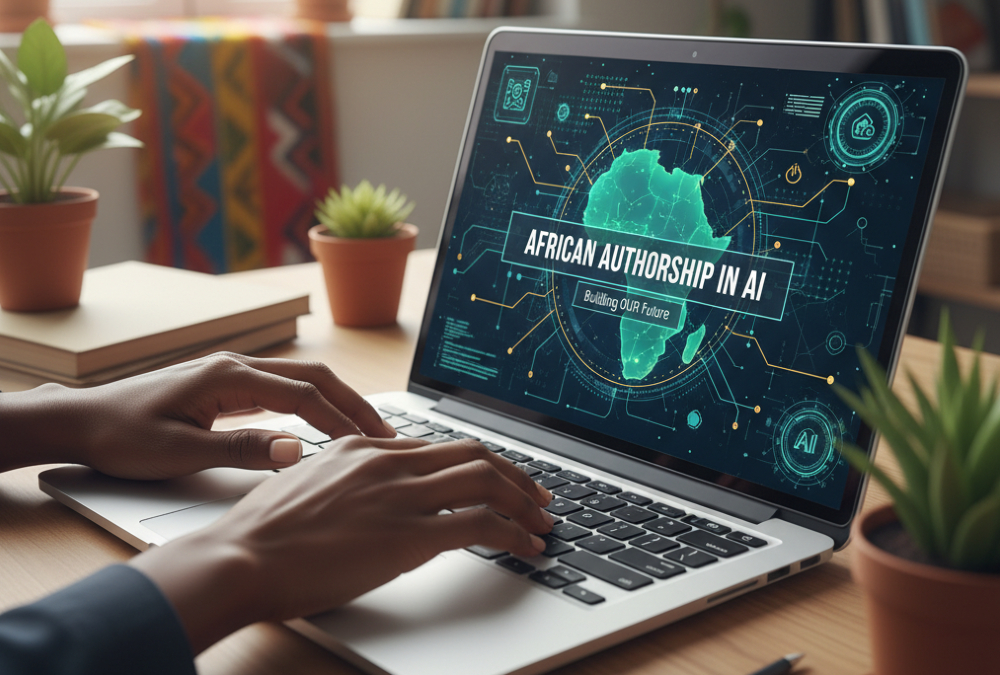
Africa’s challenge isn’t access to AI – it’s authorship of it. We are consumers of conclusions drawn elsewhere, feeding raw data into systems that return processed irrelevance.
Until African languages, histories, epistemologies, and problem-solving frameworks are embedded in AI’s training data – and, more importantly, in its design philosophy – AI will remain a mirror that reflects someone else’s world.
The path forward demands more than coding bootcamps or cloud partnerships. It requires a fundamental reimagining of education: one that prizes questioning over qualification, courage over caution, and contextual intelligence over standardized answers.
It means building AI not just in Africa, but from Africa – shaped by African thinkers, trained on African knowledge, and deployed to solve African problems.
The Future Belongs to the Shapers, Not the Adopters
The global AI race isn’t won by those who use the tools most enthusiastically – but by those who define how they work, what they value, and whom they serve. Africa stands at a crossroads: continue importing logic, or begin exporting wisdom.
Until then, no amount of access will bridge the gap between participation and power. Because in the age of algorithms, the ultimate currency isn’t data – it’s authorship.
Farouk Mark Mukiibi is the author of The African Startups Playbook and creator of the Minimum Viable Relationships (MVR) business framework. He is also a marketing consultant based in Uganda, East Africa, where he helps international brands and ventures navigate the realities of East Africa’s evolving middle class and consumer economies.
