
Opinion
Learning by Doing: The Real Reason Asia Industrialized Faster Than Africa

By Danilo Desiderio
A useful lens for understanding why some regions industrialized faster than others is to look past what they produced and examine instead how they built the capacity to produce. Industrialization is not simply about factories, export volumes, or physical infrastructure.
At its core, it is a cumulative process through which economies accumulate knowledge, skills, and organizational capability. Examined through this lens, a striking divergence emerges between the historical trajectories of much of East and South Asia and those of many African nations.
In Japan, South Korea, and India, industrialization followed a path best described as “learning through internalization.” Domestic firms in the early stages lacked advanced technology.
They depended heavily on imported machinery, foreign technical expertise, and licensing arrangements. But crucially, these external inputs were never treated as finished solutions.
They were deployed deliberately – as instruments for building homegrown capability.
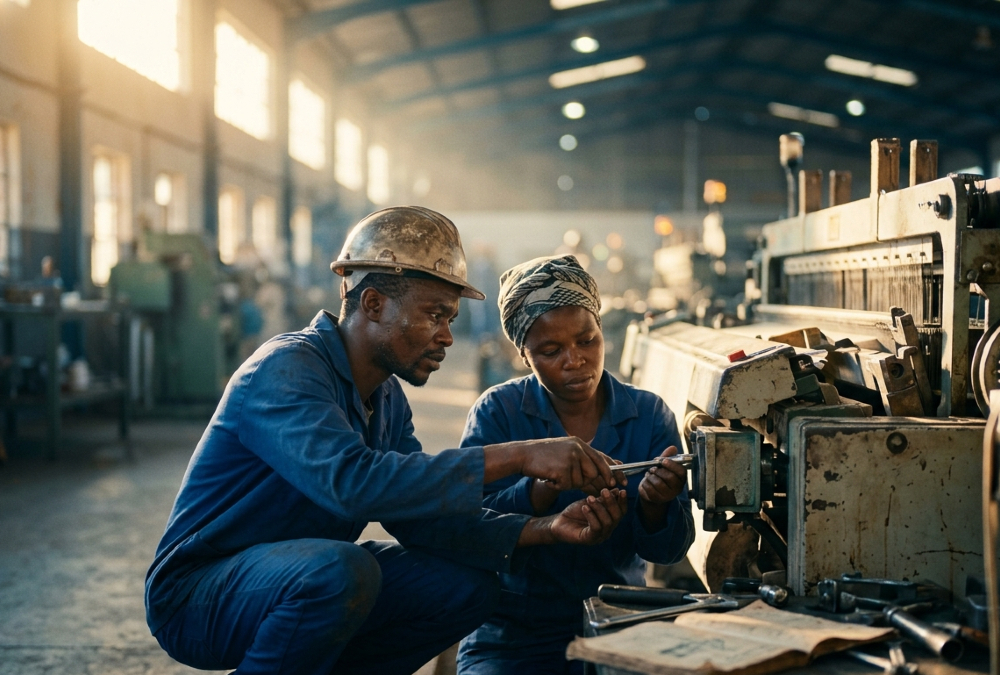
Learning happened on the factory floor. Workers accumulated hands-on experience operating and maintaining machinery.
Engineers developed the skill to adapt foreign technologies to local conditions. Managers built organizational sophistication by overseeing progressively complex production processes.
Over time, this cumulative learning allowed firms not only to replicate what they had imported, but to refine it – and eventually to innovate independently.
The critical variable here is where the center of gravity of learning resided. Foreign capital and technology played significant roles, but both were embedded within broader systems designed to encourage absorption, adaptation, and continuous upgrading.
Production, in this model, was never an end in itself. It was the means through which knowledge was built.
The Import-and-Operate Trap
Many African countries, by contrast, followed a different industrial pattern – one that can be characterized as “importing and operating.” In this model, production systems, infrastructure, and even entire industrial operations have typically been introduced through foreign direct investment, turnkey projects, or external operators.
This approach has delivered visible, sometimes rapid results, particularly in capital-intensive or technically complex sectors.
Yet its developmental impact has frequently fallen short in one decisive dimension: capability building. While production does occur, the degree to which domestic firms and workers internalize the underlying knowledge has often been constrained. Local supplier networks tend to remain thin, inter-firm linkages are weak, and technology diffusion across the broader economy is limited.
Economic activity can expand considerably – without a corresponding deepening of industrial capacity. Output grows; capability does not.
That said, this distinction should not be read as permanent or universal.
Africa’s Emerging Hybrid Model
Across the continent, important signs of change are surfacing. In Kenya, Morocco, and South Africa, businesses are progressively integrating into regional and global value chains – most visibly in agro-processing, specialized manufacturing niches, and trade-related services.
Meanwhile, digital platforms are improving coordination among market actors, reducing information asymmetries, and opening access to new markets. Platforms such as the African Trade Platform are already accelerating this shift.
What is taking shape is a more hybrid model: one that moves beyond simply importing and operating toward a process of importing, adapting, and gradually internalizing knowledge. The real question is whether this transition can be sustained and scaled.
The answer will hinge on deliberate policy and institutional choices. Foreign investment will remain central, but its developmental impact will increasingly depend on how effectively it is woven into domestic economic structures.
Strengthening linkages between foreign investors and local firms, deepening supplier networks, and investing in technical and managerial skills are all indispensable. Equally important is the design of regulatory and incentive frameworks that actively promote knowledge transfer and capability development – not simply capital inflows.
The Sequence Is Everything
Ultimately, the combined experience of Asia and Africa suggests that the decisive factor in industrialization is not the origin of capital or technology – it is the sequence through which learning occurs. Capital can be imported. Infrastructure can be built relatively quickly. But the ability to understand, adapt, and improve production processes is developed cumulatively.
It cannot be purchased or outsourced. It must be grown.
The most successful industrializers have been those that transformed production into a continuous learning process. Increasingly, there are credible indications that parts of Africa are moving in this direction – using participation in global value chains not merely to produce, but to build the capabilities that make sustained growth possible.
The real distinction, therefore, is not between regions. It is between economic systems that treat production as a platform for learning and those that do not.
Bridging that gap is less a matter of importing the right model than of carefully engineering the mechanisms through which learning becomes embedded in production itself.
In that engineering lies the difference between growth that is transient and growth that endures.
Danilo Desiderio serves as the CEO of Desiderio Consultants Ltd in Nairobi, Kenya, specializing in African customs, trade, and transport policies. He is a customs and trade expert at the World Bank and a senior associate to the Horn Economic and Social Policy Institute (HESPI).
