
Opinion
Why Capital Won’t Flow to Africa Until Institutions Get Stronger

By Dr. Princess C. Mutisya
Africa is routinely described as one of the world’s most compelling investment frontiers. At gatherings from the Africa CEO Forum to investment summits in Dubai and Riyadh, the continent’s economic promise has become a reliable refrain – ambitious, urgent, and increasingly well-rehearsed.
Yet for all the enthusiasm generated at such forums, a stubborn and telling gap persists between announcement and execution. Projects stall. Capital hesitates. Momentum dissipates.
The conventional explanation blames a shortage of money. The real culprit is something far more structural: a shortage of legal certainty.
The Infrastructure Paradox
The African Development Bank estimates that the continent requires between US$130 billion and US$170 billion annually in infrastructure investment, leaving a financing gap of US$68 billion to US$108 billion each year. These figures are frequently cited as evidence of a capital problem.
They are, in fact, evidence of an institutional one.
Capital is not scarce. Institutional investors across the globe are actively seeking exposure to emerging markets, drawn by demographic tailwinds, urbanization trends, and the promise of outsized returns.
The issue is not availability – it is directionality. Investment flows toward environments where the rules are clear, rights are protected, and disputes can be resolved without years of legal uncertainty.
As legal scholar Katharina Pistor argues in her influential work The Code of Capital, wealth is not simply created by markets – it is structured through the legal frameworks that protect assets and enforce rights. In other words: capital does not follow opportunity alone. It follows clarity.
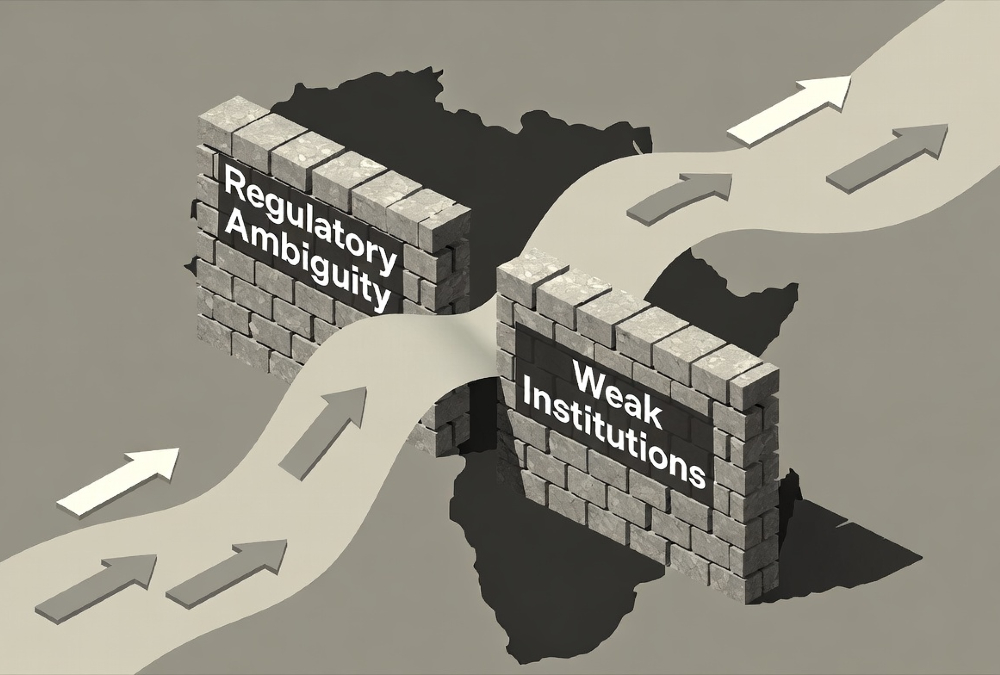
Regulatory Ambiguity: The Hidden Deterrent
Practitioners who advise cross-border investors entering African markets will recognize a familiar pattern. The initial concern that investors articulate is often corruption – a reasonable and well-documented worry.
But the obstacle they most frequently encounter in practice is something rather different: regulatory ambiguity.
The questions arise quickly. Which authority has jurisdiction to approve a given project? How long will licensing realistically take? Are the contracts that underpin an investment actually enforceable? What mechanisms exist to resolve disputes if things go wrong?
When these questions lack clear, reliable answers, investment decisions are deferred, restructured, or abandoned altogether.
This is not a uniquely African problem – but it is one with disproportionate consequences for a continent that urgently needs long-term private capital to finance its development.
What Institutional Clarity Actually Achieves
The evidence from elsewhere is instructive. Singapore, the United Arab Emirates, and Estonia have each demonstrated, through distinct paths, that predictable legal systems are among the most powerful tools of economic development available to any government.
None of these jurisdictions attracted sustained investment through natural resources or geographic advantage alone. They attracted it by making the rules legible, the institutions credible, and the contracts enforceable.
Africa’s next economic leap will not be delivered by investment announcements, however well-attended the summits at which they are made. It will be delivered by the slower, less photogenic work of building the legal and institutional infrastructure that makes those announcements mean something.
Three Priorities for Policymakers and Investors
For those shaping the continent’s investment landscape – whether as policymakers, institutional investors, or business leaders – three priorities demand sustained attention.
Regulatory clarity must be strengthened across sectors. Investors should be able to identify, with reasonable speed and confidence, which authority governs a given transaction, what approvals are required, and on what timeline decisions can be expected.
Opacity at this stage is not a minor inconvenience – it is a deal-breaker.
Contract enforcement and dispute resolution mechanisms must be modernized. The existence of a contract is worth little if enforcement is slow, unpredictable, or subject to political interference.
Investment-grade legal systems require investment-grade courts and arbitration frameworks to match.
Legal institutions must be built to inspire long-term confidence. This is perhaps the most demanding priority, because it is not merely a technical challenge but a political one. Institutions earn credibility over time, through consistent application of the law and resistance to short-term pressures.
That process cannot be rushed – but it must be started, and in many cases accelerated.
Infrastructure Builds Roads; Institutions Build Prosperity
There is a tendency in development discourse to treat physical infrastructure – roads, ports, power grids – as the primary engine of economic transformation. It is not.
Physical infrastructure is necessary but not sufficient. The deeper architecture is legal: the frameworks that determine who can own what, who bears what risks, and who has recourse when things go wrong.
Africa has no shortage of entrepreneurs, natural resources, or demographic energy. What it needs, and what international capital is waiting for, is the institutional backbone to convert potential into durable prosperity.
The conversations that will ultimately determine where global capital flows are not happening only at investment summits. They are happening – quietly and consequentially – in legislatures, regulatory agencies, and courtrooms across the continent.
Dr. Princess C. Mutisya is a Strategic Legal Architect, author, and international business leader with more than 14 years of cross-border experience across Africa and the UAE. She is the Founder & CEO of CR Advocates LLP (Kenya) and CR Advocates Consultants LLC (UAE)among other leadership Roles. A recipient of Doctor of Laws (LLD) in International Legal Strategy and Doctor of Business Administration (DBA) in International Business & Global Transformation, Dr. Mutisya is an expert in international trade and investment law, advising governments, DFIs, and multinationals on investment law, sovereign frameworks, PPP structuring, Corporate Governance, trade facilitation, energy and infrastructure projects, real estate ventures, and private wealth structuring across Africa-GCC corridors. Beyond her legal and business enterprises, she is a global speaker and thought leader on economic diplomacy, policy innovation, and Africa’s emerging investment architecture.
