
Opinion
Africa’s Invisible Trade Barrier: The High Cost of Restricted Mobility
The continent’s visa regime is not a footnote to its economic ambitions – it is a direct contradiction of them.

By Dishant Shah
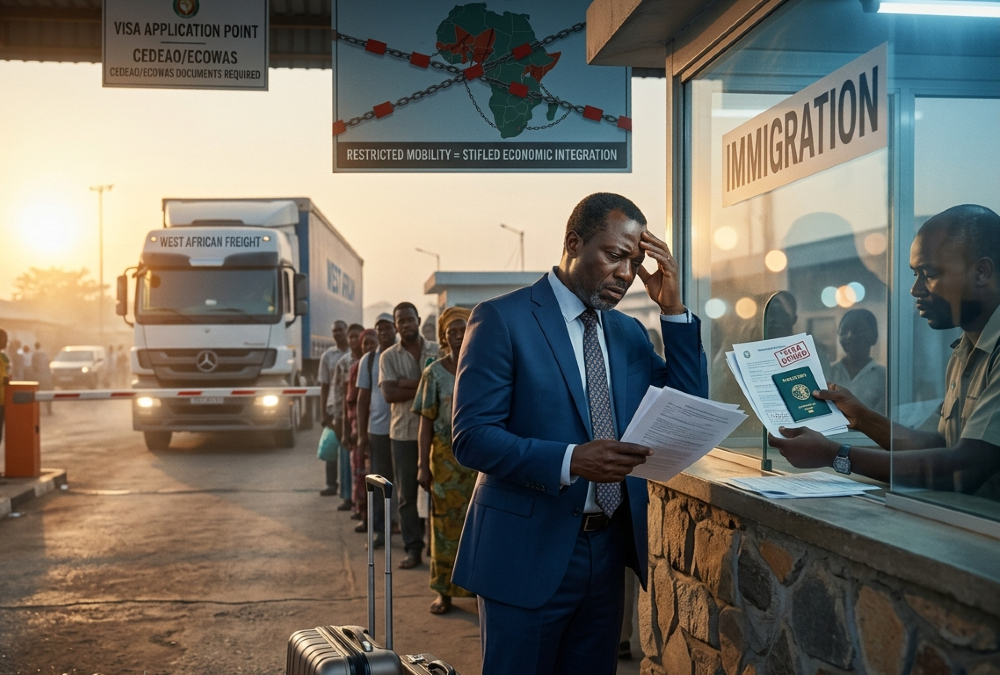
An African businessman boarding a flight to another African country will often carry a visa that took weeks to arrange, cost money he had budgeted for the trip itself, and may have been rejected at least once before it was approved. His counterpart flying from Paris to Nairobi faces considerably less friction.
This is the quiet tax on intra-African commerce – one that rarely appears in any trade report, yet compounds silently across every deal not closed, every partnership not formed, and every opportunity not pursued.
The most powerful passport on the continent belongs to Seychelles. Ranked 29th globally, it grants visa-free or visa-on-arrival access to approximately 150 countries – a genuinely impressive figure for a nation whose entire population fits comfortably inside a mid-sized African city.
Mauritius sits close behind at 32nd. Both are island states; both are outliers.
The rest of the list tells a more sobering story. South Africa ranks 54th. Kenya, 71st. Nigeria – the continent’s largest economy by GDP and most populous nation – does not place among the top twelve passports in Africa.
An entrepreneur from Lagos attempting to conduct business in Addis Ababa navigates more bureaucratic friction than a counterpart traveling between any two cities in the European Union. That is not a minor inconvenience. It is a structural impediment dressed up as administrative procedure.
When Free Trade Agreements Are Not Enough
The African Continental Free Trade Area (AfCFTA) was signed to rewrite the economic logic of the continent. Fifty-four countries agreed, at least in principle, that commerce between them should be easier, faster, and less costly.
Progress under the AfCFTA is real, even if it remains uneven and, at times, fragile. But free trade agreements move goods. Passports move people. And it is people who close deals, build partnerships, scout markets, and transfer knowledge from one economy to another.
No tariff schedule accounts for the cost of a visa denial.
The visa regime between African nations remains one of the most underappreciated barriers to the deep economic integration the continent is plainly capable of achieving. A single market cannot be constructed if the citizens it is meant to serve cannot cross each other’s borders without a paper trail, a processing fee, and weeks of uncertainty.
The logistics of a customs union mean little when the human infrastructure required to animate it is held at the border.
A Decision, Not a Destiny
Seychelles and Mauritius lead this index not by accident of geography or the fortune of small size, but because of deliberate policy choices around openness. That distinction matters.
Visa liberalization is not a passive outcome of development; it is a decision – one that can be made independently of GDP, population, or geopolitical weight. The evidence is sitting at the top of the rankings.
The question for the rest of the continent, then, is not whether open borders are desirable in principle. That argument has largely been settled. The question is when the decision to act on that principle stops looking like an exception made by two small island-nations and starts looking like a continental standard – one befitting the ambitions of an economic bloc that spans 1.4 billion people and some of the world’s fastest-growing markets.
Africa is not short of vision. It is, in too many places, still short of the visa.
Dishant Shah is a partner at Legion Exim, a company specializing in facilitating the export of high-quality engineering products directly sourced from manufacturers in India to Africa. His areas of expertise include new business development and business management.
