
Opinion
The Great Rebalancing: Why Africa Wins When Knowledge Becomes Cheap
The world isn’t racing toward the future – it’s racing back to scarcity. And no continent understands scarcity like Africa.

By John Dale
In 2025, more than US$258 billion flowed into artificial intelligence, robotics, and autonomous systems. The United States captured 79 percent of it. Europe claimed 7 percent. Africa did not register.
To the casual observer, this looks like abandonment – a continent standing motionless while the rest of the world accelerates. It is a compelling narrative. It is also precisely wrong.
The world is not moving forward. It is moving back to fundamentals. And no continent on earth is better positioned for what comes next than Africa.
The Crowding Problem Nobody Is Talking About
We are living through a genuine revolution in the economics of knowledge. Artificial intelligence is making information effortless, content abundant, and expertise cheap.
What once took years to acquire now takes seconds to generate. This is extraordinary – and it is also the source of an emerging problem.
When everyone can know, everyone can create. When everyone can create, creation loses its scarcity premium. The digital economy is not disappearing, but its most crowded corridors – content, code, consulting, ideation – are rapidly deflating in value.
AI does not discriminate. It commoditizes indiscriminately.
So the essential economic question of the coming decade is not who has the best algorithm. It is: what cannot be algorithmed away?
The answer, as it has always been, is production. Things that must be grown. Things that must be mined. Things that must be manufactured and moved across borders. The physical substrate on which every civilization – however digitally sophisticated – ultimately depends.
A History Lesson the Tech Sector Keeps Forgetting
Long before the internet, long before venture capital, and long before the mythology of the laptop entrepreneur, the people who built enduring wealth were not the most informed. They were the most productive. They controlled land, minerals, supply chains, and the physical processes that turned raw materials into civilization.
For one anomalous window in modern history, it appeared that this logic could be suspended. No farm, no factory, no freight network required – just bandwidth, a camera, and the right story.
A generation built its entire worldview of wealth creation around that exception and mistook it for a rule.
That window is closing.
When systems become uncertain – when digital trust erodes, when platform economics consolidate, when every online creator begins to look indistinguishable from the next – capital and attention migrate back to what is tangible. They always have.
The Statistics the World Has Not Yet Priced In
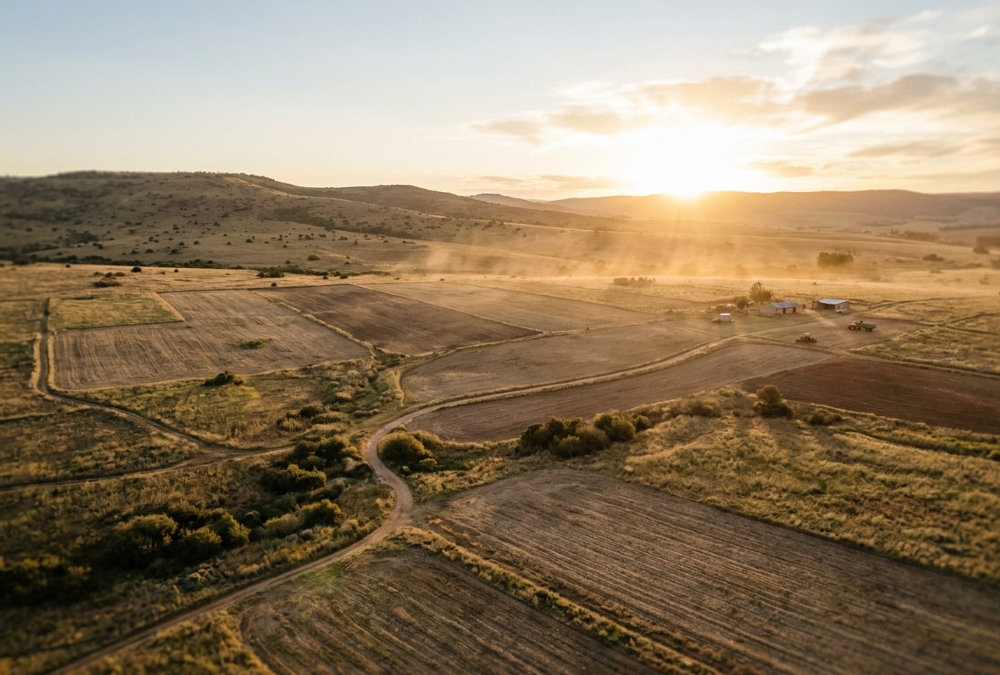
Africa holds 60 percent of the world’s uncultivated arable land while contributing only 10 percent to global food production. Read that again slowly.
That is not a poverty statistic. That is one of the largest unpriced opportunities in the history of global capital markets. As the world’s population continues to grow, as climate disruption strains food systems across Asia and the Americas, and as the billions of people served by AI-powered economies still require calories – agricultural production will become one of the most strategically valuable assets on the planet.
The continent also holds approximately 30 percent of the world’s mineral reserves, including the world’s largest deposits of cobalt, platinum, and uranium. These are not incidental resources.
They are the physical inputs powering the very devices and energy systems running the AI economy. The silicon dream runs on African earth.
The Inversion
Here is the inversion that most analysts are missing: the more AI closes the gap on knowledge and access, the more the only remaining advantage lives in physical production. The more the digital economy equalizes, the more valuable the analog becomes.
The more everyone can think, the more leverage accrues to those who can grow, mine, process, and move.
Africa is not behind in this race. Africa is, in many respects, the destination.
Farming, mining, commodity processing, aggregation, and export – these are not relics of an earlier economic era. They are the foundations of the next one.
Every advanced nation will need to source the materials and the food that sustain the systems they are so aggressively building. The continent that holds those inputs is not a passive beneficiary of someone else’s future. It is a principal.
The Argument in Plain Terms
If you are not capturing a dominant share of the AI investment wave, you are not late to the wrong party. You may simply be early to the right one.
The next era of global wealth creation will be built not in server farms, but in soil. Not in data centers, but in supply chains. Not in San Francisco, but across a continent that has barely begun to deploy what it actually holds.
Africa is not being left behind by history. History is catching up to Africa.
John Dale is an agricultural expert, procurement specialist, and export entrepreneur with 20+ years of experience in Nigeria’s agro-commodity value chain. He has deep expertise in farming, sourcing, storage, and international trade of commodities such as cashew, palm oil, ginger, and cocoa. As Co-Founder of Storgit Ltd., an agro-fintech company, he develops innovative solutions for commodity storage, trading, export, and livestock investment. Passionate about reducing post-harvest losses, strengthening procurement systems, and improving export infrastructure, John is dedicated to building a digital, efficient, and inclusive future for African agriculture.
