
Opinion
A Bovine Revolution: How Brazilian Cows Could Reshape Burkina Faso’s Dairy Destiny
A bold genetic gambit could reshape the Sahel nation’s food economy – if the politics hold
By Gregory September
Landlocked, resource-constrained, and navigating one of the most turbulent political climates in West Africa, Burkina Faso is not the country most analysts would expect to be making ambitious bets on agricultural self-sufficiency. Yet that is precisely what its government is doing.
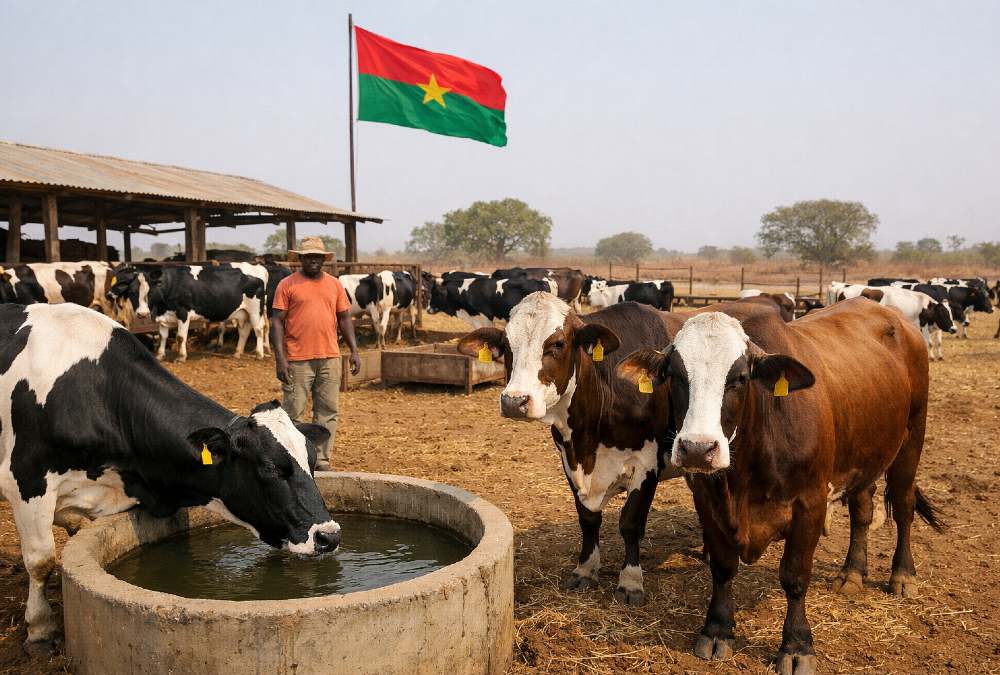
The recent importation of 710 high-performing pregnant dairy cows from Brazil is not merely a livestock transaction – it is a statement of economic intent.
The cattle – primarily Holstein and Girolando breeds – are each capable of producing between 15 and 40 liters of milk per day. That figure dwarfs the output of indigenous Burkinabè cattle, which typically yield a meager 0.5 to 1.3 liters daily.
With all 710 animals pregnant and nearing delivery, the herd is expected to generate more than 1.2 million liters of milk annually. The arithmetic is striking. The ambition, even more so.
The Import Problem
Burkina Faso currently spends an estimated 20 to 22 billion CFA francs (US$35 – US$44 million) each year importing dairy products – a chronic fiscal drain that this initiative is designed to address. That dependence is not unusual for nations in the Sahel, where arid conditions and the dominance of zebu cattle, bred for heat tolerance rather than milk output, have historically made large-scale dairy farming impractical.
What makes this move notable is its dual focus: improving herd genetics through selective breeding and establishing domestic processing infrastructure. Burkina Faso is not simply importing cows – it is importing the building blocks of an industry.
Plans are already underway to construct a local dairy processing facility, one that the government hopes will eventually supply affordable milk to Burkinabè consumers at prices below those of imported alternatives.
Genetics as Economic Policy
The average age of the imported animals is just two years, meaning the herd has decades of productive potential ahead of it. The Holstein breed, favored in industrial dairy operations worldwide, and the Girolando – a Brazilian crossbreed of Holstein and Gir cattle developed specifically for tropical climates – were selected for their adaptability as much as their productivity.
That choice reflects a degree of agricultural pragmatism: Burkina Faso’s climate is harsh, and cattle that thrive in Brazil’s tropical interior may fare better under Sahelian conditions than purely temperate European breeds.
If the program succeeds in establishing a viable second generation through selective crossbreeding with local stock, the long-term impact on the national herd could be transformative. Genetics, after all, compound.
The Bigger Picture
This initiative fits within a broader economic philosophy that has gained currency across francophone West Africa: the deliberate reduction of import dependence through domestic productive capacity. Whether driven by pan-African ideology, post-colonial economics, or simple fiscal necessity, governments across the region are increasingly skeptical of supply chains they do not control.
For Burkina Faso, a country under military-led transitional governance since 2022 and facing significant external pressures, the drive toward self-reliance carries additional political weight. Building domestic industries is not only an economic strategy – it is a sovereignty argument.
The risks are real. Infrastructure gaps, veterinary capacity, feed supply chains, and cold-storage logistics will all determine whether these 710 cows become the foundation of a thriving dairy sector or an expensive footnote.
History offers cautionary tales of well-intentioned livestock programs that withered without adequate follow-through.
But history also offers something else: examples of countries that chose, at precisely the right moment, to invest in the fundamentals of food security. Burkina Faso, against considerable odds, appears to be making that bet.
The calves are coming. The factory is planned. Whether the vision survives contact with reality remains the defining question – and the one worth watching.
Gregory September is a South African academic, author, and geopolitical analyst with extensive experience in government and Parliament. He is the founder and CEO of SAUP (Sustainability Awareness and Upliftment Projects NPC), which focuses on sustainability education and community development. He previously served as Head of Research and Development for the Parliament of South Africa. His work centers on sustainability, African geopolitics, and economic development, and he regularly contributes to analysis of global political and economic affairs.
