
Opinion
When the Strait of Hormuz Sneezes, Africa Catches a Cold
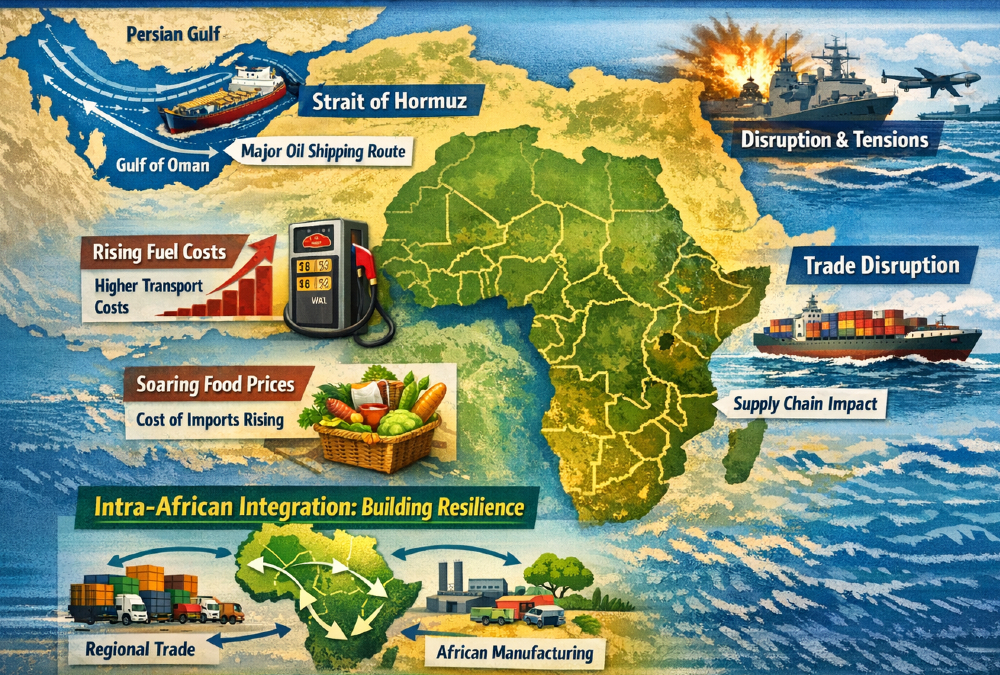

By Lailla Mutajogera
Global attention is currently fixed on the escalating tensions between Iran and the United States. For many observers, particularly in the West, this appears to be a distant geopolitical standoff confined to the Middle East.
Yet, in an interconnected global economy, no conflict remains truly local. When the Middle East sneezes, Africa often catches a cold.
The economic transmission mechanism is immediate and unforgiving. Nearly 20 percent of the world’s oil supply passes through the Strait of Hormuz. Any disruption to this chokepoint sends ripples through global markets, triggering a cascade of rising oil prices, skyrocketing shipping costs, and surging food inflation.
While developed nations may absorb these shocks with strategic reserves and fiscal buffers, developing economies feel the impact first and hardest.
The Arithmetic of Instability
The math is stark. A modest increase of US$10 to US$20 per barrel in oil prices translates into billions of dollars in additional costs for fuel-importing economies.
For nations heavily dependent on imports, this is not merely a macroeconomic adjustment; it is a humanitarian crisis in slow motion.
The consequences manifest in three distinct ways:
- Higher transportation costs, crippling logistics networks.
- Increased electricity costs, hampering industrial output.
- Surging food prices, threatening basic security.
Ultimately, the burden falls on ordinary citizens. Nowhere is this vulnerability more visible than in fragile states.
In South Sudan, where millions rely on humanitarian support and a vast majority live below the global poverty line, external price shocks are devastating. When global fuel and food prices climb, fragile economies do not just stumble; they risk collapse.
This is the reality of modern globalization. A conflict thousands of kilometers away can dictate the price of bread in Kigali, the cost of transportation in Kampala, or the food security of communities across the Sahel.
Building Resilience Through Regional Integration
However, crises often reveal structural weaknesses that demand correction. These geopolitical shockwaves should serve as a catalyst for a strategic pivot.
The question for African policymakers is not how to weather the next storm, but how to build a ship that does not capsize in rough waters. To achieve this, Africa must pursue three critical objectives.
1. Constructing Economic Resilience
Too many African economies remain perilously dependent on imports for fuel, food, and manufactured goods. This external dependency creates a structural deficit that leaves nations exposed to volatile global markets.
Resilience requires diversifying energy sources and investing in local agricultural capacity to buffer against external supply chain disruptions.
2. Moving Beyond Raw Resource Extraction
The continent possesses immense energy, mineral, and agricultural potential. Yet, historically, much of the value creation has occurred outside Africa’s borders.
Exporting raw materials while importing finished goods is an economic model that exports jobs and imports inflation. Africa must industrialize, capturing the value chain domestically rather than serving merely as a quarry for the global economy.
3. Strengthening Intra-African Trade
Perhaps the most vital step is strengthening trade between African countries. The African Continental Free Trade Area (AfCFTA) offers a framework, but implementation requires political will.
Instead of importing everything from outside the continent, African nations must increasingly produce, manufacture, and exchange goods with one another.
A Vision for Self-Reliance
Imagine a regional economy where factories in one African country produce materials that supply neighboring markets. Envision agricultural products moving seamlessly across borders without prohibitive tariffs or logistical bottlenecks.
Picture manufactured goods traveling efficiently between Rwanda, Uganda, Kenya, and beyond.
This is not merely about trade; it is about building a stronger Africa that trades with itself. It is about shifting from reacting to global supply chains to constructing indigenous ones.
Global conflicts remind us how fragile international systems can be. But they also reveal opportunity. Africa has the population, the resources, and the markets. What remains to be built are the systems, industries, and partnerships that allow the continent to rely on its own strength.
In an unpredictable world, economic independence is not just an ambition; it is one of the most powerful forms of stability.
Lailla Mutajogera is an investor, entrepreneur, and CEO of Muta Investment Firm, a cross-border investment company with operations in Uganda, Rwanda, and Dubai. She specializes in connecting global investors with high-impact opportunities in African markets, focusing on commercial real estate, tourism, agribusiness, and asset management. Committed to practical, growth-driven investments, she champions projects that drive sustainable development across the continent.
