
Opinion
The Power Hangover: Africa’s Ex-Leaders and Their Reluctance to Let Go

By Fidel Amakye Owusu
Across Africa, a recurring political drama is playing out: ousted autocrats, even after years in exile, continue to cast long shadows over the nations they once ruled. No matter how decisively they were pushed from power – by popular revolt, regional intervention, or electoral rejection – many cannot resist the pull of the spotlight.
Their message is clear: even in exile, they still want to call the shots.
The Long Arm of Exiled Autocrats
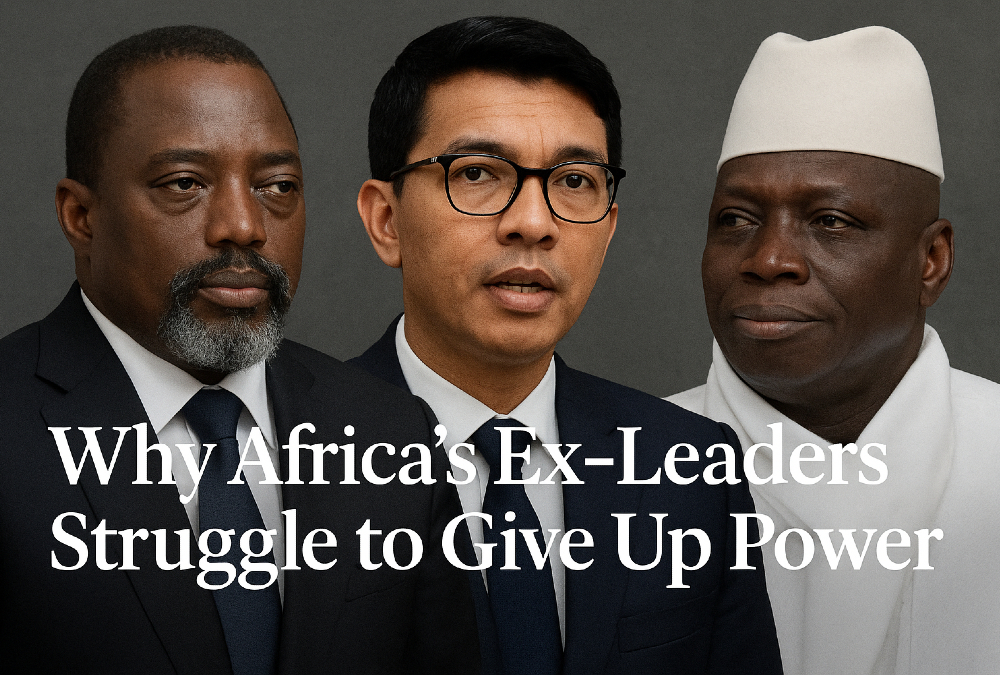
Take the Democratic Republic of the Congo. Earlier this year, authorities in Kinshasa grew visibly nervous when Joseph Kabila – president from 2001 to 2019 and now living in self-imposed exile – signaled his intention to return home.
Within days, state security forces raided his properties in the capital and seized assets. The government warned that legal prosecution awaited him. Yet Kabila’s maneuvering suggests he has not abandoned political ambition.
After nearly two decades at the helm, and despite being forced out by mass protests and international pressure, he appears unwilling to fade into obscurity.
A similar dynamic is unfolding in Madagascar. Just days ago, the country’s military junta revoked the citizenship of former president Andry Rajoelina – a man who has dominated Malagasy politics for much of the past 15 years.
The move is widely interpreted as a preemptive strike: the junta fears that Rajoelina, if allowed to return, could rally supporters and reignite a power struggle.
And now, The Gambia. Yahya Jammeh, who ruled the tiny West African nation with an iron fist for 22 years, has announced plans to come back from exile in Equatorial Guinea.
His 2016 ouster was one of the continent’s rare democratic success stories: after initially conceding defeat in an election, Jammeh abruptly reversed course and refused to hand over power. It took a credible military threat from ECOWAS – backed by Senegal, Nigeria, and Ghana – to compel his departure.
The operation succeeded not only because of regional resolve but also because of The Gambia’s geography: a narrow sliver of land almost entirely encircled by Senegal, making defiance logistically untenable.
The Shadow Play of Power After Office
Yet Jammeh’s recent declaration has already unsettled Banjul. The current government has warned he will be arrested upon arrival, citing outstanding legal cases.
But his enduring support among certain segments of the population raises legitimate concerns about renewed instability.
What explains this persistent desire to return? It is not merely nostalgia or ego.
In many African states, former leaders retain informal networks of patronage, loyalists in the security forces, and influence over key economic sectors. Their exits are rarely clean breaks; instead, they often negotiate ambiguous “golden exiles” that leave room for future re-entry.
When Institutions Hold – and When They Don’t
Contrast this with countries like Ghana, Senegal, Nigeria, Kenya, and South Africa. In these democracies – imperfect but resilient – former presidents typically remain in-country after leaving office, even when their legacies are contested. Crucially, their continued presence is not perceived as a threat to constitutional order.
They step down because the people, institutions, and regional norms demand it – and they stay out because the system holds.
The real issue is not whether former leaders wish to return – it’s whether the institutions meant to safeguard democratic transitions are strong enough to manage their reintegration or, if necessary, their exclusion. Africa’s democratic progress will be measured not only by how leaders leave power, but by how societies prevent them from hijacking it again.
As Kabila, Rajoelina, and Jammeh eye their homelands from afar, their ambitions serve as a stark reminder: authoritarianism doesn’t always end with an election. Sometimes, it lingers in the wings – waiting for an invitation that should never come.
Fidel Amakye Owusu is an International Relations and Security Analyst. He is an Associate at the Conflict Research Consortium for Africa and has previously hosted an International Affairs program with the Ghana Broadcasting Corporation (GBC). He is passionate about Diplomacy and realizing Africa’s global potential and how the continent should be viewed as part of the global collective.
