
Zina’s Youth View on Africa
Displacement and the Fragile Path to Peace in Eastern DR Congo

By Godfred Zina
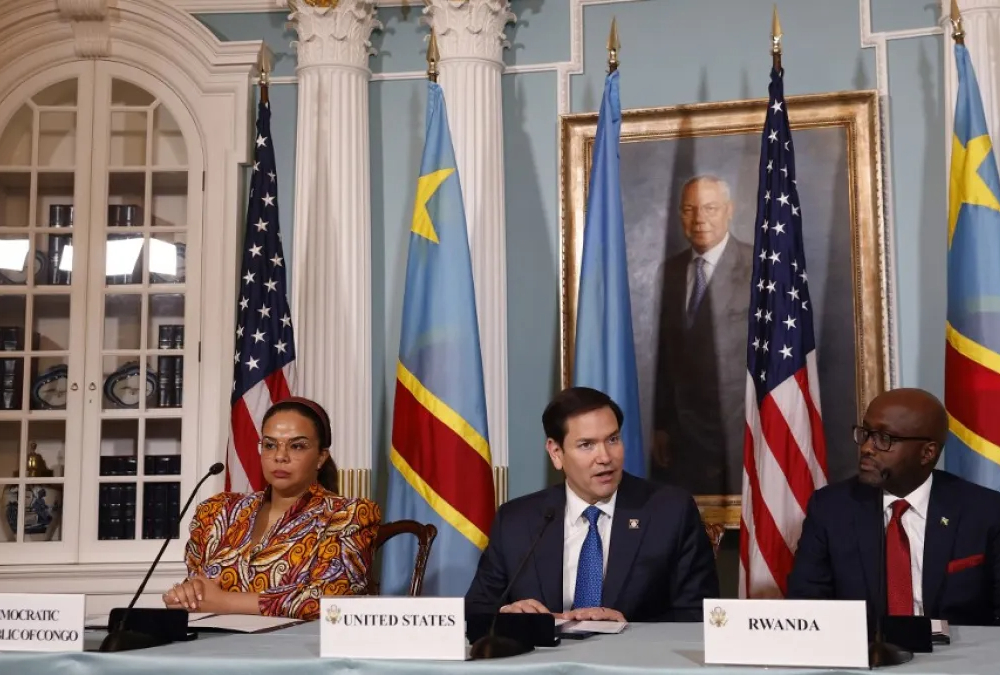
On September 3, 2025, a quiet but significant meeting took place in Washington, D.C., where officials from the Democratic Republic of the Congo (DR Congo) and Rwanda convened under the auspices of the Joint Oversight Committee for the Washington Accord. The agreement, signed in June 2025, was hailed as a breakthrough in efforts to end a decade of conflict in eastern DR Congo – a region long scarred by violence, displacement, and geopolitical tension.
Both nations reaffirmed their commitment to mutual respect for sovereignty, territorial integrity, and peaceful conflict resolution. Yet behind the diplomatic language lay a sobering admission: progress on critical elements of the accord – troop withdrawals, disarmament of armed groups, and the establishment of joint security mechanisms – has been painfully slow.
For the millions of civilians still trapped in limbo, the delay is not merely bureaucratic. It is existential.
A Decade of Conflict, Displacement, and Broken Promises
The roots of the current crisis trace back to April 2012, when the M23 rebellion emerged from the remnants of the Congrès National pour la Défense du Peuple (CNDP). Citing Kinshasa’s failure to honor a 2009 integration agreement, M23 fighters launched a violent campaign across North Kivu.
By November 2012, they had captured Goma, the regional capital – slaughtering civilians, destroying infrastructure, and forcing hundreds of thousands to flee.
One such refugee, a close friend from the region, escaped to Zambia in 2012. Over a decade later, she remains in exile, unable to return home. Her story is not unique – it is echoed by millions.
Though M23 was largely defeated by late 2013 with support from the United Nations Organization Stabilization Mission in the Democratic Republic of the Congo (MONUSCO), the group resurged in late 2021 – better armed, more organized, and allegedly backed by external forces. Once again, Goma came under threat. Towns across eastern DR Congo were overrun.
Civilians bore the brunt.
By late 2024, internal displacement in the DR Congo reached a staggering 7 to 7.8 million – the highest in Africa and among the worst globally. While over 3 million people had returned to their homes by mid-2025, between 5.9 and 7.3 million remain displaced, living in overcrowded camps with limited access to food, healthcare, and education.
The human cost is equally devastating. Since January 2025 alone, more than 7,000 people have been killed, according to DR Congo’s Ministry of Defense – nearly 3,000 more than UN estimates.
Thousands more have been injured. In North and South Kivu, recent massacres have claimed over 400 civilian lives in just a few months.
Accusations, Denials, and the Shadow of Regional Rivalry
Kinshasa continues to accuse Kigali of supporting M23, a claim Rwanda denies. Yet multiple United Nations reports and intelligence assessments from Western governments point to direct Rwandan military involvement – troop deployments, logistical support, and weapons transfers. Rwanda, in turn, accuses the DR Congo of harboring the Democratic Forces for the Liberation of Rwanda (FDLR), a rebel group linked to the 1994 Rwandan genocide.
This mutual distrust has fueled a proxy conflict that has destabilized the entire Great Lakes region. With over 120 armed groups operating in eastern DR Congo, the security landscape is fragmented, volatile, and increasingly difficult to contain.
The Washington Accord: A Lifeline at Risk
The Washington Accord was meant to break this cycle. Brokered with U.S. mediation, it called for a ceasefire, mutual troop withdrawals, disarmament of non-state actors, and the creation of joint security structures. It was a rare moment of diplomatic optimism.
But nearly four months after its signing, implementation remains stalled. Troop pullbacks have not materialized. Disarmament efforts are minimal. Joint patrols are absent. Without tangible action, the accord risks becoming another symbolic gesture – filed away with past failed peace deals like the 2002 Pretoria Agreement or the 2013 Peace, Security, and Cooperation Framework.
Every day of delay emboldens armed groups, erodes public trust, and deepens humanitarian suffering. If the current trajectory continues, the fragile calm could collapse into open interstate conflict between DR Congo and Rwanda – a scenario that would have catastrophic consequences for Central Africa.
A Call for Action: Accountability, Monitoring, and Safe Returns
To salvage the Washington Accord, the international community must move beyond rhetoric. The Joint Oversight Committee – backed by the African Union (AU) and the United Nations – must be empowered with real monitoring authority.
This includes:
- On-the-ground verification of troop withdrawals and disarmament.
- Unrestricted access to conflict zones for independent observers.
- Sanctions enforcement mechanisms for parties that violate the agreement.
- International guarantees for the safe, voluntary, and dignified return of displaced populations.
Humanitarian corridors must be established with UN and AU protection. Displaced families should not have to choose between safety and home.
Rebuilding trust requires more than promises – it demands transparency, accountability, and justice.
The Cost of Inaction: A Lost Generation?
Beyond the immediate violence, prolonged displacement threatens to create a “lost generation” in eastern DR Congo. Children growing up in camps face malnutrition, interrupted education, and recruitment by armed groups.
The long-term economic and social costs will echo for decades.
Peace is not merely the absence of war. It is the presence of justice, stability, and opportunity.
The Washington Accord offers a roadmap – but only if it is followed.
The world is watching. The people of eastern DR Congo cannot wait any longer.
Godfred Zina is a freelance journalist and an associate at DefSEC Analytics Africa, a consultancy specializing in data and risk assessments on security, politics, investment, and trade across Africa. He also serves as a contributing analyst for Riley Risk, which supports international commercial and humanitarian operations in high-risk environments. He is based in Accra, Ghana.
