
Zina’s Youth View on Africa
Are Cameroon and Ivory Coast Redefining Democracy – or Undermining It?

By Godfred Zina
As ballots are tallied in Cameroon and tensions mount ahead of Ivory Coast’s pivotal vote later this month, two of West and Central Africa’s most influential nations stand at a democratic crossroads – one that could reshape the region’s political trajectory for years to come.
The Illusion of Choice in Cameroon
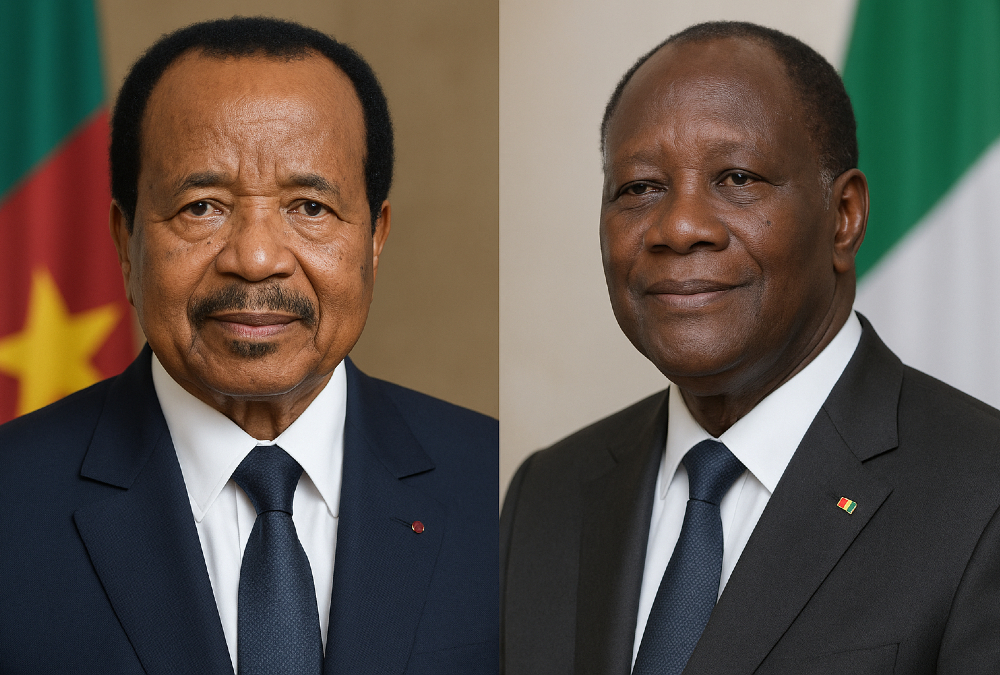
In Yaoundé, 91-year-old President Paul Biya appears set to extend his 43-year rule following the October 12 election. Despite rare public dissent – including criticism from his own daughter – and widespread calls for generational change, Biya’s grip on state institutions, security forces, and the electoral machinery remains unshaken.
With nine opposition candidates fragmented and unable to coalesce around a unified front, the path to another term seems all but assured. Yet for many Cameroonians weary of stagnation, inequality, and repression, the vote represented more than a ritual – it was a flicker of hope for renewal.
That hope now dims amid credible allegations of voter suppression, internet blackouts, and a lack of independent oversight, casting serious doubt on the election’s legitimacy.
Ivory Coast’s Constitutional Tightrope
Just over 1,000 kilometers (621 miles) west, Abidjan tells a parallel story. On the eve of Ivory Coast’s October 25 presidential election, police recently arrested 237 protesters in a stark reminder of the shrinking civic space under President Alassane Ouattara.
Having already served three terms, Ouattara is seeking a controversial fourth mandate – made possible only after constitutional term limits were scrapped in 2016. Key opposition figures, including former president Laurent Gbagbo and ex-prime minister Guillaume Soro, remain barred from running, effectively sidelining credible challengers and skewing the electoral playing field.
The Regional Reckoning
What links Yaoundé and Abidjan is not merely geography, but a troubling political playbook: the “constitutional coup.” Across Francophone Africa – from Togo to Guinea – long-serving leaders have rewritten or reinterpreted constitutions to bypass term limits, cloaking authoritarian continuity in the veneer of legality.
These maneuvers erode democratic norms, weaken institutional checks, and fuel public disillusionment. Worse, they normalize the idea that power belongs to those who hold it longest, not those who earn it fairly.
The stakes of the 2025 Ivorian election extend far beyond national borders. As one of West Africa’s largest economies and a linchpin of regional stability, Ivory Coast’s commitment – or retreat – from democratic principles will reverberate across the Economic Community of West African States (ECOWAS) and the African Union (AU).
Should flawed elections entrench Biya and Ouattara further, the credibility of these regional bodies – already strained by coups in Mali, Burkina Faso, and Niger – will suffer another blow.
It is time for ECOWAS and the AU to move beyond rhetorical condemnation. Concrete mechanisms are needed to uphold term limits, protect electoral integrity, and support independent judiciaries.
Without such safeguards, the democratic backsliding witnessed in Cameroon and Ivory Coast risks becoming the region’s new normal.
Democracy is not defined by the mere act of voting, but by the fairness, freedom, and inclusivity that surround it. If West and Central Africa wish to be seen as democratic actors on the global stage, their leaders must stop redefining democracy to suit their ambitions – and start respecting its foundational principles.
Godfred Zina is a freelance journalist and an associate at DefSEC Analytics Africa, a consultancy specializing in data and risk assessments on security, politics, investment, and trade across Africa. He also serves as a contributing analyst for Riley Risk, which supports international commercial and humanitarian operations in high-risk environments. He is based in Accra, Ghana.
