
Opinion
Roads Move Trucks. Institutions Move Regions.
A quiet institutional milestone in West Africa offers the most important lesson in the long history of continental integration: the real infrastructure of trade is not asphalt – it is governance.

By Ziad Hamoui
In February 2026, the Abidjan-Lagos Corridor Management Authority – known as ALCoMA – formally inducted its Board. The ten-member body carries a single, precise mandate: to govern a 1,028-kilometer (639-mile) highway spanning Côte d’Ivoire (Ivory Coast), Ghana, Togo, Benin, and Nigeria as one unified economic asset, not as five separate national roads that happen to be adjacent.
The announcement attracted little attention. It deserved far more.
As Africa marks Border Day, the usual rhetoric is already in circulation – speeches about integration, connectivity, and the promise of a single continental market. These aspirations are not wrong. But aspiration, however sincere, is not architecture.
Integration is not built through declarations. It is built through institutions capable of compelling sovereign states to manage shared assets collectively.
That is precisely why ALCoMA matters, and why its creation should be understood as something larger than a transport story.
The Governance Gap No One Talks About
The central obstacle to regional integration across Africa has never been a shortage of physical infrastructure. It has been the absence of governance mechanisms capable of coordinating that infrastructure across borders.
Without such mechanisms, even a flawlessly constructed highway becomes five separate problems: five customs authorities, five transport ministries, five enforcement regimes, and five competing sets of national priorities. The asphalt is the easy part. The governance architecture – the institutions, rules, and accountability systems that give the road economic meaning – is where integration either takes hold or quietly collapses.
ALCoMA is a direct attempt to solve that coordination problem. By establishing a single cross-border authority with real governing power over the corridor, the five member states have, in principle, agreed to subordinate a slice of their national prerogative to a shared institution.
That is not a bureaucratic formality. It is a meaningful act of political will that should not be underestimated.
The Payments Architecture That Already Works
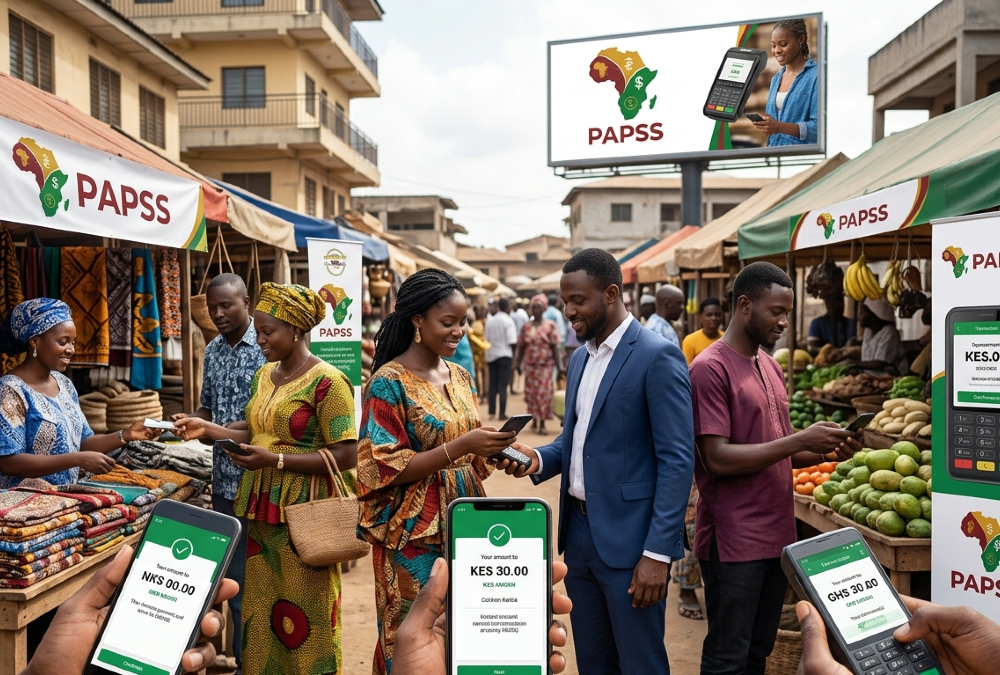
The same logic applies to financial infrastructure – and there, meaningful progress is already visible. The Pan-African Payment and Settlement System (PAPSS) now connects more than 170 commercial banks and has been adopted by 21 central banks across the continent.
Ghana and Nigeria are already settling transactions on the platform in local currencies.
For decades, the majority of intra-African payments traveled through correspondent banks located outside the continent – a circuitous and costly arrangement that added delays, fees, and foreign exchange exposure to transactions that had no logical reason to leave Africa in the first place. PAPSS removes that detour. It is, in the language of infrastructure, the financial equivalent of building a direct road between two cities that previously required a journey through a third country.
ALCoMA and PAPSS are not different types of initiatives. They belong to the same essential category: the legal, institutional, financial, and digital systems that determine whether physical investments generate genuine integration or merely expensive connectivity.
A warehouse is not trade. A port is not commerce. A highway is not a market. The systems governing how goods move, how disputes are resolved, and how payments settle – those are the actual infrastructure of trade.
Symptoms and Architecture
For years, analysts and advocates have catalogued the symptoms with commendable precision: border delays measured in days, documentation bottlenecks that render compliant traders uncompetitive, informal payments that function as a shadow tax on cross-border commerce, and layers of administrative duplication that serve no one except incumbents who benefit from opacity. These symptoms matter and deserve continued scrutiny.
But they are symptoms. The underlying condition is the weakness of the governance architecture that would otherwise prevent them – the missing authorities, incomplete legal frameworks, and accountability gaps that allow dysfunction to persist across borders where no single government bears full responsibility for the outcome.
What is now becoming visible, cautiously but unmistakably, is serious investment in that underlying architecture. ALCoMA is one piece. PAPSS is another. The African Continental Free Trade Area (AfCFTA) Secretariat’s ongoing work to establish dispute resolution mechanisms and phase in tariff schedules represents a third. None of these is sufficient on its own. Together, they begin to constitute something meaningful.
The Question That Remains
The question that should animate this Africa Border Day is therefore not whether integration is desirable – that argument was settled long ago. The question is which pieces of the integration architecture are still missing, and who is specifically accountable for delivering them.
That accountability question is harder than it sounds. Regional institutions are, by design, diffuse. Their failures produce no election, no resignation, no visible consequence for the officials responsible.
When a corridor management authority underperforms or a payment system fails to achieve adoption, the costs are borne by traders, transporters, and small businesses who lack the political voice to demand better. The beneficiaries of dysfunction – rent-seeking intermediaries, entrenched bureaucracies, border officials operating informal toll systems – are, by contrast, highly organized and highly motivated to preserve the status quo.
This is why the creation of ALCoMA, for all its promise, should be treated as a beginning and not a conclusion. A board induction is not governance. Real governance is what happens when the first serious dispute arises between member states over corridor enforcement, and the institution holds.
It is what happens when a national transport ministry issues a directive that conflicts with the corridor-wide regime, and ALCoMA’s authority is tested. Those moments have not yet arrived. They will.
The same test applies to PAPSS. Network effects in payment systems are powerful, but so are incumbents. The correspondent banking arrangements that PAPSS is designed to displace have deep institutional roots. The platform’s adoption curve over the next three years will reveal more about African financial integration than any number of ministerial endorsements.
Integration Is a Verb
The most important reframe available to those who care about African integration is this: stop measuring progress by what has been announced, and start measuring it by what is being governed. Declarations are costless. Institutions are not.
Every functioning cross-border authority, every payment system that settles a transaction without leaving the continent, every corridor that operates under a unified legal regime rather than five overlapping ones – these are the durable units of integration.
Roads move trucks. Ports move containers. But institutions move regions.
The challenge for policymakers, development financiers, and regional bodies is to apply to governance infrastructure the same rigor, resources, and political attention that have historically been reserved for physical infrastructure.
That means funding institutions not just to exist, but to enforce. It means holding corridor authorities accountable for outcomes, not just for induction ceremonies.
It means asking, on every Border Day, not only what has been built, but what is actually being governed. Africa is beginning to build the right things. The work of making them function is still very much underway.
Ziad Hamoui is the Co-Founder and Past President of the Borderless Alliance, a leading private-sector advocacy group promoting economic integration and removing trade and transport barriers in West Africa. With extensive experience in Ghana’s road transport, logistics, and shipping sectors, he currently serves as Executive Director of Tarzan Enterprise Ltd., a long-established family business. He is a former Co-Chair of the Africa Food Trade Coalition, Co-Founder of the Trade Facilitation Coalition for Ghana, and serves on multiple high-level advisory committees on trade, transport, agriculture, and security. A Chartered Fellow of the Chartered Institute of Logistics and Transport (CILT) Ghana, he is also a former member of its Governing Council.
