
A Diaspora View of Africa
Reparations Has a Long, Unresolved History

By Gregory Simpkins
Reparations to a whole group for historic wrongs go back thousands of years. The idea shows up whenever societies try to close out a conflict or injustice by compensating the victims, not just punishing the perpetrators.
There are two classes of reparations. First there are war reparations.
After the Second Punic War, 201 BCE, Carthage had to pay Rome 10,000 talents of silver over 50 years. More recently, Germany was forced to pay 132 billion gold marks to Allied powers for World War I. This fueled German resentment and helped lead to World War II. After the Second World War, Germany paid more than US$60 billion to Holocaust survivors and Israel under the 1952 Luxembourg Agreement and is still paying pensions to survivors today. Also after that war, Japan paid reparations to Burma, Philippines, Indonesia and others in the 1950s-60s. Following the Iraq-Kuwait conflict in 1991, the UN Compensation Commission forced Iraq to pay US$52.4 billion to Kuwaiti individuals, companies and the government for invasion damages. The final payment was made in 2022.
Then there are payments to descendants or a defined ethnic group such as:
- Holocaust reparations
- From West Germany to Israel & survivors (1952): The payout was US$3 billion at the time, about US$33 billion today. Also, through individual claims via the Claims Conference, more than 800,000 survivors received payments.
- Swiss banks (1998): There was a US$1.25 billion settlement for dormant accounts of Holocaust victims.
- German companies: Volkswagen, Deutsche Bank and others paid into a US$5 billion fund for slave laborers used by the Nazis.
- Japanese-American internment
- Civil Liberties Act of 1988: The US government paid US$20,000 to each of about 82,000 surviving Japanese-Americans incarcerated during WWII for a total of US$1.6 billion. There also was a formal apology from President Ronald Reagan.
- Native Americans
- Indian Claims Commission (1946-1978): About US$1.3 billion was paid to tribes for land seized in violation of treaties. The program was criticized because it extinguished future land claims.
- Alaska Native Claims Settlement Act (1971): There were 44 million acres and US$962 million given to Alaska Natives for land claims. It created Native corporations.
- Specific tribal settlements: Under the Cobell v. Salazar court decision in 2009, US$3.4 billion was paid to individual Indian account holders for mismanaged land royalties.
-
Colonial reparations
- From Germany to Herero and Nama (2021): There was €1.1 billion in development aid over 30 years for the 1904-1908 genocide in Namibia. Germany avoided using the term “reparations” to sidestep legal claims.
- From the UK to Mau Mau Kenyans (2013): There was £19.9 million paid to 5,228 survivors of torture during 1950s Kenyan Emergency and an official apology.
- From the Netherlands to Indonesia (2022): There were apologies and €5000 to widows of men executed 1945-1949.
- From Belgium to the Democratic Republic of the Congo: There has been no cash yet, but there was a 2022 apology, and Parliament is still debating the return of looted artifacts.
40 Acres and a Mule Was the Slogan of US Reparations
The US government never paid cash reparations to former slaves as a class after the Civil War. The reparations that were paid went to loyal Union slaveholders (up to US$300 for each freed person) under the District of Columbia Compensated Emancipation Act.
After the Civil War, the 14th amendment explicitly prohibited future compensation for former slaveholders. There was much that did happen for former slaves postwar, but there also was much that did not take place.
What Did Happen
“40 acres and a mule” promise (January 1865)
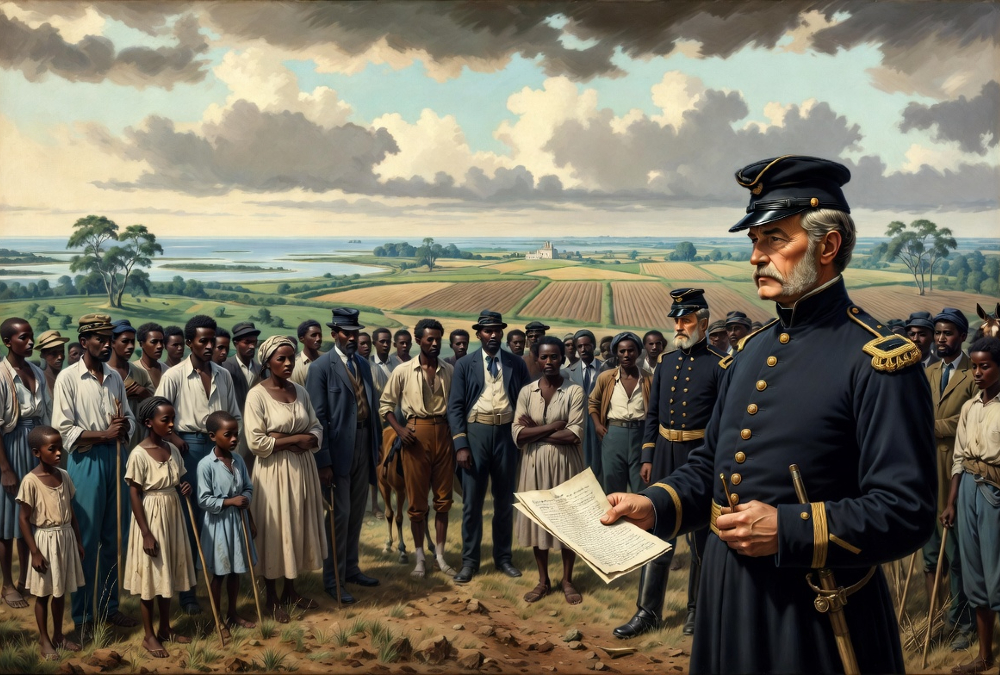
Union General William T. Sherman met with 20 Black pastors in Savannah, Georgia, as the Civil War neared its end and enslaved African Americans neared freedom to ask what they wanted from the government. The Black leaders gathered for the January 12 1865 meeting with the military officials in a mansion called the Green-Meldrim House. They explained that they didn’t want to live among white people, as they feared it would take years for racial prejudice to dissipate in the South. Instead, they wished to live amongst themselves on their own land. That would entail redistributing the land of Southern plantation owners.
General Sherman’s Special Field Order No. 15 set aside 400,000 acres of confiscated Confederate land along the Georgia/South Carolina coast for freed families. Three of its parts are relevant here. Section one states: “The islands from Charleston, south, the abandoned rice fields along the rivers for thirty miles back from the sea, and the country bordering the St. Johns river, Florida, are reserved and set apart for the settlement of the negroes [sic] now made free by the acts of war and the proclamation of the President of the United States.”
Section two specifies that these new communities, moreover, would be governed entirely by black people themselves:” … on the islands, and in the settlements hereafter to be established, no white person whatever, unless military officers and soldiers detailed for duty, will be permitted to reside; and the sole and exclusive management of affairs will be left to the freed people themselves … By the laws of war, and orders of the President of the United States, the negro [sic] is free and must be dealt with as such.”
Finally, section three specifies the allocation of land:” … each family shall have a plot of not more than (40) acres of tillable ground, and when it borders on some water channel, with not more than 800 feet water front, in the possession of which land the military authorities will afford them protection, until such time as they can protect themselves, or until Congress shall regulate their title.”
By June 1865, about 40,000 freed people were settled on it. Unfortunately, after succeeding the assassinated Lincoln, President Andrew Johnson overturned it in the fall 1865. Most land was returned to former Confederate owners. Freed people were evicted, often at gunpoint.
Without land of their own to work, the estimated 3.9 million members of the formerly enslaved population could not control their own destiny after the Civil war ended. Many found themselves working on white people’s land as sharecroppers or tenant farmers, a system that was only slightly better than slavery, given the meager wages and exploitation associated with it.
Freedmen’s Bureau 1865-1872
Congress created the Bureau of Refugees, Freedmen, and Abandoned Lands and provided food, schools, hospitals and helped negotiate labor contracts. It could lease or sell land but only had 850,000 acres total and most was returned to whites after Johnson’s amnesty.
About 2,000 Black families managed to buy land through it. This was not reparations – it was short-term relief and never meant as compensation for slavery.
Southern Homestead Act 1866
The legislation opened 46 million acres of public land in five southern states to freed people and loyal whites, but the problem was that most land was swamp or pine barrens and not farmable. Freed people had no capital for tools, seed or mules. Only about 4,000 Black families got land before it was repealed in 1876.
Pensions for Black Union soldiers
Black veterans got federal military pensions just like white veterans. By 1890, widows and dependents could claim too, but this was for military service, not slavery. Enslaved people who didn’t serve got nothing.
What didn’t happen
Again, unlike Japanese-Americans in 1988 or Holocaust survivors, ex-slaves as a group never got a payment from the federal government. Of nearly four million freed people in 1865, fewer than 0.5 percent ended up owning land from any federal program.
By 1900, about 25 percent of southern Black farmers owned land, but they bought it themselves. Many freed people deposited savings in the Freedman’s Savings Bank. It collapsed due to fraud/mismanagement.
Depositors lost about US$3 million, equivalent to approximately US$80 million today. Congress reimbursed only about 60 percent over decades.
Why It Didn’t Happen
- Johnson’s opposition: After Lincoln died, Johnson pardoned ex-Confederates and gave land back. He said redistribution was “confiscation.”
- Congress balked: Radical Republicans like Thaddeus Stevens pushed for land seizure, but moderates feared violating property rights and alienating the South and upsetting reconciliation after a destructive Civil War.
- Legal theory at the time: Reparations weren’t a common concept. The government saw its role as freeing slaves, as it did with the 13th amendment to the constitution, not compensating them. The idea that slaves owed owners for “lost property” was more common than the reverse.
Later attempts
- Ex-Slave Pension Movement (1890s-1910s): White southern Democrat Walter Vaughan and former slave Callie House lobbied for a US$15/month payment to ex-slaves. Their petition gained 600,000 signatures, but the Department of Justice shut it down and prosecuted organizers for mail fraud.
- H.R. 40 (1989-present): Congressman John Conyers’ bill to study reparations passed the committee stage in 2021, but it never got a floor vote. The matter is technically still pending.
So, there were lots of promises and short-lived programs in 1865-66, but they were reversed within a year. No direct cash compensation was ever paid.
Still, returning to this matter of reparations for the descendants of American slaves is quite complex as I will present in Part 2.
Gregory Simpkins, a longtime specialist in African policy development, is the Principal of 21st Century Solutions. He consults with organizations on African policy issues generally, especially in relating to the U.S. Government. He further acts as a consultant to the African Merchants Association, where he advises the Association in its efforts to stimulate an increase in trade between several hundred African Diaspora small and medium enterprises and their African partners.
