
Opinion
Produce and Conserve: What African Farmers Can Learn from Brazil
A week among farmers from 17 nations in São Paulo yielded a lesson that transcends soil and seed: Africa must tell its own agricultural story – before someone else does.

By Jean Claude Niyomugabo
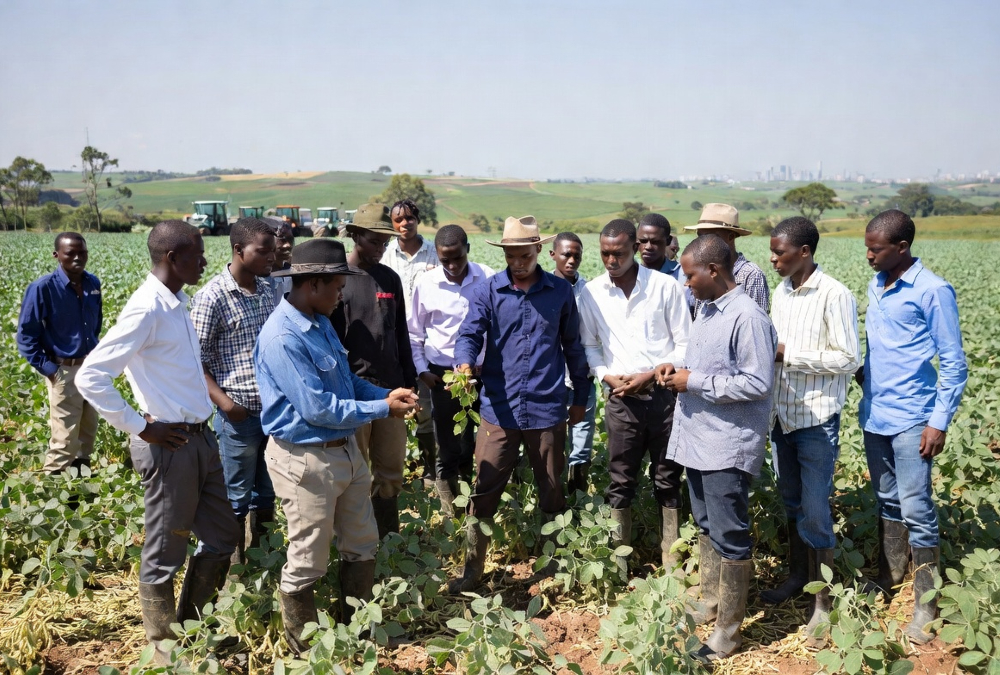
Arriving in São Paulo after more than ten hours of travel, with no firm expectations but a genuine readiness to learn, few visitors anticipate walking away with a philosophy. Yet by the end of a week spent in conversation with farmers from seventeen nations – Brazil, Bulgaria, Canada, Chile, Japan, Lesotho, Mexico, Morocco, Nepal, Romania, Rwanda, Turkey, the United Kingdom, the United States, Uruguay, and Zambia – that is precisely what emerged.
The backgrounds were strikingly different. The farming systems were, in many cases, worlds apart. But the questions animating every conversation were remarkably alike: How do we build agriculture that endures? How do we grow without destroying what we grow from?
Revolution Measured in Millions of Tons
During a session on Brazilian agriculture, one set of numbers brought the room to a halt. Soybean production has grown from roughly 13 million tons in 1980 to more than 170 million tons today.
That kind of scale does not materialize through accident or luck. It is the compounded result of sustained research investment, millions of farmer decisions made over decades, and a long-term commitment to systems thinking rather than short-term yield-chasing.
Then came the figure that reframed everything: 42 million hectares under no-till farming. Suddenly the production numbers made a different kind of sense.
Brazil had not simply learned to grow more. It had learned to grow more while asking less of the land. The logic was not extractive – it was regenerative.
Produce and conserve.” Two words. Deceptively simple. Anything but easy.
That phrase, offered almost in passing during a field session, became the most durable idea of the week. It captures a discipline that many agricultural systems – including those across much of Africa – have yet to fully internalize.
Productivity and stewardship are not in tension. They are, over any meaningful time horizon, inseparable.
The Story Africa is Not Yet Telling
But the most consequential lesson of the week did not come from a field visit or a data presentation. It came from the communication sessions – and it is one that Africa, in particular, cannot afford to ignore.
African farmers are producing extraordinary things. Smallholders across the continent are adapting to climate variability, innovating under resource constraints, and feeding communities with a fraction of the infrastructure available to their peers in the Global North.
Yet too often, that story is told by outsiders – by development agencies, international researchers, and foreign journalists – whose framing, however well-intentioned, rarely captures the texture and agency of African agricultural life.
If African farmers do not learn to narrate their own experience, someone else will. And the version that gets told may not reflect reality. It may flatten complexity into crisis, reduce innovation to charity, or mistake resilience for helplessness.
The stakes of that misrepresentation are not merely reputational – they shape policy, investment, and the way African farmers see themselves.
Technology As Tool, Not Substitute
Technology should not replace farmers. It should help them lead.
This connects directly to a second lesson that crystallized over the week: innovation, for the African farmer, does not always arrive in expensive packages. The most durable agricultural advances – crop rotation practices, soil-cover techniques, community-based seed systems – are often low-cost, knowledge-intensive, and deeply local.
Brazil’s no-till revolution was not primarily a technology story. It was a knowledge story: farmers and researchers working together over generations to understand their soil.
Africa has equivalent depth of agricultural knowledge, accumulated across extraordinarily diverse agroecological zones. The challenge is not a deficit of innovation. It is a deficit of platforms through which that innovation can be recognized, shared, and scaled on African terms.
Transformation Begins With Long-Term Thinking
Returning from São Paulo, one conviction has only strengthened: the future of African agriculture will not be written in São Paulo, or Washington, or Brussels. It will be written by the farmers, researchers, and policymakers who choose to engage seriously with the continent’s own conditions, constraints, and possibilities.
The lesson from Brazil is not that Africa should replicate what Brazil did. It is that transformation at scale is possible when long-term thinking, farmer agency, and institutional commitment align.
The ingredients exist across Africa. What remains is the will – and the voice – to bring them together.
The more one learns, the more there is to understand. That is not a counsel of despair. It is the beginning of a serious conversation.
Jean Claude Niyomugabo is an entrepreneur and digital communication specialist with a strong passion for Africa’s development. He is dedicated to harnessing the power of social media to drive positive change and enhance livelihoods. With diverse interests and a strategic approach to digital engagement, he strives to create meaningful impact through innovation and connectivity.
