
Opinion
Owusu on Africa: Flashback; my thoughts 10 months ago, on inequality and insecurity in Africa

By Fidel Amakye Owusu
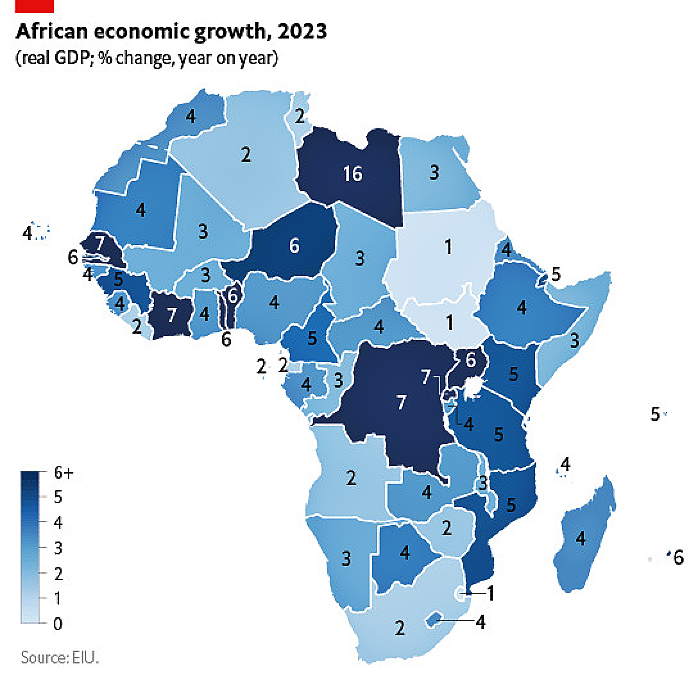
The map above depicts the expected growth rates of African states in 2023. Some estimates have adjusted these a bit upward due to some positive signs despite global difficulties.
While none of the four largest economies on the continent is expected to grow beyond 4 percent, many others have above above-average outlook. Libya is leading the continent with 16 percent year-on-year growth. In West Africa, Cote d’Ivoire and Senegal are leading with 7 percent each.
Niger, Togo, Benin and The Gambia are also expected to expand their economies by 6 percent each. The Democratic Republic of Congo (DR Congo) and Rwanda are also at the top of the East African Community with 7 percent each, with Uganda, Kenya and Tanzania taking 6, 5 and 5 respectively.
Notably, growth forecasts for this year (on average) have been lower. In the past couple of decades, the continent has seen impressive growth rates.
For a continent of developing countries, how these growth rates affect the livelihoods and development of the people has ramifications for the security of each state.
Some states have made some gains in transforming the lives of their populations by significantly investing in education and health. They have used mostly proceeds from natural resource exploitation and tax revenues from expanded economies for these investments.
Growth is good, but when is not shared, it can be violently destabilizing and a source of protracted insecurity.
For some others, economic growth may only be seen in the upward movement of the skyline of major cities, usually the commercial or administrative capitals. Growth in these countries seems to benefit the political elites and their business cronies.
Rural communities and the urban poor seldom benefit from the impressive growth their countries have achieved over the years. Infrastructure and social services are either non-existent, inadequate or not affordable.
This has immensely contributed to the rise in insecurity across the continent in recent times. Admittedly, the continent has had its politically induced wars since independence. However, many of these frictions had gone down, especially after the fall of the Berlin Wall.
In recent times, many of these tensions have resurfaced and new ones coming up. These have partly resulted from growth that is not shared by the center.
Even with the current wave of jihadi extremism, extremists are exploiting economic deprivation and neglect (of the periphery) for their propaganda and recruitment of the youths. They are succeeding.
Growth is good, but when is not shared, it can be violently destabilizing and a source of protracted insecurity.
Fidel Amakye Owusu is an International Relations and Security Analyst. He is an Associate at the Conflict Research Consortium for Africa and has previously hosted an International Affairs program with the Ghana Broadcasting Corporation (GBC). He is passionate about Diplomacy and realizing Africa’s global potential and how the continent should be viewed as part of the global collective.
