
Opinion
Owusu on Africa: Burkina Faso and Niger exit the G5 Sahel merely symbolic

By Fidel Amakye Owusu
When violent extremists swept across northern Mali in 2011 and 2012, the governments in Bamako and Niamey were particularly concerned.
Something needed to be done, but who undertook it was another question. France resolved – as a matter of urgency – to stop the ferocious extremists in their tracks before things could get worse.
Operation Serval was launched by French forces to hit extremists and disperse them in their strongholds, especially in the Timbuktu area. They also cut vital weapon supply corridors in the Sahara.
Later in August 2014, Operation Barkhane was initiated by French forces as a long-term measure against extremists and their radicalization of the local populations. In December, of that same year, the G5 Sahel was established.
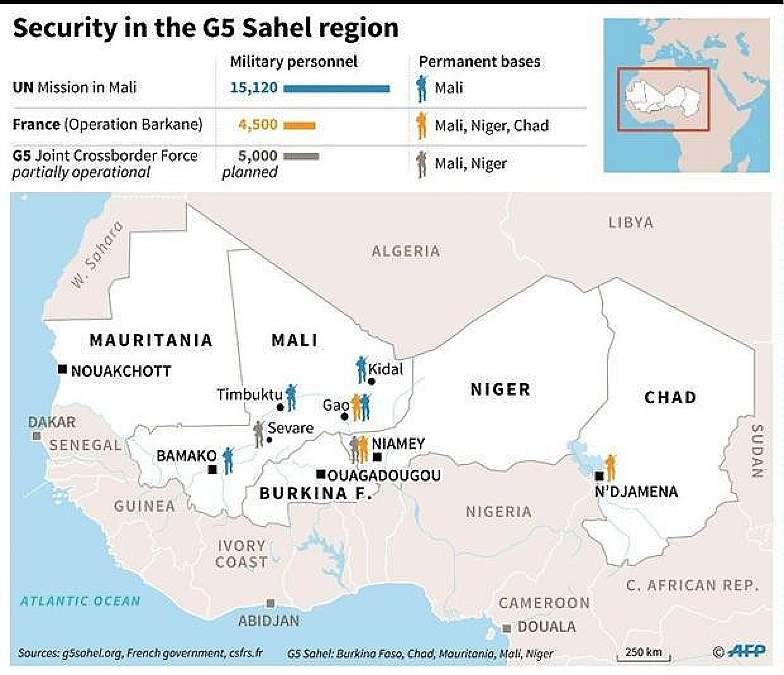
The G5 Sahel was created to have better coordination among the forces of Sahel states fighting terrorism. Most essentially, France backed the alliance. A European Union partnership was also established to give financial support to handle the “soft” side of the fight.
Last weekend, it was announced that Niger and Burkina Faso are formally exiting the G5 Sahel. The two landlocked states would want to leave the alliance which had Mauritania, Mali, Burkina Faso, Niger and Chad as members. While this has made the news, it is in fact, “nothing new”.
How is that?
When the G5 Sahel was established in 2014, all member states were governed by civilian administrations with some constitutional rule. Democratic values, therefore, became part of the guiding principles of the pact.
The second coup in Mali in 2021 therefore, created a challenge for the alliance. In principle, Mali needed to be sanctioned. In response, the junta pulled out of the alliance in mid-2022. Geographically, Mali’s exit disrupted the alliance by cutting Mauritania off the rest of the states. Later, it asked French forces to leave the country.
Interestingly, after the 2022 and 2023 coups in Burkina Faso and Niger, the juntas of the respective countries asked French forces to exit their countries. In effect, the G5 Sahel alliance has been more dormant with each military take-over.
The last time I checked, I was really surprised Burkina Faso and Niger were still pretending to be members of an alliance they have effectively collapsed.
Even though all the coup makers mentioned insecurity as a major reason for taking power, the security situation in each of these countries is worse than they came to meet. In recent days, the Mali junta has been quite loud about taking Kidal from the Coordination of Azawad Movements (CMA) – an umbrella name for “moderate” Tuareg rebels who are not extremists.
This exit is merely symbolic and nothing else.
Fidel Amakye Owusu is an International Relations and Security Analyst. He is an Associate at the Conflict Research Consortium for Africa and has previously hosted an International Affairs program with the Ghana Broadcasting Corporation (GBC). He is passionate about Diplomacy and realizing Africa’s global potential and how the continent should be viewed as part of the global collective.
