
Opinion
From Extraction to Empowerment: Rethinking Africa’s Copper Future

By Dishant Shah
Copper is often called the “metal of electrification” – and for good reason. It powers our cities, pulses through our smartphones, and quietly underpins nearly every modern infrastructure system we rely on.
From electric vehicles to renewable energy grids, copper is the indispensable conductor of the 21st-century economy.
But beyond its physical properties, copper also reveals a deeper story – one about power, value, and who ultimately benefits from the world’s most essential mineral.
Nowhere is this more evident than in Africa.
Copper is not just a commodity on the continent. It is a legacy – etched into the soil, shaped by colonial extraction, and central to national identities.
It is also a symbol of both potential and paradox: Africa produces vast quantities of the world’s copper, yet captures only a fraction of its value.
While over 50 African countries engage in copper-related trade, the reality is stark – nearly 98 percent of Africa’s copper exports come from just ten nations, with the Democratic Republic of the Congo (DR Congo) and Zambia dominating the field. This concentration isn’t accidental.
It is the result of historical infrastructure, geopolitical decisions, and enduring economic models built for extraction, not transformation.
The Roots of the Copper Belt
The story begins in the 1920s, when European mining companies turned their gaze to Central Africa’s so-called Copper Belt – a mineral-rich arc stretching across what is now Zambia and the DR Congo. Railroads were laid, mining towns sprang up, and entire economies were restructured around one goal: extract copper, export it, and repeat.
After independence, the political flags changed – but the economic model did not. Today, while colonial powers have long since withdrawn, multinational corporations – many from China, Europe, and North America – dominate ownership and trade flows.
The DR Congo now ranks as the second-largest copper producer in the world, trailing only Chile.
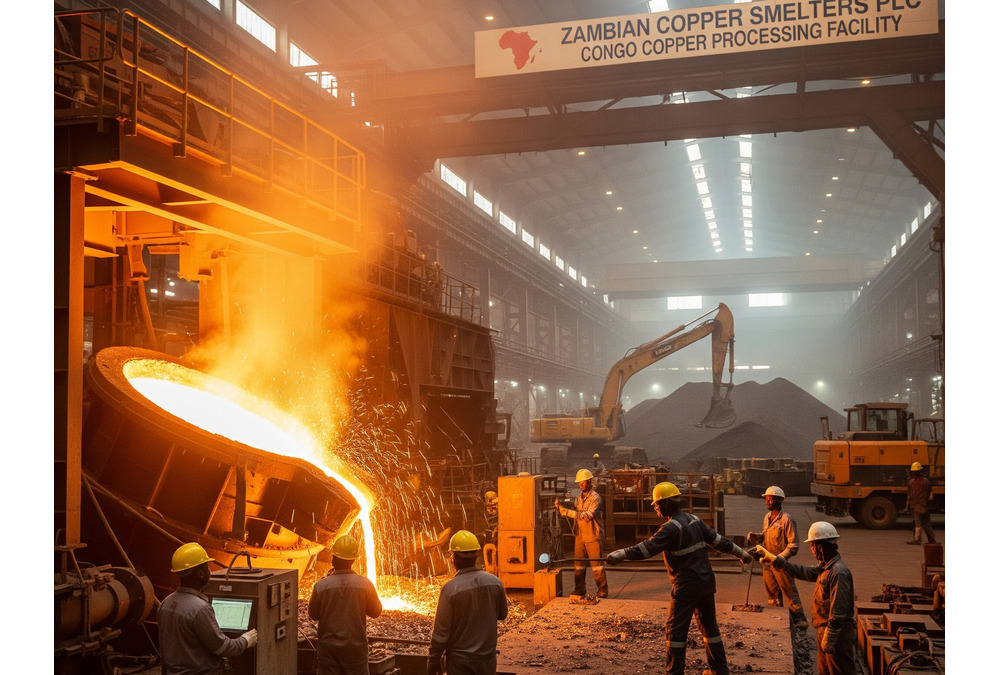
Yet here lies the critical divergence: Chile doesn’t just mine copper – it processes it. The country has invested heavily in downstream industries – smelting, refining, manufacturing – turning raw ore into high-value products like wire, tubing, and advanced components.
These value-added industries generate jobs, spur innovation, and keep more wealth within national borders.
Africa, by contrast, still exports over 90 percent of its copper in raw or semi-processed form.
The Missed Opportunity: Value That Leaves the Continent
Consider the case of a Zambian entrepreneur a few years ago who sought to build a small copper rod plant near Kitwe. His vision was straightforward: instead of shipping raw copper cathodes abroad, why not convert them into copper wire for use across Africa’s growing power and construction sectors?
He secured modest financing and technical support. But within two years, the plant shuttered.
Why?
Because imported copper wire from China – often subsidized and produced at scale – was cheaper. Local utilities, accustomed to global supply chains, preferred established foreign suppliers.
The system, quite simply, wasn’t designed to support local manufacturing. It was built for extraction.
This isn’t just a story about one failed factory. It’s a microcosm of a continent-wide challenge.
Trade statistics may highlight export volumes, but they obscure the deeper structural barriers: unreliable energy, fragmented regional markets, inconsistent customs policies, and underdeveloped logistics corridors. Without coordinated investment in these foundational systems, African nations will continue to supply the world with raw materials – while watching the profits from finished goods flow elsewhere.
Toward a New Model: Copper as a Beginning, Not an End
The question is no longer just how much copper Africa produces. It’s how much value Africa retains.
To shift from being a mere source to becoming a center of copper innovation and manufacturing, a new kind of investment is needed – one that looks beyond mines and shipping manifests.
What would it take?
- Regional industrial policy coordination to harmonize standards and reduce cross-border trade friction.
- Energy infrastructure investment to provide reliable, affordable power for processing plants.
- Local content mandates that incentivize domestic beneficiation and procurement.
- Skills development and technical partnerships to build a workforce capable of operating advanced metallurgical facilities.
- Strategic partnerships with global buyers committed to ethical, regional sourcing — not just the cheapest option.
Countries like the DR Congo and Zambia are already exploring export restrictions on raw copper to force domestic processing. Rwanda and Ethiopia are investing in special economic zones aimed at attracting metal fabrication.
These are promising steps – but they require regional cooperation and long-term vision to scale.
The Global Energy Transition Is a Chance – Not a Guarantee
As the world races toward electrification and decarbonization, demand for copper is projected to double by 2050, according to the International Energy Agency. Africa sits atop a golden opportunity – not just to supply the metal of the green economy, but to build parts of that economy itself.
But opportunity does not guarantee equity. Without intentional policy and inclusive investment, Africa risks being left behind – rich in resources, yet poor in returns.
Copper should not be Africa’s fate – it should be its foundation.
The metal of electrification can also be the catalyst for industrial transformation. But only if we stop seeing African copper as a raw export, and start seeing it for what it could be: a starting point for innovation, jobs, and sustainable growth on African terms.
The world is being rewired. Africa has the power – and the metal – to help lead that change. The only question is whether it will do so on its own behalf.
Dishant Shah is a partner at Legion Exim, a company specializing in facilitating the export of high-quality engineering products directly sourced from manufacturers in India to Africa. His areas of expertise include new business development and business management.
