
A Diaspora View of Africa
France Trying to Reengage Africa

By Gregory Simpkins
After decolonization in the 1960s, France kept deep economic, military and political ties called “Françafrique”. This included: the CFA franc currency used in Francophone Africa tied to the French treasury, military bases and defense pacts allowing French intervention and support for autocratic regimes in exchange for stability and access.
President Emmanuel Macron came to power in 2017 vowing to end Françafrique and broaden ties beyond former colonies. He diversified partners, integrated civil society and addressed colonial history. But past dependencies remained, especially the military engagement in the Sahel.
France’s Sahel rupture in 2021-2023 centered on Mali, Burkina Faso and Niger – all former G5 Sahel members hosting French troops to fight jihadists. Operation Barkhane in Mali, Burkina Faso and Niger not only didn’t eliminate extremist elements as promised, but there were serious deficiencies in operation execution that endangered civilians.
Airwars, a not-for-profit transparency watchdog, and various non-governmental organizations documented civilian deaths from French airstrikes. The January 3 2021 Bounti wedding strike in Mali killed about 20 civilians according to the United Nations Multidimensional Integrated Stabilization Mission in Mali (MINUSMA) investigation.
France initially claimed it hit jihadists. French special forces and Malian units trained by France faced accusations of torture and extrajudicial killings.
Mali’s 2022 withdrawal request cited lack of accountability.
Counterterror operations contributed to mass displacement. Critics argue France prioritized security over human rights protections, similar to the double standards charge that came up when France supported Chad’s 2021 military transition but sanctioned Mali’s coup.
This made Western liberalism look “cheap and hypocritical to many observers.
Despite 10 years of Operation Barkhane, jihadist attacks worsened. Civilians felt French forces couldn’t protect them, and villages were still massacred.
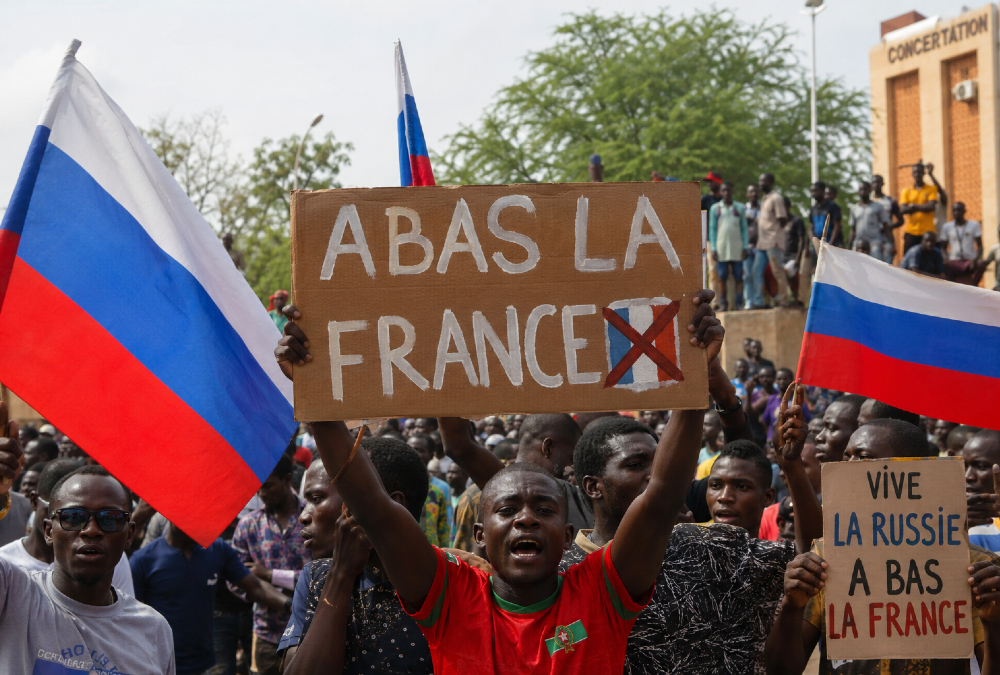
Coups in Mali (May 2021), Burkina Faso (January 2022 and September 2022) and Niger (July 2023) were created by popular anti-colonial sentiment, and protests featured Russian flags and slogans calling for French ouster. French troops were replaced by Russian forces, who were no more successful in eliminating the jihadist threat or protecting civilians.
There is a persistent neo-colonial perception of France due to the CFA franc, uranium concessions and the apparent backing of dictators that has fueled resentment.
Beyond the Battlefield: Economic Grievances and the Fall of Françafrique
France kept control over the CFA franc and mining. In Niger, French company Orano held uranium rights powering French nuclear plants while Niger remained one of the world’s poorest countries.
After the coup in Niger, Orano’s license was revoked.
In the aftermath of the coups in the three countries, the juntas canceled defense agreements and ordered French troops to leave. French development aid and visas were suspended.
There are no French ambassadors in Mali, Burkina Faso and Niger today. The UN MINUSMA peacekeeping mission in Mali ended. The three juntas left ECOWAS and formed the Alliance of Sahelian States. Russia became their main security partner via Wagner/Africa Corps.
The trend went beyond the Sahel:
- Central African Republic (CAR): France suspended military collaboration.
- Senegal: France handed over its last major military facility in July 2024 after President Bassirou Diomaye Diakhar Faye said French bases were incompatible with sovereignty.
- Chad: The government reduced the French military presence.
- Gabon: There was an August 2023 coup. A former U.S. Sahel envoy said: “In the old days of ‘Françafrique,’ this coup would not have happened, and if it did, it would have been quickly reversed.”
- Ivory Coast: The government asked French troops to leave.
By July 2025, France concluded its military presence in Mali, Burkina Faso, Niger, CAR, Chad, Senegal and Ivory Coast. It retains bases only in Gabon and Djibouti.
There is a persistent neo-colonial perception of France due to the CFA franc, uranium concessions and the apparent backing of dictators that has fueled resentment. New leaders have demanded meaningful control.
Meanwhile, there are Russian/Chinese alternatives. Russia has offered arms and mercenaries without democracy lectures. Also, youth leaders and civil society has rejected the old model. Macron tried to engage them, but the military-first image stuck.
France’s African Pivot
Stung by Sahel and other West African rejections, France is courting non-Francophone Africa. In 2025, France hosted the Africa-France Summit in Kenya – the first in an English-speaking country in 2025.
There is a new defense deal and 800 French troops in Mombasa for exercises. Rwanda, Ethiopia and Botswana have signed new health or security MOUs.
Macron has announced a new security partnership with no security guarantees, just training. France is said to be moving away from some of its former colonial partners towards countries where it has a different footprint.
However, Kenyan President William Ruto’s hosting of Macron at the Africa Forward summit in Nairobi has triggered scrutiny over Kenya’s growing ties with France, particularly a defense cooperation agreement critics say could undermine sovereignty through legal protections for French personnel. In an article in The Standard after the conference, Macron was described as using the summit to present France’s Africa strategy as investment-led and based on equal partnership after setbacks in West Africa and the Sahel, while Kenyan critics, analysts and opposition figures questioned whether Nairobi was embracing arrangements similar to those rejected by countries such as Mali, Burkina Faso and Niger amid anti-French sentiment.
Furthermore, a post-summit report by Reuters, assessing Macron’s US$27 billion promise of new investments, stated that his pledges to support Africa’s debt strapped economies and push to reform the international financial system by offering a first-loss guarantee mechanism fell short of what is needed, such as debt relief and payment pauses, analysts said.
“There are a vast range of new commitments France could have made that would have helped to shift the international financial architecture,” said Hannah Ryder of the Africa-focused consultancy Development Reimagined. “Those France picked, even if they were credible…will simply preserve the architecture as it stands.”
A first loss guarantee is a mechanism in which one party absorbs initial losses on an investment, aimed at making projects more attractive to private investors.
Still, French and African leaders have announced more than US$11 billion in renewable energy investments across Africa, underscoring the continent’s growing importance in the global push for cleaner energy and industrial development.
The commitments were unveiled during a closed-door CEO forum held alongside the France-Africa Summit in Nairobi, attended by Macron, Ruto and leaders from more than 30 African countries.
Executives from major companies including TotalEnergies, EDF, Kenya Airways and Rubis Energy announced projects spanning sustainable aviation fuel, hydropower, solar energy, wind generation and clean cooking initiatives. “Africa has a historic opportunity to not only participate in the global energy transition but to help lead it,” Ruto told delegates at the summit. “For Africa, this energy transition must also be an industrial transition.”
French relations in Africa didn’t sour overnight. Decades of Françafrique resentment and failed Sahel intervention, as well as new juntas leveraging anti-colonial sentiment caused the 2021-2023 rupture. France went from 5,100 troops across the Sahel to almost none in two years.
The situation is now seen as a historic turning point where the real question is whether Paris can shape the change or just watch. Yet Macron and his government must overcome a more than troubled history to repair and build relations with African nations, as I will examine in Part 2.
Gregory Simpkins, a longtime specialist in African policy development, is the Principal of 21st Century Solutions. He consults with organizations on African policy issues generally, especially in relating to the U.S. Government. He further acts as a consultant to the African Merchants Association, where he advises the Association in its efforts to stimulate an increase in trade between several hundred African Diaspora small and medium enterprises and their African partners.
