
Opinion
Europe Shrinks as Africa Surges: The New Demographic Power Shift
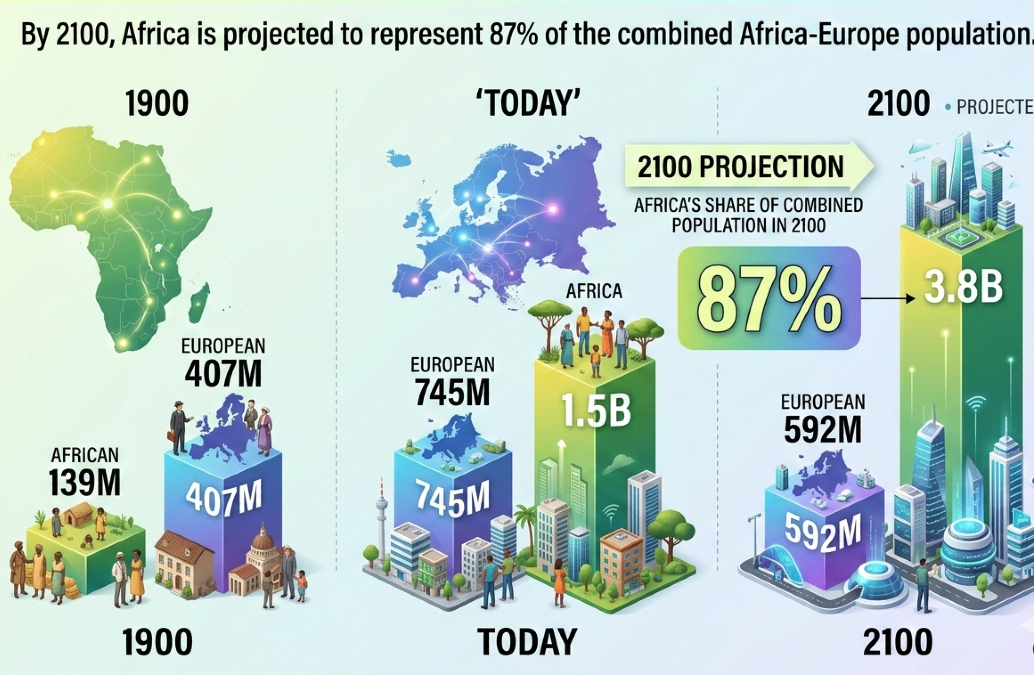
By 2100, Africa could account for nearly nine in ten people shared between the two continents. The implications reach far beyond population statistics – they extend to governance, capital, labor, and global power.

By Gregory September
In 1900, Europe’s demographic dominance was seemingly unassailable. With approximately 407 million people, it outnumbered Africa’s population of 139 million by nearly three to one.
The political and economic order of the time was constructed around this arithmetic – colonial hierarchies, trade flows, and institutional power all reflected a world in which Europe set the terms.
That arithmetic no longer holds. Today, Africa’s population stands at approximately 1.5 billion, while Europe’s has grown only modestly to around 745 million.
The reversal is already substantial. By 2100, United Nations projections suggest it will be dramatic: Africa could reach 3.8 billion, while Europe may contract to roughly 592 million.
Consider what this means in terms of combined share. In 1900, Africa represented 25 percent of the combined Europe-Africa population. Today that figure stands at approximately 67 percent. By 2100, it could reach 87 percent.
Europe, which accounted for three-quarters of the pair in 1900, may represent barely one in eight people by century’s end. These are not projections to be filed away as distant abstraction. The structural forces driving them are already in motion.
This Is Not Just Demographics
It would be a mistake to treat population change as a background variable – the inert stuff of census bureaus and actuarial tables. When populations shift at this scale and speed, they reshape everything downstream. Consider the domains already in motion:
- Labor supply. Africa’s working-age population is expanding rapidly, while Europe’s is aging and contracting. This creates a structural asymmetry in economic potential that no monetary policy can offset.
- Urban growth pressure. African cities are absorbing millions of new residents each year. Demand for housing, sanitation, transportation, and energy is surging at a pace that existing infrastructure was never designed to accommodate.
- Education system demand. A young, growing population requires schools, teachers, curricula, and credentialing at scale. The investment gap between what is needed and what is currently committed is enormous.
- Fiscal strain in aging states. Europe faces the mirror-image problem: shrinking tax bases supporting expanding pension and healthcare obligations. The mathematics of European welfare states increasingly depend on managed immigration and productivity gains that remain elusive.
- Infrastructure financing gaps. Africa’s infrastructure needs are vast and underfunded. Traditional multilateral financing models, built for a different era, are straining to respond. New instruments – and new lenders – are filling the void, not always on favorable terms.
- Representation in global institutions. The United Nations, the International Monetary Fund, the World Bank, and the G20 were designed to reflect a world that no longer exists demographically. Institutional weight still tilts toward the North Atlantic. That imbalance is increasingly difficult to justify.
Structural, Not Situational
The temptation in policy circles is to treat demographic trends as one variable among many – something to be managed, offset, or deferred. This is an error.
What the data describe is structural transformation: a fundamental reordering of the human geography that underpins economic activity, political legitimacy, and strategic competition.
Europe’s relative decline is not a sign of failure, nor is Africa’s surge a guarantee of success. Both require serious institutional responses.
Europe must confront the fiscal and social implications of demographic contraction without retreating into nativist delusion. Africa must build governance capacity, educational infrastructure, and productive employment at a pace that has rarely been achieved anywhere in modern history.
The question is whether the institutions designed to support global development are equal to this challenge. On current evidence, the answer is uncertain.
The Sustainable Development Goals Most at Stake
Several of the United Nations’ Sustainable Development Goals are directly stress-tested by this demographic reality:
- SDG 4 – Quality Education: Expanding youth populations in Africa require massive, sustained investment in schools, teachers, and technical skills. Without it, demographic growth becomes demographic liability.
- SDG 8 – Decent Work and Economic Growth: Youth employment must scale in parallel with labor supply. Economies that cannot absorb their young populations generate exactly the social instability that undermines everything else.
- SDG 11 – Sustainable Cities and Communities: Urbanization across African cities will accelerate regardless of policy choices. The question is whether it occurs with planning and investment, or without.
- SDG 13 – Climate Action: Population growth in some of the world’s most climate-vulnerable regions is not an abstraction. It is a compounding risk factor that demands integrated responses, not siloed ones.
- SDG 16 – Peace, Justice, and Strong Institutions: Governance capacity must scale with demographic pressure. States that cannot deliver basic services to rapidly growing populations face mounting legitimacy crises.
The Preparedness Deficit
The demographic shift underway is not a competition between continents. It is a test of preparedness – of whether the institutions, financing mechanisms, and governance frameworks built in the twentieth century can adapt to a twenty-first century in which Africa is home to the majority of the world’s young people.
The International Monetary Fund, the World Bank, regional development banks, and bilateral donors have each, to varying degrees, acknowledged this reality in their strategic documents. Whether their operational priorities, lending volumes, and institutional structures reflect genuine adaptation is a different question – and a harder one to answer affirmatively.
Capital flows, technical assistance, and debt architecture designed for a world of European demographic centrality are an inadequate response to the world now taking shape. Adjusting fast enough is not merely a development imperative.
It is a matter of global stability.
Are global financial institutions adjusting fast enough to this demographic reality? The evidence suggests the window for a managed, orderly response is narrowing.
Gregory September is a South African academic, author, and geopolitical analyst with extensive experience in government and Parliament. He is the founder and CEO of SAUP (Sustainability Awareness and Upliftment Projects NPC), which focuses on sustainability education and community development. He previously served as Head of Research and Development for the Parliament of South Africa. His work centers on sustainability, African geopolitics, and economic development, and he regularly contributes to analysis of global political and economic affairs.
