
Opinion
Ethiopia: Cradle of Civilization and the Birthplace of Coffee

By Des H. Rikhotso
Nestled in the Horn of Africa, Ethiopia isn’t just a country – it’s a living chronicle of human history, a mosaic of cultures, and a dynamic engine of economic potential. From the misty highlands where coffee was first brewed to the rock-hewn churches of Lalibela that seem carved by divine hands, Ethiopia offers a compelling blend of ancient legacy and modern ambition.
By the Numbers
Size:
At roughly 1.1 million square kilometers (425,000 square miles), Ethiopia is larger than France and Spain combined. Its dramatic topography – dominated by rugged highlands, fertile plateaus, and the Great Rift Valley – has shaped not only its climate and agriculture but also its historical resilience.
Population:
With an estimated 126 million people in 2025, Ethiopia is Africa’s second-most populous nation, trailing only Nigeria. Its youthful, fast-growing population represents both a challenge and a vast reservoir of human capital.
Geopolitical Position:
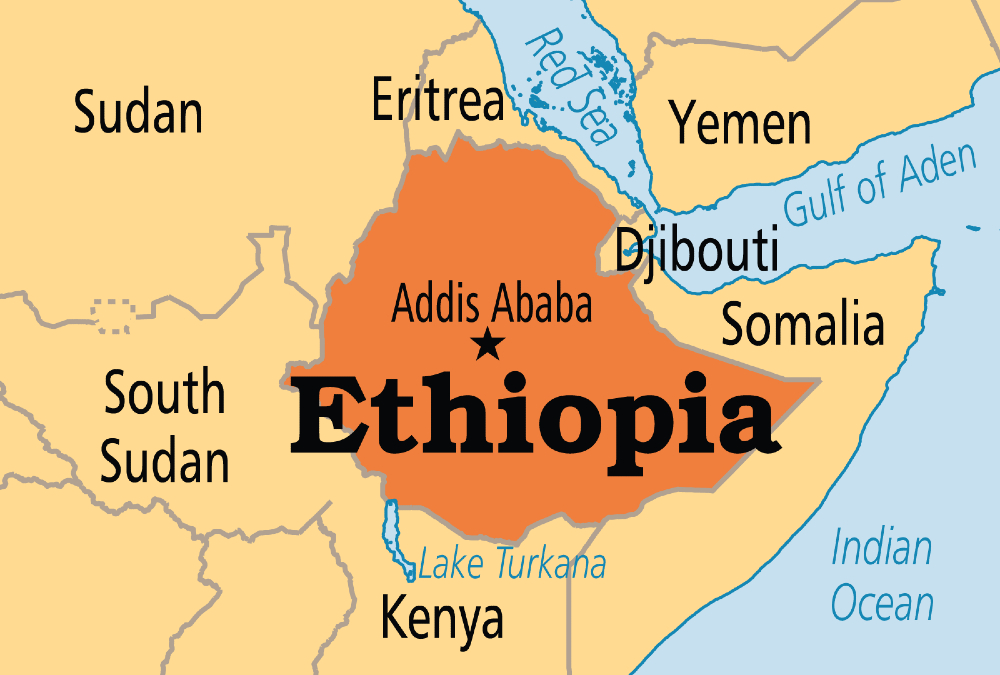
Ethiopia shares borders with six nations – Eritrea, Djibouti, Somalia, Kenya, South Sudan, and Sudan. Though landlocked since Eritrea’s independence in 1993, Ethiopia maintains critical access to the Red Sea through ports in Djibouti, sustaining its role as a regional trade hub.
An Economy on the Rise
Ethiopia’s economy rests on multiple pillars:
- Agriculture: The backbone of livelihoods for over 70 percent of Ethiopians. The country is Africa’s largest coffee producer – and the world’s original coffeehouse. Other staples include teff (the gluten-free grain used to make injera), pulses, and livestock.
- Mining: Rich deposits of gold, tantalum, and potash are increasingly attracting foreign investment.
- Energy: Massive hydropower projects, including the Grand Ethiopian Renaissance Dam (GERD), underscore Ethiopia’s ambition to become a clean-energy exporter.
- Currency: The Ethiopian birr (ETB) remains tightly managed, though recent reforms aim to liberalize foreign exchange and attract private capital.
Despite inflationary pressures and structural hurdles, Ethiopia has consistently ranked among Africa’s fastest-growing economies over the past decade – a testament to its strategic reforms and demographic dividend.
Faith, Language, and Culture
Ethiopia is a tapestry of faiths and tongues. Roughly two-thirds of the population identifies as Christian – primarily Ethiopian Orthodox – with a sizable Muslim minority and growing Protestant communities.
This religious coexistence has deep historical roots and remains a hallmark of national identity.
Amharic is the official language, but Ethiopia is home to more than 80 ethnic groups and languages, reflecting its extraordinary cultural diversity. Addis Ababa, the capital and diplomatic capital of Africa, hosts the headquarters of the African Union – a symbolic nod to Ethiopia’s pan-African leadership.
Why Ethiopia Matters
- Unbroken Sovereignty: Ethiopia is one of only two African nations never formally colonized (the other being Liberia). Though it endured a five-year Italian occupation from 1936 to 1941, it never lost its institutional sovereignty or national identity.
- Archaeological Treasure: From the ancient obelisks of Axum to the subterranean churches of Lalibela, Ethiopia preserves some of humanity’s oldest architectural and spiritual achievements.
- Culinary Richness: Dishes like doro wat (spicy chicken stew), kitfo (Ethiopian beef tartare), and, of course, the ritualistic coffee ceremony offer a sensory journey as rich as its history.
- Time Zone Quirk: Ethiopians traditionally tell time on a 12-hour clock offset from the Western standard – effectively making their “6 a.m.” correspond to midnight UTC. Officially, however, the country operates on UTC+3.
The Big Picture
Ethiopia stands at a crossroads. Its blend of historical pride, strategic location, and economic momentum positions it as a potential anchor of stability and growth in a volatile region.
As the African Continental Free Trade Area (AfCFTA) gains traction and global investors seek new frontiers, Ethiopia’s ability to deepen reforms, ensure inclusive growth, and harness its youthful energy will determine whether it rises as a true continental leader.
So, which captivates you more: sipping coffee where it was first discovered or standing in awe beneath the hewn stone roofs of Lalibela? One thing is certain – Ethiopia’s story is far from over. It’s being written anew, every day.
Des H Rikhotso (PgDip-BA, MBL) is a seasoned C-suite Multi-Industry business executive with 25+ years of Business Leadership Experience across the South, East and Western Sub-Sahara Africa Region. Based in Kampala, Uganda he serves as East Africa Region Business Executive, driving Business Strategic Growth and Operational Excellence – contributing his Leadership Voice and Clarity to the Region. Des has held Business Leadership roles at BMW Group Africa, Volkswagen Group Africa, Peugeot Motors South Africa, Toyota/Lexus South Africa, Nissan Group of Africa, G.U.D Holdings (Africa Exports Operations Division) and The HDR Group of Companies. He holds Under-Graduate and Post-Graduate business degrees from the University of the Western Cape, Wits University (Wits Business School) and the University of South Africa.
