
A Diaspora View of Africa
Ebola Is Back and As Dangerous As Ever

By Gregory Simpkins
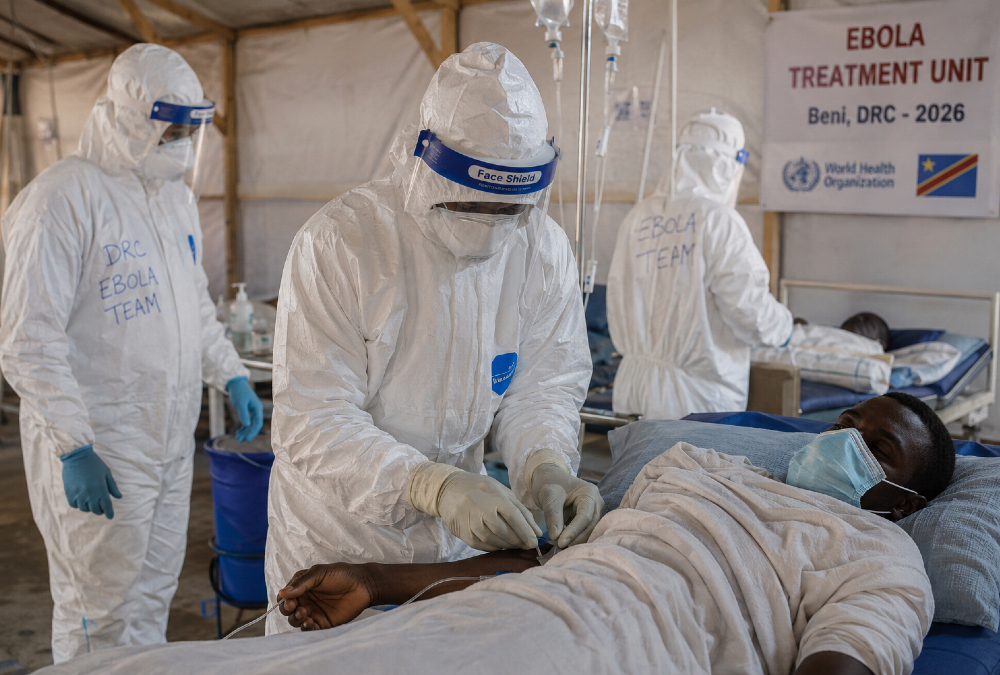
Health workers in the Democratic Republic of Congo (DR Congo) reportedly are scrambling to contain an outbreak of the Ebola virus, which is suspected to have killed more than 200 people as of this writing and risks spreading across international borders.
According to World Health Organization figures recently released, health workers have registered more than 900 suspected cases of Ebola and 220 suspected deaths. But the real figures are likely much higher, as the outbreak went undetected for some time.
The Congolese government first declared an outbreak on May 15. Since then, confirmed and suspected cases have popped up across an area of Congo larger than the state of Florida.
In the face of this renewed threat from a deadly disease that is difficult to detect and treat in the best of circumstances, this current outbreak is made worse by the conflict in the outbreak area, ongoing citizen disconnection from government and ingrained cultural traditions surrounding burial that brings those who are uninfected into direct contact with those infected with this highly communicable disease.
The WHO has declared the outbreak of the rare Bundibugyo strain of Ebola, the third-largest such outbreak on record, a public health emergency of international concern. This disease has a fatality rate of about 90 percent, largely because the vast majority of people who contract it do so in rural areas of Africa lacking adequate medical surveillance or timely and effective treatment.
In the face of this existential threat – not only to the East Africa region, but actually globally – who will lead the protection of the world from this health menace?
The Retreat of American Global Health Leadership
The US Agency for International Development (USAID) had been the single largest bilateral funder of health programs in Africa for decades, but 2025 marked a major shift as the Trump administration dismantled USAID under the “America First Global Health Strategy” model. US global health funding peaked at US$12.9 billion in Fiscal Year 2023 but declined each year since.
In FY2026 it was US$11.3B, lowest since FY2020.
Replacing USAID grants, the State Department is signing five-year “co-investment” deals directly with African governments. As of December 2025, the plan was for 50 bilateral agreements.
The US government has been the largest donor to global health in the world for quite some time. USAID underpinned national HIV responses, immunization programs and maternal/reproductive health across Africa.
Nigeria alone lost more than US$600 million in health funding when USAID cuts hit, which represented about 1/5 of its entire annual health budget. USAID funded 40 percent of Nigeria’s immunization program.
Botswana, a middle-income country, depended on US sources for 1/3 of its HIV response before funds were withdrawn. In 2024, the US provided US$440 million to health/population programs in Kenya, with US$310 million for HIV/AIDS.
From 2014-2024, the U.S. was the backbone of Ebola response – funding surveillance, running labs and deploying US Centers for Disease Control and Prevention (CDC) teams. When funding shifted from USAID/non-governmental organizations to State Department bilateral deals with African governments, the transition created surveillance gaps that likely delayed detection in the 2025 DR Congo outbreak, but emergency funds are still flowing for treatment clinics and case management.
Historically, much of the health assistance went through NGOs and contractors. USAID and the Development Finance Corporation also used blended-finance like the US$10 million Transform Health Fund for African health supply chains.
Recipient countries now must put in their own money. Across four Memoranda of Understanding signed, the US committed US$1.4 billion and countries co-invested more than US$900 million.
MOUs include “clear benchmarks, strict timelines, and consequences for nonperformance” to reduce long-term dependence. President Obama proposed transferring responsibility for PEPFAR programming during his first term, but it was widely felt that African partners would not be ready to take on significant responsibility for health programming at that point.
Funding moves from what some call the “NGO industrial complex” to direct government-to-government. Secretary Rubio said: “We’re not doing this anymore,” that is: NGOs taking disproportionate share.
Countries are expected to gradually take over costs. For example, in Sierra Leone, the US front-loads US$30 million in 2026, but by 2030, Sierra Leone is expected to assume most commodity/workforce/lab costs.
A Weakened Surveillance Chain and the Push for African Self-Reliance
Africa CDC lost 37 percent of funds due to US and other Western cuts. The decision to reduce developed country aid has contributed to the weakening of the surveillance chain.
In DR Congo, USAID cuts in March 2025 meant the International Red Cross lost outbreak preparedness funding. One health worker said there was “failure in the epidemiological surveillance chain” because training/equipment funding ended.
WHO’s Africa base budget was cut 14 percent for 2026-2027, from US$1.326 billion to US$1.139 billion, partly due to US withdrawal.
The Africa Centres for Disease Control and Prevention (Africa CDC) launched a 2025-2030 plan for health financing self-reliance. Phase 1 updates financing plans in 30 countries. The goal is for 20 countries to finance more than 50 percent of health budgets domestically by 2030.
Troubling Situation on the Frontlines
Reuters reported on May 25 that doctors operating on the front lines of the fight against Ebola in the DR Congo, already grappling with shortages of basic supplies, are now also having to deal with attacks on their facilities and fleeing patients as the virus spreads rapidly.
At least three such incidents have occurred in the northeastern province of Ituri where the first Ebola cases were reported, including two on one weekend targeting the same hospital that saw more than two dozen patients run away. The attacks recall the widespread violence targeting health facilities during a 2018-2020 outbreak in eastern Democratic Republic of Congo that killed more than 25 health workers.
Some were perpetrated by civilians who were angry about not being able to bury their loved ones or were convinced that the outbreak was a hoax. The influx of money and manpower into an area that had felt neglected during decades of conflict and humanitarian crisis has spurred local suspicions about the real motives for the sudden spike of interest.
A similar dynamic seems to be playing out now, said Dr Richard Lokodu, medical director of the Mongbwalu General Referral Hospital, which came under attack first on a Saturday and again on a Sunday.
“There is denial of the disease within the population, with some members wanting to claim the bodies of suspected and/or confirmed cases,” he said.
US Draws Into the Crisis After Paris-to-Detroit Flight Diversion
A May incident involving a DR Congo passenger who was suspected to have Ebola apparently has sparked more concerted action on the disease by the Trump administration. An Air France flight from Paris to Detroit was abruptly diverted to Montreal, Canada, on May 20 after US authorities discovered a passenger from the DR Congo had boarded “in error” despite strict Ebola-related entry restrictions.
Now the Trump administration wants Kenya to host a quarantine and treatment facility for American citizens exposed to Ebola, a move that would place the country at the center of Washington’s latest containment strategy. During past health emergencies, African nations often became critical operational bases for global powers responding to disease outbreaks, especially when cases threatened to spread internationally.
For Kenya, the proposal reflects how increasingly central African countries have become to managing global health and security risks.
According to reports from the New York Times and Wall Street Journal, the proposal which at the moment, still awaits approval from the Kenyan government, would allow high-risk American citizens, including those exposed to or infected with Ebola, to be isolated and treated within Kenya instead of being transferred to Europe.
The plan marks a significant shift in Washington’s response to the worsening Ebola outbreak spreading across parts of East and Central Africa. According to Reuters, some members of the US Public Health Service Commissioned Corps, a uniformed branch under the Department of Health and Human Services, have received notices to deploy.
Earlier arrangements reportedly focused on placing exposed individuals under temporary observation in Kenya before relocating confirmed cases abroad for treatment. However, the administration now intends to provide full treatment capabilities within the proposed Kenyan facility.
US public health officers are expected to operate the center, with members of the US Public Health Service Commissioned Corps already placed on standby for possible deployment.
International Community Races to Match the Outbreak’s Pace
Governments and international partners have announced approximately US$498.8 million in commitments during a high-level ministerial meeting to strengthen response operations in affected and high-risk countries, according to Jean Kaseya, Director General of the Africa CDC.
“At the moment, the epidemic is outpacing us,” said the WHO’s Tedros Adhanom Ghebreyesus, warning that the outbreak is spreading in an increasingly complex environment.
Will stepped-up US involvement, perhaps with added assistance from other developed countries, contain this epidemic before it gets out of control? We can only hope so, but we shall see soon enough.
Gregory Simpkins, a longtime specialist in African policy development, is the Principal of 21st Century Solutions. He consults with organizations on African policy issues generally, especially in relating to the U.S. Government. He further acts as a consultant to the African Merchants Association, where he advises the Association in its efforts to stimulate an increase in trade between several hundred African Diaspora small and medium enterprises and their African partners.
