
Opinion
East Africa Emerges as Africa’s Fastest-Growing Region Amid Global Uncertainty


By Des H Rikhotso
East Africa is solidifying its position as one of the most dynamic and resilient economic regions on the African continent, outpacing peers with robust growth, structural transformation, and an impressive ability to weather global shocks.
Recent data highlights East Africa as a standout performer in Africa’s evolving economic landscape. According to the latest growth projections, the region is home to some of the continent’s – and the world’s – fastest-growing economies:
- South Sudan: 34.4 percent GDP growth
- Uganda: 7.2 percent GDP growth
- Rwanda: 7.1 percent GDP growth
- Ethiopia: 6.6 percent GDP growth
These figures underscore a broader trend: East Africa is not only growing rapidly but doing so on a foundation of deep structural transformation. This shift – defined by the reallocation of economic activity from agriculture to higher-productivity sectors like manufacturing and services – is driving long-term, inclusive development across the region.
Resilience in the Face of Global Crises
Two key factors distinguish East Africa from other African regions: economic resilience and sustained per capita growth.
During the height of the global pandemic in 2020, when most regions plunged into recession, East Africa stood apart as the only African region to avoid negative growth. While global supply chain disruptions and the fallout from the Russia-Ukraine war dampened growth in 2023, the region is poised for a strong rebound.
According to projections from the World Bank and African Development Bank, East Africa is expected to regain momentum in 2024 and 2025, with growth forecasts averaging above 6 percent across major economies. This resilience is attributed to diversified service sectors, regional integration through the East African Community (EAC), and proactive policy responses by national governments.
Structural Transformation Fuels Long-Term Growth
Unlike regions reliant solely on commodity exports, East Africa’s growth is increasingly driven by internal transformation. The expansion of financial services, digital innovation, logistics, and light manufacturing is reshaping economies and creating jobs for a young, growing population.
Countries like Rwanda and Kenya are emerging as regional tech hubs, while Ethiopia’s industrial parks are attracting foreign direct investment. Meanwhile, Uganda and Tanzania are investing heavily in energy and transport infrastructure to support regional trade.
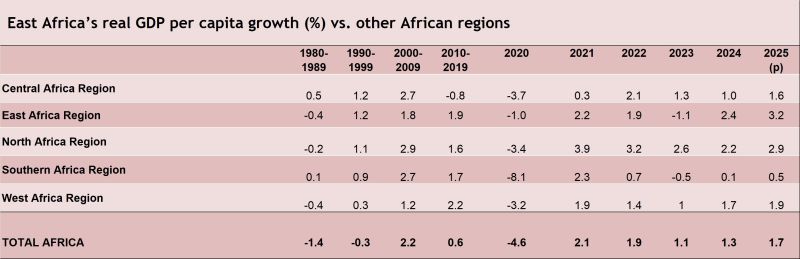
Source: East Africa Economic Outlook Publication – 2024 [Africa Development Bank Group]
Looking Ahead: Challenges and Opportunities
Despite its momentum, the region faces challenges – including climate vulnerability, debt pressures, and political instability in certain areas. However, regional cooperation, improved governance, and private-sector-led innovation are helping to mitigate risks.
With a population projected to exceed 600 million by 2050, East Africa’s economic trajectory will be critical not only for the continent but for global investors seeking high-growth markets.
As the world watches Africa’s rise, East Africa is proving it’s not just keeping pace – it’s leading the charge.
Des H Rikhotso (PgDip-BA, MBL) is a seasoned C-suite Multi-Industry business executive with 25+ years of Business Leadership Experience across the South, East and Western Sub-Sahara Africa Region. Based in Kampala, Uganda he serves as East Africa Region Business Executive, driving Business Strategic Growth and Operational Excellence – contributing his Leadership Voice and Clarity to the Region. Des has held Business Leadership roles at BMW Group Africa, Volkswagen Group Africa, Peugeot Motors South Africa, Toyota/Lexus South Africa, Nissan Group of Africa, G.U.D Holdings (Africa Exports Operations Division) and The HDR Group of Companies. He holds Under-Graduate and Post-Graduate business degrees from the University of the Western Cape, Wits University, and the University of South Africa.
