
Opinion
Building Nigeria’s Global Footprint: From Exports to Enterprise

By Ryan Elcock
Earlier this week, when I attended the Nigeria–Canada Trade and Investment Summit and Awards (NICATISA) 2025, my intention was simple: sit in the background, observe the conversation, identify the right people to connect with, and absorb insights from others in the space. No grand agenda. No expectation of a spotlight.
But as fate would have it, one of the scheduled panelists wasn’t able to make it. And without hesitation, Erica Henry-Jackman, Manager of Investment Attraction at the City of Brampton – a woman I deeply respect – turned to me and asked if I would step in.
I hadn’t prepared a speech. But I didn’t need one. Because what I’ve been building, observing, and connecting across borders for years is rooted in the very topic at hand: the urgent need for Nigeria to elevate its global economic footprint.
Although I’m not Nigerian, I am one of the founders of The Habari Journal and The Habari Network – platforms dedicated to amplifying African and diaspora narratives while dissecting the economic, political, and geopolitical forces shaping the continent’s trajectory. Through these platforms, we’ve worked with policymakers, entrepreneurs, academics, and institutions to document Africa’s rise and challenge outdated perceptions.
This work has afforded me an uncommon lens – not only observing from the sidelines but engaging directly with the networks, strategies, and tensions that define progress. Over the past decade, I’ve closely followed Nigeria’s policy evolution, economic ambitions, and global influence – from its energetic diaspora to its emerging role in trade and diplomacy.
So when I was asked to step onto the panel, I didn’t speak as an outsider. I spoke from a place of long-standing proximity, informed insight, and grounded respect. What I shared wasn’t an off-the-cuff opinion. It was perspective – earned through years of study, partnerships, and an unshakable belief in Nigeria’s right and responsibility to shape its own global narrative.
It’s Not Enough to Export Goods – Nigeria Must Export Power
One thing became very clear to me during that panel discussion:
Nigeria’s future cannot rely solely on exporting its products and talent. Its true power lies in exporting its presence.
We often celebrate how well Nigerians do overseas – and rightly so. The diaspora is filled with world-class talent, professionals, entrepreneurs, creatives, and innovators.
But that alone doesn’t build a strong nation.
It’s one thing for Nigerians to succeed abroad. It’s another for Nigeria itself to succeed on the global stage – as a force, a brand, and a generator of global value.
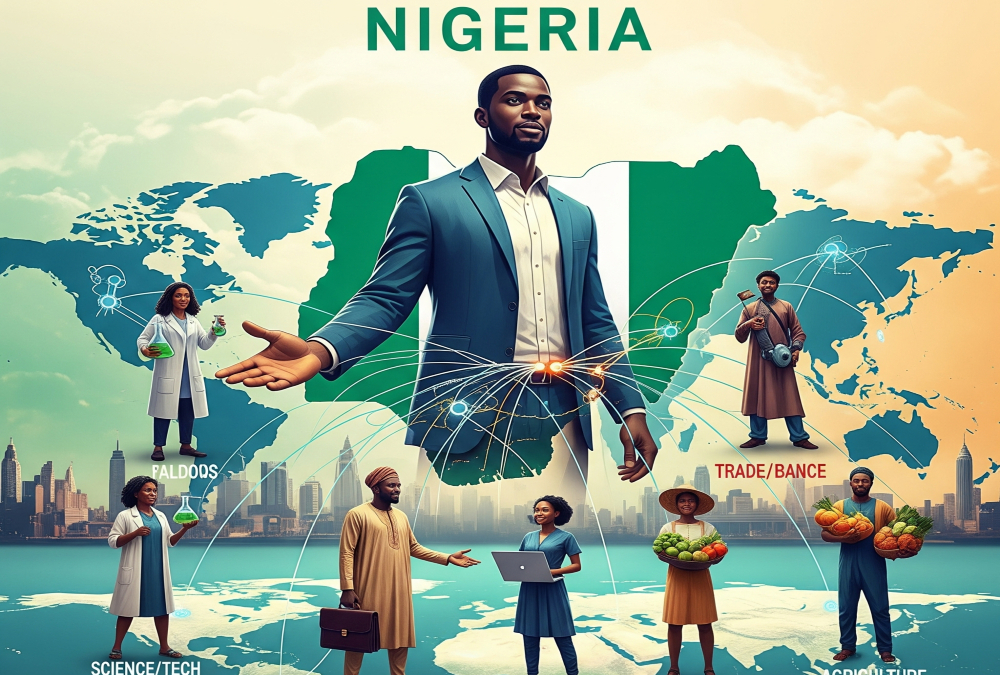
A strong nation isn’t defined by its exports, but by the footprint of its enterprises and the influence of its institutions. To date, Nigeria’s presence on the global corporate map remains limited, despite its population, natural resources, and intellectual capital.
To truly compete on the global stage, Nigeria must plant its flag through international conglomerates, multinational institutions, and globally scaled operations that proudly bear its name and reflect its vision. Much like China and India, which have built global brands and invested in multinational expansion, Nigeria must think beyond being a promising market – it must also be an assertive player.
Influence isn’t just earned by GDP – it’s enforced through presence.
That means more Dangotes abroad. More globally recognized Nigerian-led ventures. More headquarters in foreign cities. More strategic acquisitions. More boards, more factories, and more signatures on international contracts that proudly say “Made by Nigeria.”
Nigeria cannot be seen only as a stage for foreign investment. It must also rise as a producer of world-stage leaders in business, culture, innovation, and diplomacy.
That shift – from simply receiving to actively projecting power and leadership – is where the real promise of the Nigeria brand lies. Until then, its global influence will remain restrained.
But with intentional investment in global expansion, institution-building, and narrative control, Nigeria can take its rightful place among the architects of the 21st century. The opportunity is still wide open – and the time to act is now.
Ryan Elcock serves as the Vice-Chair and Co-Founder of the Brampton Community & Economic Empowerment Network (BCEEN) and is also the Co-Founder and Chief Operating Officer of The Habari Network.
