
Opinion
Africa’s Soil Crisis: Why Agropastoralism Beats Monoculture

By Franco Bonghan
Sub-Saharan Africa’s pursuit of foreign exchange through monoculture exports is exacting a quiet but devastating toll on its most fundamental resource: soil. Across the continent, millions of smallholder farmers are working land that is steadily losing its biological vitality – locked in a familiar and punishing cycle of heavier chemical inputs, mounting debt, and diminishing dietary diversity on local tables.
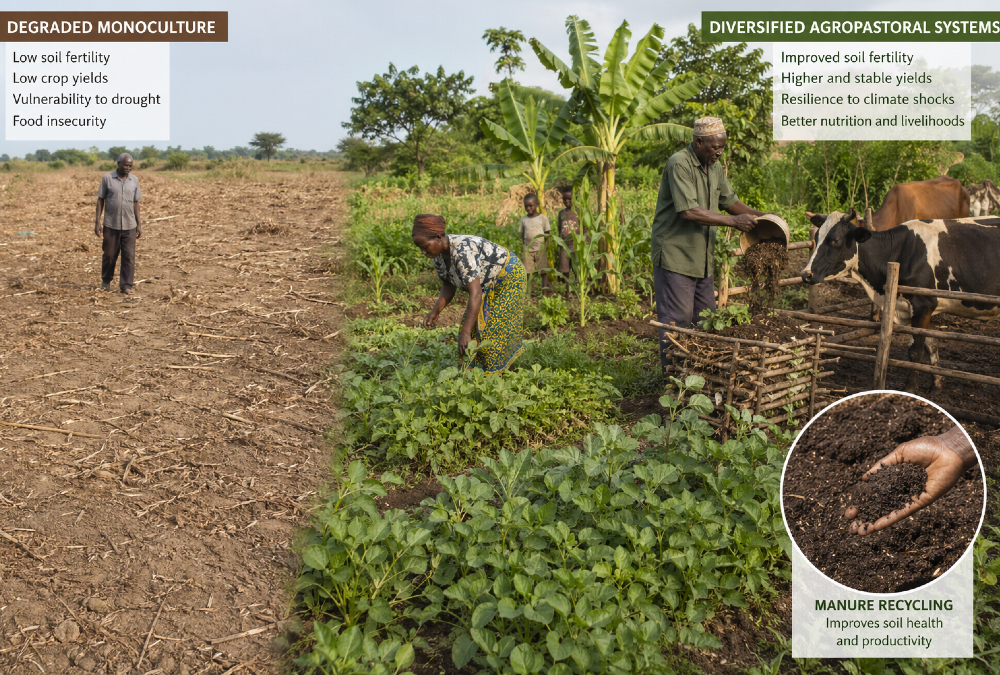
The answer, hiding in plain sight, is agropastoralism – the integration of crops and livestock that many rural communities have practiced for generations. By returning animal manure to fields, rotating crops with grazing land, and repurposing crop residues as feed, these systems close nutrient loops, rebuild soil organic matter, and reduce dependence on imported fertilizers.
Research confirms that integrated crop-livestock systems meaningfully increase soil carbon and nitrogen stocks, improve aggregation and water infiltration, and raise yields relative to simplified monocultures. The cow, the goat, and the millet stalk, rather than being managed as separate agricultural sectors, become components of the same regenerative engine.
A System That Works – and the Millions Who Depend on It
The scale of what is at stake is considerable. Pastoral and agropastoral systems support tens of millions of people across the Sahel, the Horn of Africa, and other dryland zones – with some estimates placing the number of agropastoralists continent-wide at up to 200 million.
Women are frequently central to these systems, tending and watering animals, managing family plots and kitchen gardens, and handling post-harvest processing and marketing. When agropastoralism functions well, it delivers on three fronts simultaneously: it keeps soils productive for staple crops; it supplies milk, meat, and eggs that strengthen household nutrition; and it creates diversified income streams that insulate rural women and smallholder farmers from climate shocks and commodity price swings.
This matters enormously for the continent’s stated ambitions. It is difficult to speak seriously about food sovereignty – or about the inclusive growth promised under the African Union’s Agenda 2063 – while continuing to privilege export-driven monocultures over the integrated systems that actually feed rural families.
The Policy Shift That Could Change Everything
For policymakers and development partners, the implications are clear. Investing in agropastoralism is not a retreat to romanticized tradition; it is the modernization of what demonstrably works.
That means better rural water infrastructure, extension services trained to understand crop-livestock synergies, and financial products designed for farmers who grow grain and keep animals on the same holding. These are targeted, practical investments – not ideological ones.
At a moment when soil degradation, nutritional insecurity, and rural poverty are all worsening simultaneously, agropastoralism is neither nostalgia nor niche. It is a science-backed, field-tested pathway for Africa to restore its soils, nourish its people, and return meaningful economic agency to the smallholder farmers who feed the continent.
Franco Bonghan is an international development strategist and Co-Founder/Co-Chair of the African and Caribbean Energy Network (ACEN) and Founder of Bright Light Projects (BLP). He curates the LinkedIn newsletter Global Pulse Africa, unpacking Africa’s economic challenges and showcasing innovative solutions for a sustainable future. He can be reached on X via https://x.com/Francobonghan
