
Opinion
Africa’s Real Economy Isn’t in the Spreadsheets – It’s in the Streets

By Dishant Shah
Every few months, the headlines return with familiar fanfare: “Africa’s gross domestic product Set to Grow by 5%,” “Fastest-Growing Economy in the Region,” “Post-Pandemic Recovery Gains Momentum.”
On the surface, these numbers suggest progress. But behind the glossy forecasts lies a deeper, more complex truth – one that gross domestic product (GDP) alone cannot capture.
Because while policymakers and financial analysts fixate on macroeconomic indicators, the true engine of African livelihoods operates just beyond the reach of spreadsheets and central bank reports.
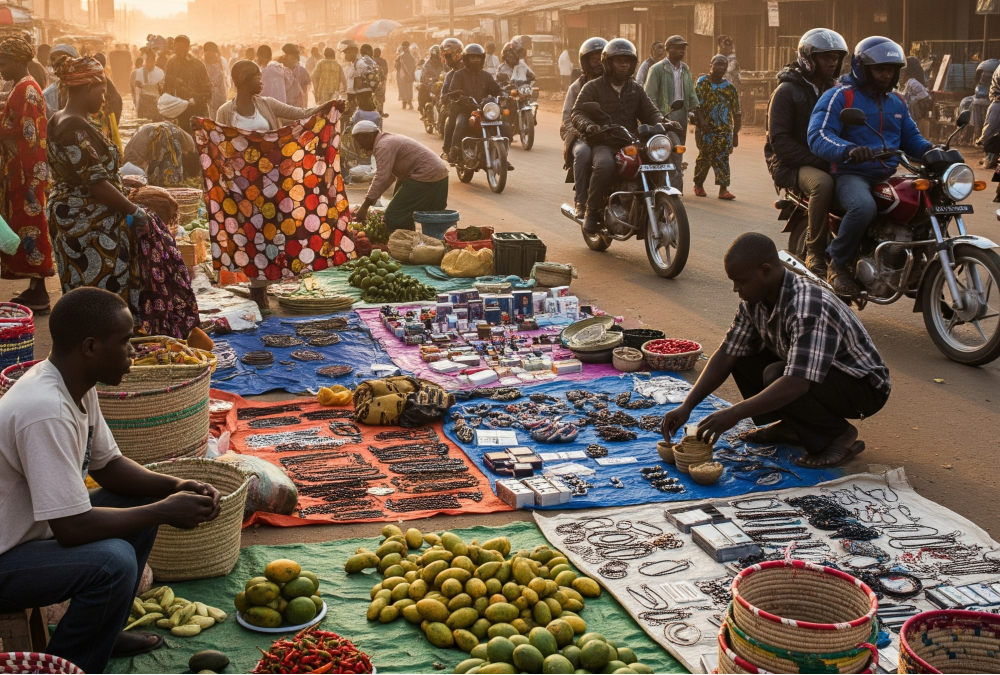
It thrives in bustling markets that open before sunrise. In the side hustles conducted in cash. In networks of barter, trust, and ingenuity passed down through generations.
This is Africa’s informal economy – and it is not marginal. It is the economy.
Take Lagos, Nigeria – the continent’s largest city and a symbol of modern African ambition. Officially, Nigeria’s GDP is driven by oil and formal services.
Yet step into Alaba International Market or the motor parts hub of Ladipo, and you will find a parallel economic universe: importers, recyclers, mechanics, and traders operating with remarkable efficiency – entire supply chains functioning entirely off the books.
This isn’t chaos. It’s order of a different kind – organic, adaptive, and deeply resilient.
Like a beehive, each participant plays a role, guided not by corporate hierarchies but by necessity, trust, and survival.
GDP does not account for the hairdresser in Nairobi who runs a one-room salon and sends her three children to school. It ignores the boda boda riders in Kampala who use mobile money to buy fuel, repay loans, and support their families.
It fails to measure the elderly woman in Accra who rises at 4 a.m. to bake kenkey, selling it daily to fund her grandchildren’s education.
None of these activities show up in national accounts. Yet all of them are undeniably economic.
The Informal Economy Isn’t a Shadow – It’s the Foundation
The World Bank often refers to such activities as part of the “shadow economy.” But calling it a shadow implies something hidden, temporary, or illegitimate.
In Africa, the informal sector is not a shadow – it is the foundation.
According to the International Labour Organization (ILO), up to 85 percent of employment in sub-Saharan Africa is informal. In countries like Nigeria, Tanzania, and Uganda, that figure climbs even higher.
These are not temporary jobs or stopgaps. They are the primary means of survival and dignity for millions.
And when formal systems falter, it is the informal economy that holds society together.
During the height of the pandemic, when borders closed and formal supply chains collapsed, it was smallholder farmers who kept food moving. It was street vendors who pivoted overnight – selling face masks instead of sunglasses, sanitizers instead of phone chargers.
Communities didn’t survive on stimulus checks or GDP rebounds. They survived because of informal resilience.
Resilience Without Recognition: Stories from the Ground
Consider Dada, a young entrepreneur in Maputo, Mozambique. He began by repairing second-hand phones on a sidewalk.
Within a year, he was selling accessories, then SIM cards, and eventually offering mobile money services. Today, he employs four people – all paid in cash, none registered with the state.
No bank gave him a loan. No government policy was designed for him.
Yet he created jobs, built trust, and generated real value in his community.
GDP cannot see Dada. But Dada is the face of Africa’s real growth story.
We have been measuring economic strength the wrong way – like judging a tree by its branches while ignoring the roots that keep it standing.
Africa’s informal economy is not a flaw to be formalized or eradicated. It is a testament to human creativity, adaptability, and endurance.
It is where innovation happens without venture capital, where entrepreneurship flourishes without permits, and where communities self-organize in the absence of state support.
Redefining Progress: From Margins to Mainstream
So what if we stopped treating the informal sector as an embarrassing footnote – and started recognizing it as the core of African economic life?
What if our policies were designed not to “bring people into the formal economy,” but to support the systems they have already built?
Imagine mobile licensing platforms, micro-insurance schemes, and digital record-keeping tools that empower informal workers – without burdening them with bureaucracy. Imagine credit systems that recognize cash flow from street trade as legitimate collateral.
Imagine urban planning that integrates, rather than displaces, market vendors.
The future of African prosperity doesn’t depend solely on attracting foreign investment or boosting export figures. It depends on seeing the economy as it truly exists – not in GDP reports, but in the streets, markets, and back-alley workshops where millions are already building value every single day.
It’s time we stop measuring Africa’s progress by what’s recorded – and start valuing what’s real.
Dishant Shah is a partner at Legion Exim, a company specializing in facilitating the export of high-quality engineering products directly sourced from manufacturers in India to Africa. His areas of expertise include new business development and business management.
