
Opinion
Africa’s Quiet Rise in Global Trade: A New Battleground for Influence

By Dishant Shah
While the world remains fixated on the intensifying rivalry between the United States and China, a quieter but equally transformative shift is unfolding beneath the radar – one that could redefine the future of global trade: Africa’s emergence not just as a consumer, but as a strategic theater of economic and geopolitical influence.
In the first half of 2025, as Chinese exports to the United States declined by over US$10 billion, a striking reversal occurred on the other side of the globe. Chinese trade with Africa surged by US$21.4 billion – the largest regional increase of any major market.
This isn’t a statistical anomaly. It’s a signal of a profound recalibration in global economic gravity.
This pivot goes beyond balance sheets. It’s about trust, timing, and the tangible transformation of terrain.
For decades, Africa’s role in the global economy was narrowly defined: a supplier of raw materials – copper from Zambia, cocoa from Ghana, cobalt from the Democratic Republic of the Congo – exchanged for finished goods from the West and conditional aid packages. The value chain rarely extended beyond extraction.
But the rules are changing.
China’s Infrastructure-First Strategy: Building the Foundations of Trade
China’s approach to Africa has been notably different: less moralizing, more mobilizing. Instead of demanding political reforms or imposing structural adjustment conditions, Beijing has focused on building the foundations of modern economies – roads, power grids, ports, and digital infrastructure.
In doing so, it has not only improved connectivity but also created the very channels through which its goods now flow.
Take Kenya’s capital, Nairobi. In 2023, a Chinese consortium modernized the city’s commuter rail system, a project that did far more than upgrade transit.
It catalyzed a grassroots economic ripple effect. Small traders near the new stations began importing affordable Chinese electronics, appliances, tiles, textiles, and agricultural equipment.
Within months, Chinese brands – once confined to formal retail – became staples in bustling informal markets.
This pattern repeats across the continent. From Lusaka to Lagos, Addis Ababa to Abidjan, Chinese-built infrastructure is enabling new trade corridors, empowering local entrepreneurs, and embedding Chinese supply chains deep into African economies.
Western investors, often deterred by perceived risks, bureaucratic hurdles, or slow decision-making, have watched from the sidelines. Meanwhile, China has moved with speed and scale, filling gaps with pragmatism rather than rhetoric.
The message is clear: presence matters more than perfection.
The Cost of Growth: Debt, Dependency, and Local Industry at Risk
Yet this rapid integration comes with real challenges. Local industries in several African nations struggle to compete with low-cost imports.
Textile producers in Ghana, electronics assemblers in Nigeria, and ceramics manufacturers in Tanzania face mounting pressure from cheaper Chinese alternatives.
Debt sustainability concerns linger, particularly around large infrastructure loans offered under opaque terms. Critics warn of a “debt-trap diplomacy” narrative, though evidence remains mixed.
Still, the risk of overdependence on a single trading partner cannot be ignored.
For many African leaders, however, the choice is pragmatic. Faced with sluggish Western investment cycles, conditional aid, and years-long approval processes, Chinese financing – despite its strings – offers a faster path to development.
As one senior trade official from Zambia put it: “We are not choosing between perfection and peril. We’re choosing between movement and stagnation.”
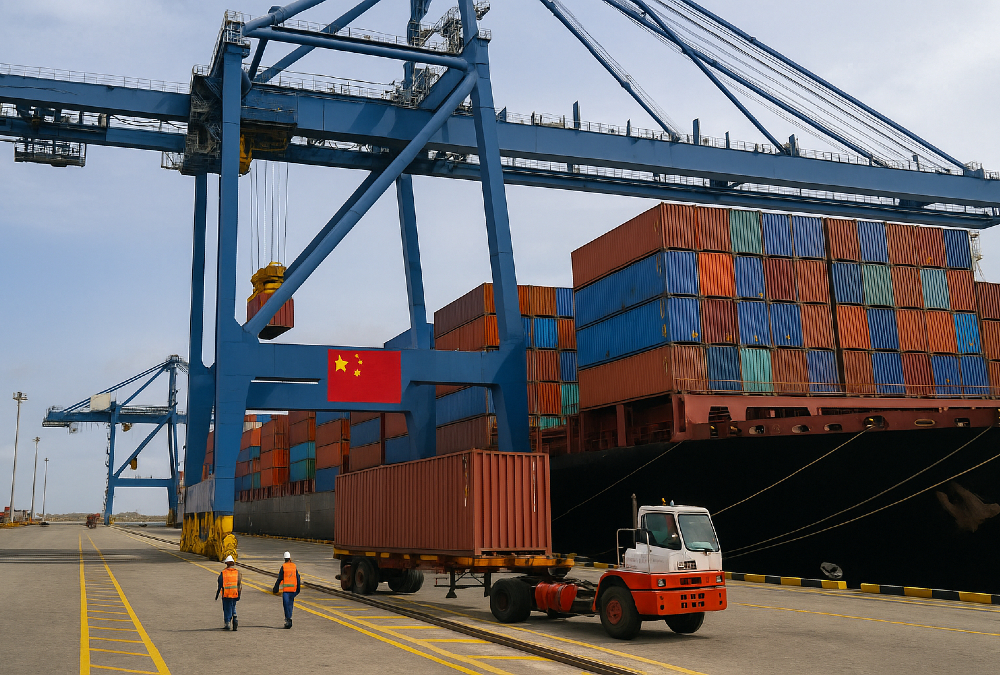
In this calculus, the cranes unloading at Dar es Salaam or Lomé aren’t just symbols of foreign influence – they are signals of progress in motion.
From Recipients to Architects: Can Africa Own Its Economic Future?
The critical question now is not whether Africa is becoming more integrated into global trade, but whether African nations can leverage this moment to build lasting economic agency.
Some countries are already proving it’s possible. Rwanda, for example, now exports premium processed coffee directly to Chinese consumers through Alibaba’s eWTP (Electronic World Trade Platform), bypassing traditional intermediaries.
Ethiopia has transformed its textile sector by partnering with Chinese-built industrial parks, boosting exports and creating thousands of jobs.
These are not aid stories – they are stories of strategic alignment and economic ambition. But they remain the exception, not the norm.
In many ways, today’s Africa mirrors Southeast Asia in the 1980s – youthful, dynamic, complex, and underestimated. Like ASEAN before it, the continent is becoming a nexus where new supply chains, digital economies, and diplomatic alliances converge.
The real test ahead is not just about who builds the most ports or signs the most trade deals. It’s about agency: Will African nations shape this new era of trade – or will they be shaped by it?
The answer lies in whether local governments, private sectors, and regional blocs can move beyond transactional partnerships toward transformative industrial strategies – adding value, protecting local enterprise, and negotiating from a position of strength.
China may be writing the first chapters of this new economic chapter. But the pen must ultimately be in African hands.
Dishant Shah is a partner at Legion Exim, a company specializing in facilitating the export of high-quality engineering products directly sourced from manufacturers in India to Africa. His areas of expertise include new business development and business management.
