
Opinion
Africa’s Industrial Imperative: Why Manufacturing Is a Key Path to Prosperity

By Davida Ademuyiwa
History offers a clear and unambiguous lesson: no nation has ever achieved sustained prosperity without first undergoing an industrial transformation. From 18th-century Britain to post-war South Korea, and from Meiji-era Japan to modern China, economic ascendancy has always been forged in factories – not in fields or mines alone.
Consider the pattern. Britain didn’t become the world’s first industrial superpower by merely possessing coal and cotton; it did so by converting those raw inputs into textiles, steam engines, and railways – then exporting finished goods and technological know-how across the globe.
Japan, after the Meiji Restoration, bet heavily on machinery, technical education, and state-backed industrial policy to leap from feudal isolation to global relevance in a single generation. South Korea, emerging from the ashes of war, prioritized heavy industry and export-oriented manufacturing, transforming itself into a high-income economy within decades.
China, meanwhile, laid railroads, built ports, and erected special economic zones before becoming the workshop of the world.
The common thread? Wealth is not derived from what a nation owns – but from what it makes.
The Cost of Staying a Raw Material Exporter
Today, Africa stands at a pivotal crossroads. The continent is richly endowed with natural resources – cobalt, copper, oil, gas, arable land, and renewable energy potential.
Yet more than 90 percent of these resources are exported in raw or minimally processed form. Africa feeds the world but rarely packages the meal. It supplies the inputs for global smartphones, electric vehicles, and fertilizers – but captures only a sliver of the final value.
This is not just an economic inefficiency; it is a structural vulnerability. Exporting unprocessed commodities locks economies into price volatility, limits job creation, stifles technological learning, and perpetuates dependency.
Without industrial capacity, African nations remain price takers – not price makers – in the global economy.
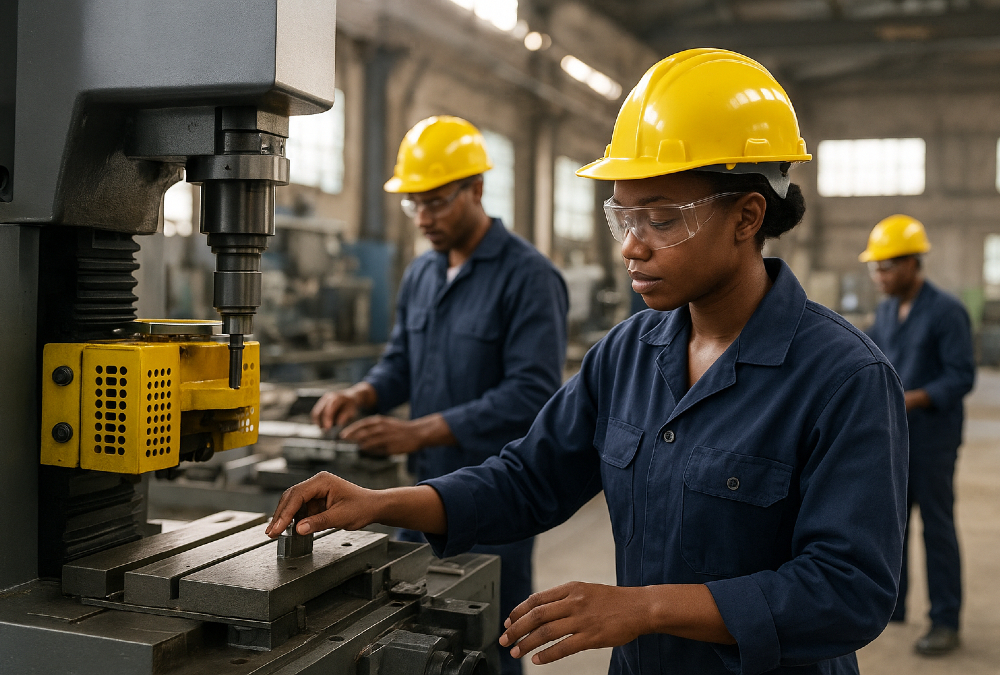
Industrialization is the indispensable bridge between resource endowment and real prosperity. It is the engine that transforms latent potential into tangible wealth, creates high-productivity jobs, fosters innovation, and builds resilient, diversified economies.
Crucially, it shifts a nation’s role from passive supplier to active creator – enabling it to compete, not just comply.
Why Leapfrogging Manufacturing Is a Myth
Some argue that in an era of digital services and green transitions, Africa can “leapfrog” manufacturing altogether. This is a dangerous illusion.
While digital innovation and renewable energy are vital, they cannot substitute for the foundational role of industry in absorbing labor, building supply chains, and anchoring value addition. Even the most advanced service economies rest on industrial bedrock.
Africa cannot – and must not – skip the industrial step. Every nation that has climbed the development ladder did so by building things.
The question is not whether Africa should industrialize, but how quickly, inclusively, and sustainably it can do so.
The time for pilot projects and policy paralysis is over. What’s needed now is bold investment in infrastructure, strategic trade policies, skills development, and regional value chains – backed by political will and private-sector dynamism.
The blueprint exists. The resources are there. What’s missing is the collective urgency to act.
Because one truth remains unshaken by time or technology: no country has ever become prosperous by remaining a raw material exporter. Africa’s industrial revolution isn’t optional – it’s existential.
Davida Ademuyiwa is a UK politician and founder of DaviGlobal International Trade & Investment. She facilitates cross-border investment and connects capital with scalable ventures across the UK, Europe, the Middle East, and Africa. She also serves as Regional Ambassador for the Conservative Policy Forum in the East of England, contributing to grassroots policy dialogue alongside her work in global trade and investment.
