
Opinion
Africa’s Food Sovereignty Requires Collective Action, Not Isolation or Individual Hustle
Why young African innovators in agriculture need fewer followers and more collaborators.

By Juwon Akin-Olotu
There is a quiet inefficiency spreading across Africa’s agricultural innovation scene, and it has nothing to do with soil quality, financing gaps, or climate shocks. It has to do with how talented people choose to work.
Watch closely enough, and a pattern emerges. Brilliant young Africans in agriculture are building polished individual profiles – conference panels, LinkedIn thought leadership, award shortlists – while the peers solving the adjacent piece of the same puzzle remain strangers to them. Organizations duplicate each other’s work because their founders have never had a single conversation. Promising ideas quietly die not for lack of merit, but because the person holding the idea never crossed paths with the person holding the missing piece.
This is not a minor flaw in an otherwise sound system. It is a structural drag on the continent’s ability to feed itself.
The Scale of the Problem Demands Collaboration, Not Solo Brilliance
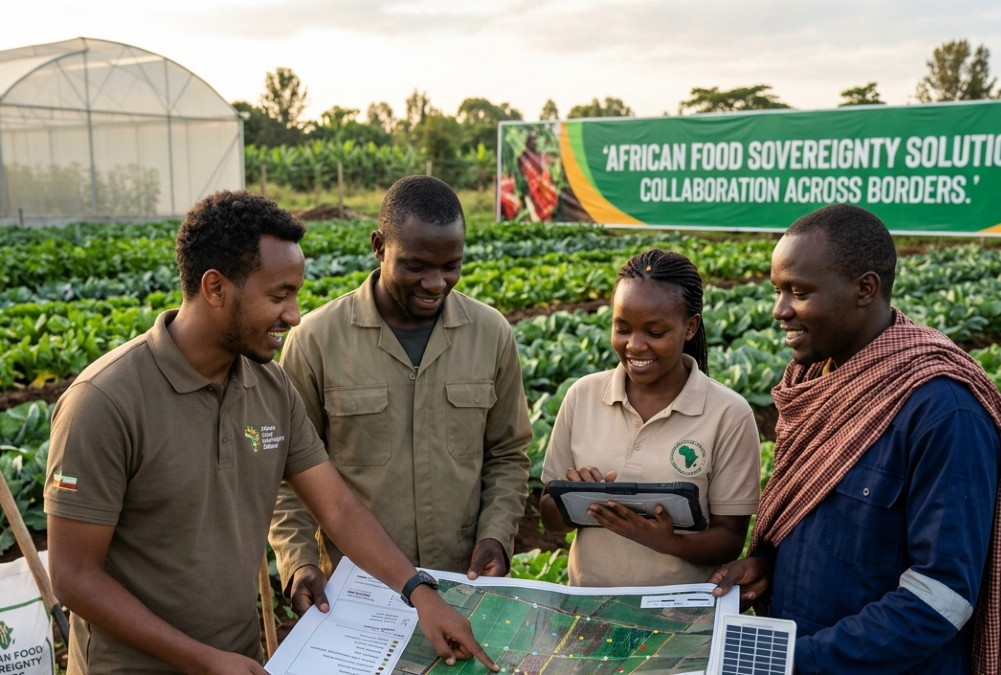
Food sovereignty is not a problem any single actor can solve from a silo. It requires policy practitioners and agribusiness operators in the same conversation. It requires farmers and technologists at the same table. It requires Nigerian policy expertise informed by Kenyan operational experience and sharpened by Rwandan execution discipline. It requires the climate-finance specialist and the smallholder-production expert building something together – not citing each other’s work from a respectful distance.
The supply chains, regulatory frameworks, and market systems that will ultimately feed this continent do not stop at national borders. There is no reason the relationships meant to build them should stop there either.
Cross-border integration, in other words, is not a development-sector buzzword to drop into a grant proposal. It is the practical, unglamorous reality of what African food sovereignty actually requires.
Two Things Have to Happen at Once
Fixing this does not require abandoning personal ambition. It requires pairing it with something Africa’s agricultural innovation ecosystem currently undervalues: deliberate, intentional collaboration.
First, build real competence – not the performance of it. This starts with depth, not visibility. There is a meaningful difference between looking like an expert and being one, and that difference shows up the moment real collaboration is required. Nobody can contribute meaningfully to a shared effort while bringing nothing substantive to the table. The goal is straightforward: know your domain well enough that other serious people genuinely need what you know.
Second, pursue collaboration with the same discipline applied to personal achievement. This is not networking. It is not adding contacts or following the right people online. It is the slower, less glamorous work of building actual working relationships – grounded in mutual respect, a shared vision, and a genuine willingness to build something that neither party could build alone.
Personal credibility without collaborative infrastructure is a dead end. Collaboration without personal substance is just noise. The continent needs both, operating simultaneously, at scale.
A Modest, Specific Challenge
None of this requires a summit, a coalition, or a memorandum of understanding. It requires one honest conversation.
Identify a single person building seriously in a space adjacent to your own. Reach out – not to pitch a project, not to ask for funding, not to extract anything. Reach out to explore, honestly and without an agenda, whether there is something worth building together.
That is the entire assignment: one intentional conversation.
Africa’s food crisis will not be solved by better individual branding. It will be solved by people willing to build—deliberately, across borders, and together.
Africa will feed Africa. But only if the people capable of doing it stop building alone.
Juwon Akin-Olotu is the founder and CEO of Forthwith Global Limited, an agribusiness and consultancy advancing sustainable farming and modern agricultural solutions across Africa. A recognized voice in the continent’s agricultural sector, he champions technology adoption, human-capital development, and leadership grounded in service. Akin-Olotu is also a frequent speaker and moderator at international forums, where he addresses sustainable agriculture, agri-technology, and entrepreneurial education.
