
Opinion
Africa’s Agricultural Paradox: Coordination, Not Output, Keeps Traders Poor
The continent ships billions of dollars in crops to the world every year. The people who grow and move them rarely see a fair share. That is beginning to change.

By Caleb Maru
Africa exports more than US$90 billion in agricultural goods each year – cashews, cocoa, shea, coffee – and yet the local traders who form the backbone of those supply chains capture remarkably little of that value. This is not, as is so often assumed, a story of insufficient production. It is a story of structural invisibility.
Consider the economics of a typical cashew transaction in northern Ghana. A farmer harvests his crop. A local trader buys it, aggregates it with supply from neighboring farms, and moves it along the chain.
Weeks later, a buyer in Rotterdam pays a premium for a verified, traceable batch. The farmer never sees that premium. Neither does the trader. The value accrues at the end of the chain – and the beginning of the chain has no means of claiming it.
The reason is deceptively simple: the local trader operates without verifiable information. He cannot prove the quality of what he is selling. He has no reliable record of what he has moved, no documentation a distant buyer can trust, and no mechanism for demonstrating that his inventory meets the specifications required for a premium contract. He is, in the language of economics, informationally excluded from the market he supplies.
International buyers respond rationally to this uncertainty. Either they fly in their own personnel to manage procurement on the ground – an expensive solution that few can sustain at scale – or they bypass African supply chains entirely and source from regions where the information infrastructure already exists.
The consequence is that the local trader takes whatever price appears at the farm gate, his income remains flat, and Africa continues to ship enormous volumes of agricultural commodities at commodity prices.
The Coordination Deficit
What is being described here is not a resource problem. Africa is not short of cashews, cocoa, or coffee. It is short of the coordinating infrastructure that allows the people who produce and aggregate those goods to prove their value to the people who buy them.
This distinction matters enormously. The dominant development framework for African agriculture has long emphasized production – more output, better yields, expanded acreage.
These are worthwhile goals. But they do not address the fundamental obstacle, which is that existing output is already being underpriced because it cannot be verified, tracked, or credibly presented to buyers operating thousands of miles away.
A cohort of agricultural technology companies is now betting that coordination, not production, is the more tractable problem – and that solving it unlocks value that has always been there but has never been captured.
A Tablet on a Farm
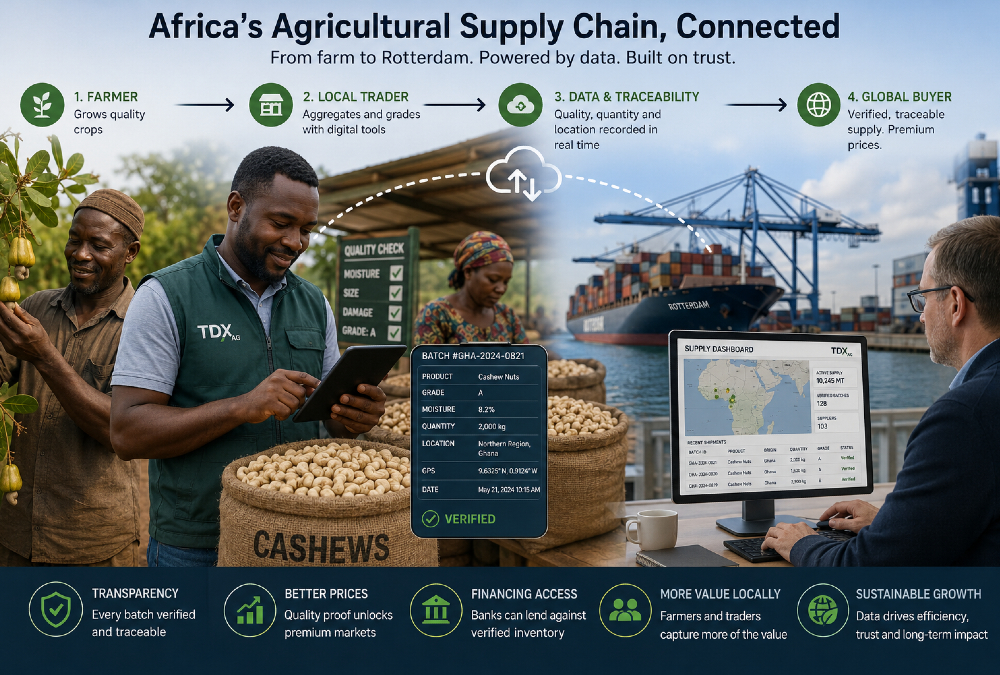
Among the clearest illustrations of this thesis is TDX Ag, a Ghanaian agtech company working directly within the existing supply chain rather than attempting to build a new one. The model is straightforward in concept, though meaningful in execution.
When a local trader arrives to purchase a batch of cashews, he uses a tablet application to photograph the crop and grade it on the spot – assessing moisture content, kernel size, and physical damage. That grade is immediately logged, GPS-stamped, and pushed to a dashboard visible to international buyers in real time.
A consignment that was previously invisible to anyone beyond the farm gate is now traceable, documented, and verifiable.
The impact is not merely transactional. Banks and trade financiers have historically been reluctant to extend credit against agricultural inventory they cannot see or verify.
A documented, GPS-tagged batch of graded cashews is a fundamentally different collateral proposition than an unverifiable claim of stock sitting somewhere in rural Ghana.
In six months of operation, TDX Ag has onboarded 103 aggregators, reached approximately 4,000 farmers, and facilitated $500,000 in verified crop transactions. The numbers are modest in the context of a $90 billion continental export market – but the proof of concept is significant.
A quality-control and traceability system that once required the capital and logistics of a large international trading firm now runs on an inexpensive tablet in the hands of a local trader.
TDX Ag did not plant a single additional farm. It did not increase the volume of cashews being grown in northern Ghana. It changed what could be proven about what was already there – and in doing so, changed who could claim value from it.
The Broader Lesson
The TDX Ag example points toward a more general principle with implications well beyond agricultural commodities. A great deal of what constrains economic participation in developing markets is not the absence of goods or services or willing workers – it is the absence of legible, trustworthy information about them.
Coordination infrastructure, whether in the form of grading systems, digital records, verified identities, or standardized contracts, has an outsize effect because it unlocks value from activity that already exists.
This reframes the question of African export competitiveness in a useful way. The debate about how Africa can capture more value from its natural resources has traditionally focused on processing – on moving from raw commodity exports to finished goods, from cocoa beans to chocolate, from raw cashews to packaged snacks.
That argument is correct as far as it goes, and the case for domestic processing capacity is strong.
But processing is a long-term structural ambition. Coordination is available now. The local trader does not need a new factory to command a better price for his cashews. He needs a system that can prove to a buyer in Rotterdam what those cashews are worth.
Africa does not simply need to export more. It needs to own more of what it already exports. In many cases, the tools to begin doing so are already within reach.
Caleb Maru is Founder and CEO of Tech Safari, Africa’s leading tech community and media company, specializing in tech innovation, market trends, and exclusive insights across the continent. Based in Nairobi, Kenya
