
Opinion
Africa’s Agricultural Export Revolution: A Continent Feeding the World
From Ivory Coast’s cocoa fields to South Africa’s citrus groves, ten nations are reshaping global food supply chains – and signaling that Africa’s agricultural moment has arrived.

By Ashish Muley
For too long, Africa has been cast as a continent of agricultural potential perpetually deferred. That narrative is becoming obsolete.
Across ten pivotal nations – stretching from Morocco’s sun-drenched Mediterranean coast to South Africa’s temperate wine valleys – a quiet but consequential transformation is underway.
African agricultural exports are no longer defined solely by raw commodity volumes. They are increasingly characterized by diversification, value addition, and strategic positioning in the world’s most competitive food markets.
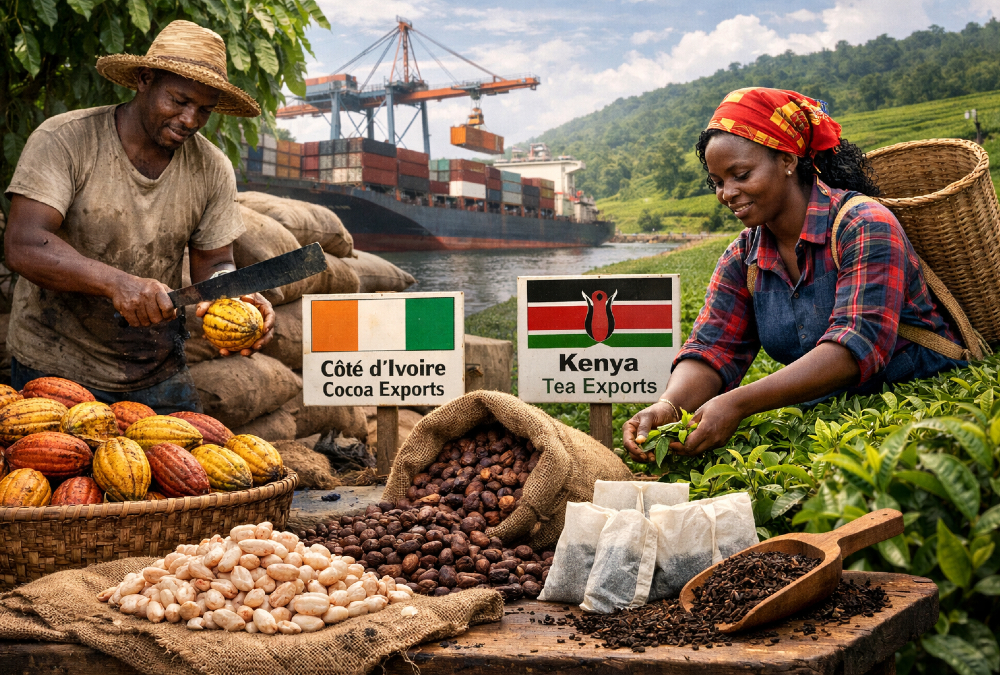
The data are unambiguous. Côte d’Ivoire (Ivory Coast) controls roughly 45 percent of global cocoa supply. Egypt has ranked as the world’s leading orange exporter for six consecutive years. Kenya’s tea dominates the London auction system. Ethiopia’s Arabica coffee commands premium prices from specialty roasters in Tokyo, Milan, and New York.
These are not peripheral footnotes to global agricultural trade – they are its central chapters.
Africa’s agricultural exports are no longer defined solely by raw commodities. They are increasingly characterized by diversification, value addition, and strategic ambition.
What follows is a country-by-country assessment of the ten leading agricultural export economies on the continent, the commodities driving their trade performance, and the structural forces that will determine whether Africa’s harvest can sustain its remarkable momentum.
The Top 10: Country Profiles
| Country | Leading Export Commodities |
|---|---|
|
South Africa Most diversifed export base |
Citrus fruits (oranges, mandarins), grapes, apples & pears, wine & wine products, maize & animal products |
|
Ivory Coast Africa’s cocoa powerhouse |
Cocoa beans & butter, cashew nuts, natural rubber, bananas, rice products |
|
Nigeria West Africa’s largest economy |
Cocoa beans, sesame seeds, cashew nuts, soybean products, yam & cassava derivatives |
|
Kenya East Africa’s horticulture hub |
Tea, cut flowers & fresh horticulture, coffee, fruits & nuts, vegetables & spices |
|
Ghana Cocoa & grains exporter |
Cocoa beans & related products, maize, rice, shea products, plantains & root crops |
|
Ethiopia Coffee export giant |
Coffee (Arabica), oilseeds (sesame), pulses (beans, lentils), cereals, horticulture & vegetables |
|
Uganda East Africa’s coffee leader |
Coffee (Robusta), tea, fish & fish products, fruits (bananas, mangoes), tobacco & cotton |
|
Morocco North Africa’s high-value produce hub |
Tomatoes & vegetables, citrus fruits, olives & olive oil, cereals (barley, wheat), nuts & dried fruits |
|
Egypt Major cereals & processed agri-exporter |
Rice, cotton, wheat, fruits & processed vegetables, oils & oilseeds |
|
Senegal West African diversified exporter |
Groundnuts & peanut products, fish & seafood, cotton, millet & sorghum, fruits & vegetables |
Source: Latest available trade data. Countries are illustrative and not ranked by export value
Beyond the Raw Numbers: Why This Matters
The true significance of Africa’s agricultural export story lies not merely in the volume of goods shipped, but in the structural evolution of what is being shipped and how. Historically, African nations occupied the least remunerative segment of global agricultural supply chains – exporting primary commodities at world-market prices while importing finished food products at far greater cost.
That dynamic, while far from eliminated, is showing signs of meaningful change.
South Africa offers the clearest example of a mature, diversified agri-export model. Its wine industry competes at the premium end of international markets.
Its citrus exports meet stringent phytosanitary standards required by European Union buyers. Its cold-chain logistics infrastructure supports year-round shipments of perishables.
The result is an agricultural export sector that consistently registers trade surpluses – a rarity on a continent that, in aggregate, remains a net food importer.
Ivory Coast presents a more complex picture. Its dominance in cocoa is both an asset and a vulnerability. Concentration risk – the susceptibility to price shocks and climate variability in a single crop – has prompted Abidjan to push processing investment, attempting to capture more of the value chain domestically rather than ceding it to European chocolate manufacturers.
The policy is sound. Its execution will define whether cocoa wealth translates into broad-based rural prosperity or remains confined to export statistics.
Kenya’s model is instructive for a different reason: its success in high-value horticulture and cut flowers demonstrates that African producers can meet the exacting quality and timeliness standards demanded by European supermarkets. The Nairobi flower auctions supply a significant share of blooms sold in Dutch flower markets.
This is sophisticated logistics at continental scale – and it is African-managed.
The Case for Investor Attention
For global investors, the African agricultural export sector presents a distinctive risk-return profile. Yields on well-managed agribusiness investments in sub-Saharan Africa have historically outperformed comparable investments in saturated markets, driven by land availability, demographic tailwinds, and rising domestic food demand.
The continent is home to approximately 60 percent of the world’s uncultivated arable land.
Yet the investment thesis extends beyond acreage. The more compelling opportunity lies in infrastructure: cold-chain logistics, post-harvest processing, digital market platforms, precision irrigation, and export-compliance services.
Countries such as Morocco and Egypt have demonstrated that state investment in agricultural infrastructure – combined with strategic trade agreements – can catalyze rapid growth in non-traditional exports.
Agritech represents perhaps the highest-potential frontier. Mobile-based advisory services, satellite-driven crop monitoring, drone-assisted precision agriculture, and blockchain-enabled traceability platforms are already being deployed across the continent at scale.
Startups based in Nairobi, Lagos, and Cairo are not merely replicating Silicon Valley models – they are engineering solutions tailored to the specific agronomic and economic conditions of African smallholder farming.
The continent is home to approximately 60 percent of the world’s uncultivated arable land – and the infrastructure investment opportunity is even larger than the land itself.
Structural Headwinds Cannot Be Ignored
Any credible assessment of African agricultural export potential must confront the structural obstacles that continue to constrain performance. Infrastructure deficits inadequate rural road networks, unreliable electricity supply, limited port capacity impose substantial post-harvest losses in Sub-Saharan Africa are widely estimated at 30 – 40 percent for many crops and supply chains, particularly for perishables such as fruits, vegetables, and tubers.
These losses represent both an economic tragedy and, viewed differently, a recoverable opportunity.
Trade policy fragmentation remains a persistent impediment. Despite the formal establishment of the African Continental Free Trade Area (AfCFTA) in 2021, intra-African agricultural trade remains below 20 percent of the continent’s total trade volume.
Non-tariff barriers, inconsistent sanitary and phytosanitary standards, and weak border infrastructure continue to fragment what could be the world’s largest single market. Unlocking intra-continental trade flows would be transformative – not merely for agricultural producers, but for the food security of urban consumers across the continent.
Climate volatility poses an existential long-term risk. Ethiopia’s coffee belt is migrating to higher altitudes as temperatures rise. Southern Africa’s winter rainfall regions face increasing drought frequency. The Sahel’s agricultural frontier is under sustained pressure from desertification.
These are not distant scenarios – they are present realities requiring urgent adaptation investment.
The Opportunity That Beckons
Africa’s agricultural export landscape is neither a success story to be uncritically celebrated nor a potential to be reflexively dismissed. It is a complex, heterogeneous, and rapidly evolving sector in which extraordinary achievement coexists with stubborn constraint.
What is clear is that the trajectory is positive. The diversification of export baskets – away from single-commodity dependence and toward higher-value, more processed products – represents genuine structural progress.
The emergence of world-class agritech ecosystems in Nairobi, Lagos, and Casablanca signals that African entrepreneurs are not waiting for external solutions. And the demographic arithmetic is unambiguous: with a population projected to reach 2.5 billion by 2050, Africa will be both the world’s fastest-growing food producer and its fastest-growing food consumer.
For global buyers seeking supply chain diversification in the wake of pandemic-era disruptions and geopolitical instability, Africa offers something increasingly scarce: agronomic depth, geographic spread, and scale potential. For investors with the patience to navigate regulatory complexity and infrastructure gaps, the returns available in African agricultural value chains are among the most compelling in global food systems.
The harvest is ready. The question is whether the infrastructure, the investment, the policy environment and the patience to build them will arrive in time to bring it to market.
Ashish Muley is an independent consultant with Stalwart Management Consulting, with 27+ years in agricultural commodity value chains, export markets, and international trade. He has led projects on business development and capacity building across African countries in partnership with international organizations. Formerly, he spent 15 years in financial services leadership, focusing on sales, marketing, and business development. Based in Pune, India, Ashish advises on agricultural trade, commodity markets, and Asia–Africa economic opportunities, and regularly writes on international trade and logistics.
