
Opinion
Geography Is Not Destiny: Institutions, Not Maps, Will Decide Africa’s Future
Landlocked nations face real constraints. But the countries that thrive are those that build something harder than roads: trustworthy institutions.

By Gregory September
There is a comforting myth in development economics: that geography is fate. A country without a coastline, the thinking goes, is condemned to higher shipping costs, thinner trade networks, and permanent dependence on its neighbors’ goodwill. It is a tidy explanation for uneven growth – and it is largely wrong.
Landlocked status does impose real costs. Goods must travel farther to reach a port. Every additional border crossing adds delay, paperwork, and risk. Reliance on a neighboring country’s roads, railways, and political stability is not optional; it is structural. These are genuine handicaps, not myths to be waved away.
But they are not destiny. Switzerland, Austria, and Luxembourg – three of the wealthiest nations on Earth – have no coastline at all. In Africa, Botswana has built one of the continent’s steadiest economies without a single port, and Rwanda has transformed itself from a byword for catastrophe into a magnet for investment and a hub for regional commerce. Geography set the terms. It did not write the ending.
The Real Variable: Institutions, Not Infrastructure
The temptation is to credit roads and railways for these success stories. Infrastructure certainly matters. But infrastructure is a tool, not a strategy – and tools are only as good as the hands that wield them. A highway built by a government that cannot enforce contracts is just an expensive strip of asphalt. A port run by a customs authority riddled with graft becomes a bottleneck, not a gateway.
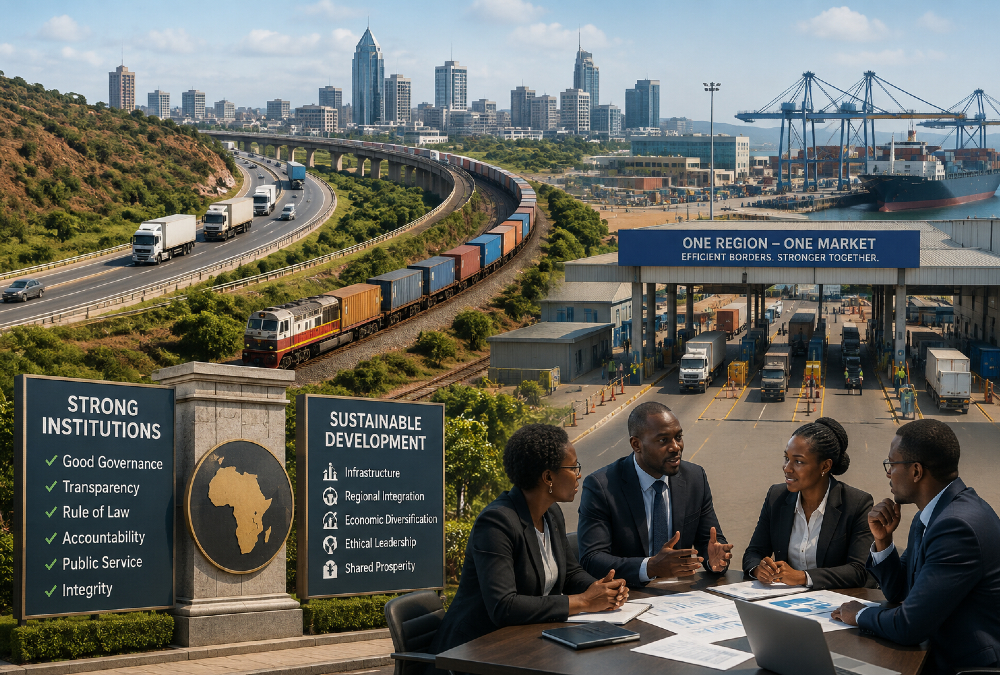
The difference between landlocked countries that thrive and those that struggle isn’t infrastructure – it’s governance. Five characteristics recur, almost without exception, among the countries that have turned geographic disadvantage into competitive advantage:
- Strong institutions. Predictable, enforceable rules give investors the confidence to commit capital for the long haul – capital that simply will not show up where the rules can change on a minister’s whim.
- Efficient trade corridors. Roads, railways, ports, and customs agencies function as a single, coordinated system rather than a chain of disconnected checkpoints, each with its own delays and demands.
- Regional integration. Neighboring states that recognize shared prosperity breeds shared stability tend to cooperate on transit rights and trade facilitation – turning a geographic liability into a regional asset.
- Economic diversification. Natural resources are treated as a foundation for broader industry, not as the entire economic model – insulation against the commodity cycles that have wrecked so many resource-rich but institution-poor economies.
- Ethical leadership. Accountability, transparency, and a genuine ethic of public service are what convert national wealth into public value, rather than private fortune.
Why This Matters Now
None of this is academic. As competition intensifies among the United States, China, Europe, India, and the Gulf states for influence and access across Africa, the continent’s governments face a defining test. They must welcome foreign capital without surrendering sovereignty. They must deepen regional trade while still protecting national interests. They must build partnerships that create opportunity, not dependency dressed up as aid.
A road cannot eliminate corruption. A railway cannot substitute for sound policy. A port, however modern, cannot compensate for weak institutions. Infrastructure is necessary. It is never sufficient.
The Bottom Line
Africa’s future will not be decided by maps or coastlines. It will be decided by the quality of its institutions, the integrity of its leadership, and the wisdom of the strategic choices its governments make in the years ahead.
Botswana and Rwanda are proof that geography is a starting condition, not a life sentence. The question facing the rest of the continent is not whether it can overcome the accident of location – it demonstrably can – but whether it has the institutional will to do so.
Gregory September is a South African academic, author, and geopolitical analyst with extensive experience in government and Parliament. He is the founder and CEO of SAUP (Sustainability Awareness and Upliftment Projects NPC), which focuses on sustainability education and community development. He previously served as Head of Research and Development for the Parliament of South Africa. His work centers on sustainability, African geopolitics, and economic development, and he regularly contributes to analysis of global political and economic affairs.
