
Opinion
The Heat Is On: Why Women Farmers Hold the Key to Climate Policy
A forecast of 31,400 extra deaths this El Niño season is a warning about whom Nigeria has left unprotected.

By Juwon Akin-Olotu
Forecasts of catastrophe tend to travel on a single number. This season’s is 31,400. According to the Climate Impact Lab, that is roughly how many additional heat-related deaths Nigeria will suffer between September 2026 and February 2027, more than any other country on earth. It is a figure built to be quoted, and it will be. It is also, on its own, a poor guide to what Nigeria should do.
A death toll measures what has already failed. It says nothing about who is most exposed, why, or what could be done before the next heat wave arrives. To answer those questions, look away from the thermometer and toward the farm.
Nigeria’s Invisible Farming Majority
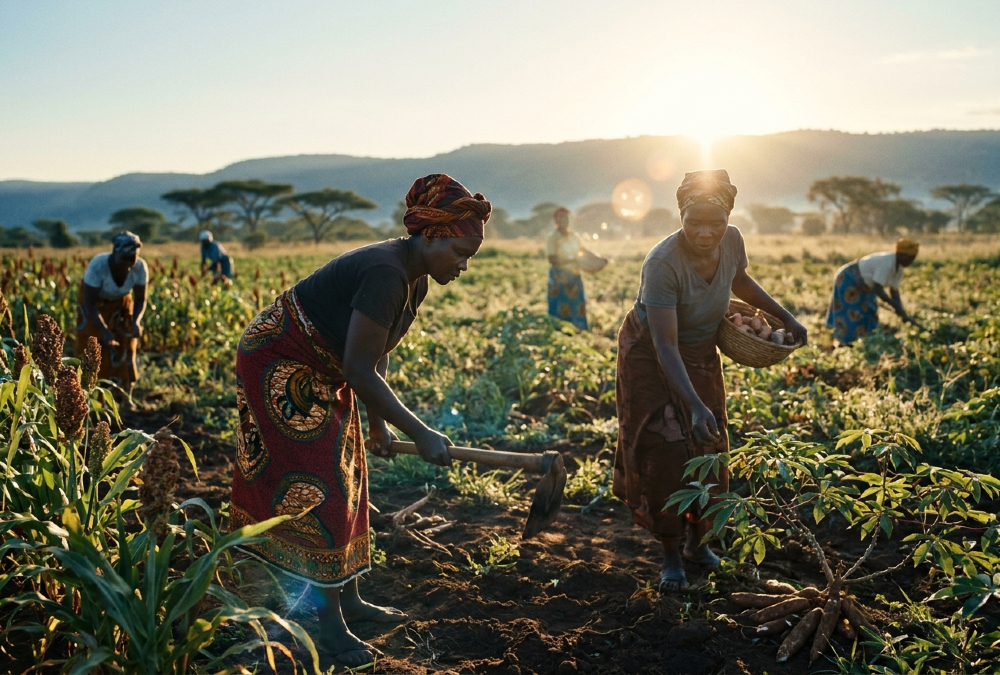
By most estimates, women grow 60 to 80 percent of the food produced in Nigeria. They plant, weed, harvest and process the crops that fill the country’s markets. Yet they are routinely absent from the rooms where climate decisions are made: the budget meetings, the extension-service planning sessions, the committees that decide which farmers receive early warnings and which receive nothing.
The consequences show up in the research. Studies of smallholder households find that female-headed farms are markedly more vulnerable to climate shocks than male-headed ones. The reason is not that a drought discriminates. The same dry spell scorches both fields. The difference lies in what happens next. Women have less access to credit, so they cannot buy drought-tolerant seed or pay for irrigation. They are less likely to hold secure title to land, so they have little incentive, and often little permission, to invest in it. And they are less likely to receive the timely information that lets a farmer shift planting dates or change crops before the rains fail.
This is a structural handicap, not a natural one. The Food and Agriculture Organization (FAO) estimates that closing the resource gap between women and men could raise women’s yields by 20 to 30 percent. Nigeria, in other words, is forfeiting a substantial share of its harvest before the first heat wave arrives. A country that imports food it could grow, and that frets about inflation at the market stall, can scarcely afford the waste.
What Waiting Costs
The deeper failure is what happens when the shock comes. For most Nigerian farming households, there is no structured plan waiting for them. Relief arrives, when it arrives at all, as an improvised response after the losses have been counted: the harvest gone, the savings spent, the children pulled out of school. This is the most expensive way to handle disaster, and the one that falls hardest on those with the thinnest cushions.
It does not have to be this way. Consider Ethiopia, a country with far fewer resources than Nigeria and a history of famine that once defined it in the world’s imagination. Its Productive Safety Net Programme (PSNP) pays vulnerable households, in cash or food, to work on community projects and keeps them afloat when harvests fail. Research by the International Food Policy Research Institute (IFPRI) found that the program cut the initial impact of drought shocks on household food security by 57 percent. Within two years, the adverse effect had been eliminated entirely.
That result is worth lingering on. It is not a pilot, a promise or a conference communiqué. It is evidence that a government can stand between a climate shock and a farming household, provided it builds the machinery in advance: the targeting systems, the payment channels, the financing triggers, the local administration. Ethiopia did not improvise its way to resilience. It designed it.
Policy is a Teachable Craft
The lesson for Nigeria is uncomfortable because it is so plain. Forecasting heat is the work of meteorologists, and they have done theirs. Designing a safety net that keeps the burden from landing most heavily on the people with the least protection is the work of policymakers, and it is a skill. Ethiopia’s program worked because someone understood how to structure incentives, finance contingencies and reach women who sit outside formal systems. None of that happens by accident.
That is why climate risk and adaptive policy design belong at the center of agricultural education, not at its margins. At the School of Agricultural Policy, they are treated as core material rather than an elective, because the next generation of Nigerian and African policymakers will inherit a warmer continent whether or not they are prepared for it. Training them to build the equivalent of the PSNP before the crisis, rather than to apologize after it, may be among the most valuable things a university can do.
The Test Ahead
Nigeria’s heat season will pass, and the toll will be tallied. The more important question is what the country builds in its aftermath. A government that treats 31,400 deaths as an act of nature will repeat the exercise next year. One that reads the figure as a verdict on its preparedness will invest in women’s access to credit, land and information, and in a safety net designed before the drought rather than after it.
The tools exist, the evidence is in, and the model has been proven next door in Ethiopia. What remains is the decision to use them.
Africa will feed Africa. But only if the people who grow its food are protected enough to keep doing so.
Juwon Akin-Olotu is the founder and CEO of Forthwith Global Limited, an agribusiness and consultancy advancing sustainable farming and modern agricultural solutions across Africa. A recognized voice in the continent’s agricultural sector, he champions technology adoption, human-capital development, and leadership grounded in service. Akin-Olotu is also a frequent speaker and moderator at international forums, where he addresses sustainable agriculture, agri-technology, and entrepreneurial education.
