
Opinion
Could Africa’s Rural Economy Outpace AI in the Coming Decades?
From India’s villages to Africa’s farmland, the countryside is getting rich. Africa, with the world’s largest reserve of uncultivated arable land, has the most to gain.

By Balbir Singh
The next great economic story may not be unfolding in Silicon Valley. It may be taking shape in the countryside.
During a recent visit to rural India, I was struck by how dramatically village economies have changed. I had expected agriculture to dominate the landscape. Instead, I found rural communities increasingly connected to technology, education, luxury consumption, real estate and sophisticated services.
Rising Land Values and Rural Spending Power
The first surprise was land value. In some villages, agricultural land along ordinary roads was being valued at roughly US$120,000 per hectare – far beyond what many middle-income households could comfortably afford. Whether these prices reflect genuine economic potential, speculation, or landowners simply choosing to wait for higher values, they reveal growing confidence in rural assets.
Then there is rural consumption. The value generated by village economies appears considerably larger than many outsiders assume. A simple roadside tea can cost about ₹60 (US$0.60), while lunch at a good local establishment can approach ₹1,000 (US$10). Behind these prices is a deeper transformation: money is circulating through rural communities in ways that challenge the old assumption that economic dynamism belongs exclusively to cities.
The transformation is also visible in lifestyle and wealth. Some rural households now own luxury vehicles, including Audi, BMW and Range Rover models. Large houses, farmhouses and high-end resorts are increasingly common in areas once associated primarily with subsistence agriculture.
And the migration pattern is changing. It is no longer only villagers moving toward cities in search of opportunity. Wealthier urban residents are increasingly looking toward the countryside for larger homes, cleaner air, more space and a different form of luxury. Rural areas are becoming destinations for leisure, investment and lifestyle.
Perhaps most striking is the digital transformation of the village.
Young people in rural communities routinely use high-end smartphones, laptops and digital applications. In some cases, their technological fluency is comparable to – and occasionally exceeds – that of their urban counterparts. At the same time, higher education is spreading rapidly. It is increasingly common to find young people from rural families pursuing medicine, engineering, computer science and other technical professions.
What This Means for Africa
This matters for Africa.
Across the continent, the rural economy remains deeply connected to agriculture, natural resources, food processing, logistics and increasingly digital services. As roads, electricity, mobile connectivity, financial technology and education improve, the traditional boundary between the “village” and the “city” will become less meaningful.
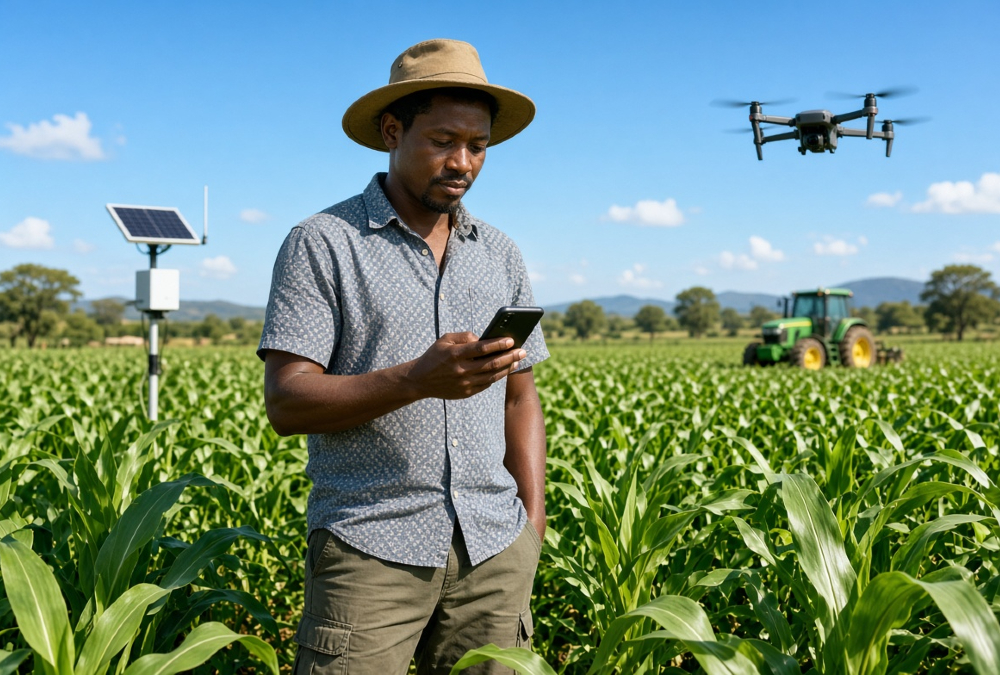
Africa should therefore be careful about treating rural development as merely an agricultural question. The future rural economy could encompass agribusiness, food processing, renewable energy, tourism, real estate, digital commerce, education, healthcare and technology.
Artificial intelligence may transform productivity in almost every industry. But AI itself will require land, energy, food, infrastructure and consumers. Those foundations will remain rooted in the real economy.
Perhaps the more interesting question is not whether agriculture will beat AI.
It is whether the rural economy and AI will eventually converge – with technology making agriculture and rural communities dramatically more productive, while rising rural wealth creates new markets for technology.
If current trends continue, the village of the future may look very different from the village of the past. And in a few decades, the world’s most important economic growth story may come not from the cloud, but from the countryside.
Balbir (Shekhawat) Singh, PhD, is a results-driven agribusiness techno-commercial professional with over 18 years of experience in sales, marketing, agronomy, product management, farming, commodity trading, and agri-inputs (fertilizers, seeds, agrochemicals). Passionate about advancing sustainable farming, he currently serves as Director General/CEO of Sodesep SA-Fertilizer Abuja, Nigeria. He has worked across emerging markets including India, Uganda, Kenya, Cameroon, Tanzania, Indonesia, and Nigeria.
