
Opinion
Diesel’s Gray Shock: The Hidden Inflation Squeeze Strangling Landlocked Markets
The Strait of Hormuz crisis is hitting landlocked African economies hardest, and the data that would prove it does not exist.

By John Kourkoutas
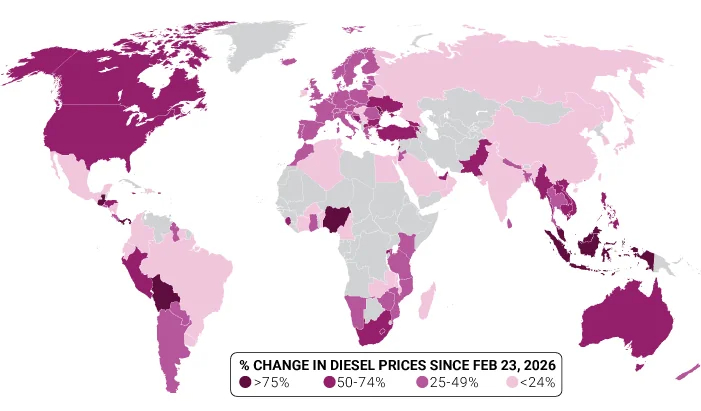
A map circulated this week detailing the change in global diesel prices since February 23, 2026. It is a vivid heat map: deep purple for price surges above 75 percent, pale pink for increases under 24 percent.
But look closely at Africa. Most of the continent is painted gray.
Gray, in this context, does not mean diesel prices remained flat. It means the data remains stubbornly unpublished. And tragically, this gray sits almost exactly where diesel volatility inflicts the most structural damage.
To understand why this matters, we must first look at the catalyst. On February 28, the Strait of Hormuz effectively closed following the outbreak of war with Iran. Roughly a fifth of the world’s oil transits this chokepoint. Major shipping lines – Maersk, CMA CGM, MSC, and Hapag-Lloyd – suspended operations, leaving more than 150 tankers anchored outside. Within a single week, diesel prices spiked by 96 cents, marking the largest one-week move in the 32-year history of the benchmark. Compounded by Houthi attacks in the Bab al-Mandeb strait and constrained Russian refining capacity, this ceased to be merely an oil story. It became a diesel story.
Geography is Destiny: The Hidden Freight Cost
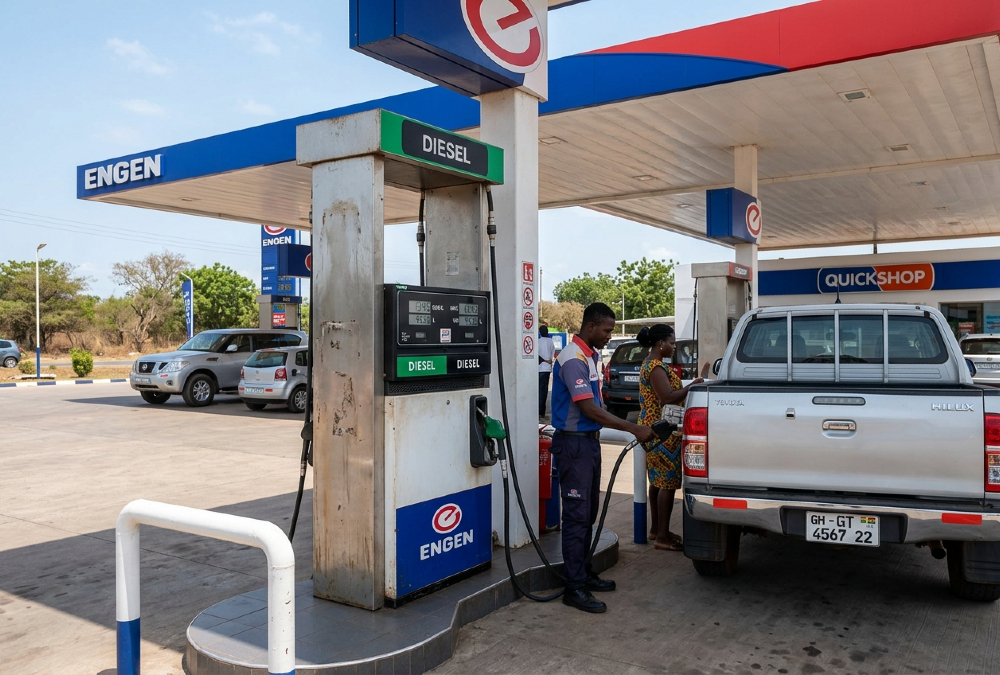
The crisis lands differently in Africa because of a fundamental geographic asymmetry. If you export to the continent, diesel is not just a fuel cost; it is a freight cost. And in Africa, the vast majority of that freight moves by road.
The continent is home to sixteen landlocked countries. When a shipping container clears the port, its journey is far from over. The corridor from Dar es Salaam to Lusaka spans roughly 1,850 kilometers (1,150 miles) of road. The route from Mombasa to Kigali covers about 1,700 kilometers (1,056 miles). That final leg is pure diesel consumption, and its cost is usually invisible in the initial price quoted to the buyer.
Consequently, the same percentage move in global diesel prices hits a landlocked delivered price several times harder than a coastal one. This is not because the fuel itself is different, but because there is vastly more of it burned between the ship and the shelf.
The Price of Being Landlocked
Malawi remains the clearest, most painful case study. Landlocked, chronically short of foreign exchange, and situated at the end of a long, arduous supply corridor, the country was blindsided. Pump diesel prices surged more than 40 percent in a single overnight adjustment in January. By mid-year, Malawi had become the second most expensive country in the world for diesel at US$3.63 per liter – more than double the global average.
Zambia’s regulator felt the same squeeze, adjusting pump prices on October 1 to take diesel to 33.27 kwacha (US$1.69) per liter.
Yet, this pain is not strictly automatic. Uganda, also landlocked and situated on a comparable corridor, has seen its diesel prices barely move through the exact same shock. What made the difference? Procurement strategies, strategic fuel stocks, and proactive tax policy. Geography sets your exposure, but policy decides the outcome.
Four Imperatives for Exporters
For international businesses selling into these markets, ignoring the road leg is no longer an option. Here are four critical adjustments to make this week:
1. Reprice your existing quotes.
If you quoted anything on a Delivered Duty Paid (DDP) or Delivered at Place (DAP) basis before late February, that margin is gone. You are currently absorbing the loss. Recalculate immediately.
2. Shorten your quote validity.
Reduce quote validity from ninety days to thirty days until the situation in the Strait of Hormuz stabilizes. The volatility is simply too high to lock in long-term fixed pricing.
3. Implement fuel adjustment clauses.
Insert a formal fuel surcharge or adjustment clause into your contracts. Most established African distributors will accept this; they live with the same volatility and would vastly prefer to share the risk transparently rather than reopen the entire price negotiation later.
4. Rethink your pricing models.
Stop pricing landlocked markets off a coastal landed cost. Lusaka is not just Dar es Salaam “plus a bit.” The inland premium is now a massive, volatile variable that must be modeled independently.
The Bottom Line
Africa’s supply chains are resilient, but they are not immune to the mathematics of global energy shocks. The gray spaces on the map are not empty; they are hiding a profound vulnerability in the continent’s logistics network.
If you sell into Africa and you are not entirely certain what the road leg is doing to your delivered price right now, you are flying blind. Reach out to me directly with your product and destination, and I will show you what the real number looks like. In today’s market, clarity is the only competitive advantage left.
John Kourkoutas is business development expert that specializes in helping companies, export teams, and business leaders succeed in Africa’s dynamic and emerging markets.
