
Opinion
Botswana’s Diamond Gambit: Owning the Mine Is No Longer Enough
A sovereignty deal masquerading as a mining deal, and a test for every resource-rich nation.
By Gregory September
For decades, Botswana supplied the diamonds. Someone else owned the company that sold them.
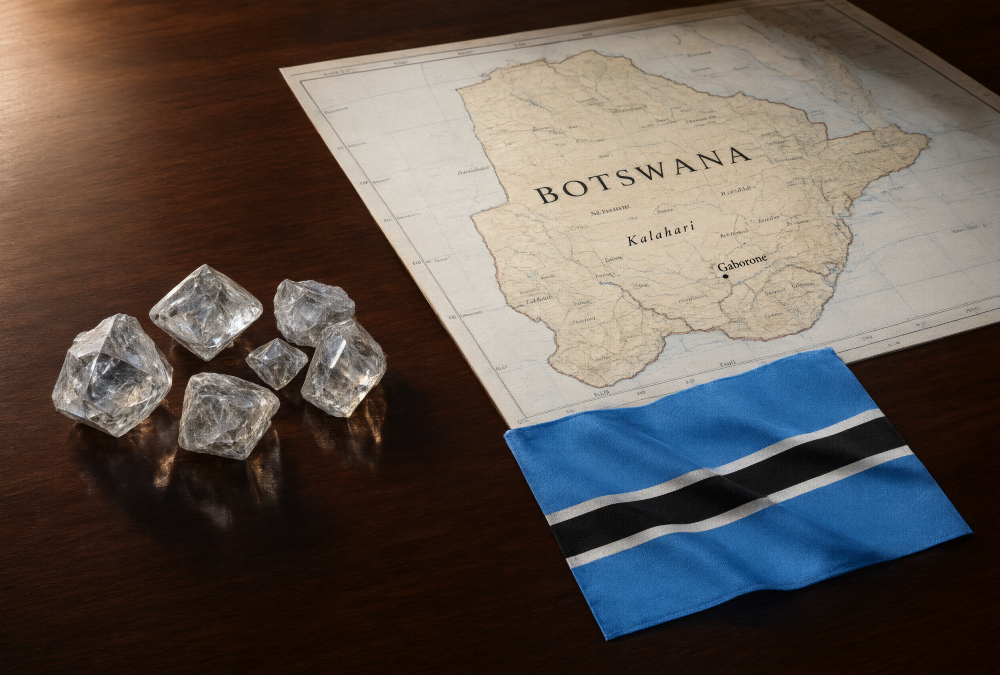
That arrangement is now being renegotiated. Anglo American, the London-listed mining giant, is selling its 85 percent stake in De Beers. Botswana, which already holds the remaining 15 percent, wants majority control. Its president has framed the push as a matter of economic sovereignty, and he is right to. This is not a mining transaction. It is a bid to move from owning a resource to owning the value chain built on top of it.
The Arithmetic of Dependence
The logic starts with an uncomfortable asymmetry. De Beers sources roughly 70 percent of its diamonds from Botswana. The country is not a marginal supplier but the foundation of the business. Yet for most of the modern diamond era, the decisions that mattered most were made elsewhere: how rough stones are priced, where they are cut and polished, how they are marketed, and who keeps the margin between the ground and the jewelry case.
Botswana has done better than many of its peers. Its partnership with De Beers is often cited as a rare African mining success story, funding schools, clinics, and a reputation for fiscal discipline. But a good royalty is not the same as control. A country that collects revenue from someone else’s company remains a customer of its own geology.
A Seller’s Market, at a Buyer’s Price
The timing reflects a company in transition. De Beers was valued at around US$4.9 billion in February 2025. Anglo American has since cut its carrying value of the business to about US$2.3 billion, after US$7.8 billion in impairments. Those numbers tell the story of an industry under strain, with weaker demand and heightened competition from lab-grown stones, and of a parent keen to shed an asset that no longer fits its strategy.
For a seller, that is a problem. For a would-be buyer with a long-term view, it may be an opportunity. A distressed price lowers the cost of entry to precisely the sort of strategic asset that rarely comes to market.
The deal is targeted for completion in the fourth quarter of 2026, and Botswana will not be alone in pursuing it. A rival consortium, reportedly led by Gareth Penny, a former De Beers chief executive, may include Angola and Namibia, two other diamond-producing states. Reports have also linked the transaction to Oman’s sovereign wealth fund. Whatever the final shape of the deal, the cast of bidders reveals the underlying theme: governments and state-backed capital are increasingly willing to buy what they once merely sold.
Why Ownership Matters for Development
The case for Botswana’s ambition rests on three arguments, each of which maps onto the United Nations’ Sustainable Development Goals.
Who captures the income (SDG 8). Ownership of the value chain changes who captures mining income. Royalties and taxes are a share of the proceeds. Equity is a claim on the profits, the pricing power, and the strategy. A majority owner decides how much value stays at home.
Who decides what happens next (SDG 9). Control over the company shapes future processing decisions. If the cutting, polishing, and sorting of diamonds is to move closer to where they are mined, someone must choose to build that industry. A foreign-owned parent has little reason to prioritize a host country’s industrial ambitions. A domestically controlled one has every reason to.
How governments negotiate power (SDG 16). The deal is also a test of institutional maturity. Negotiating over a company of this scale requires transparency, professional governance, and insulation from political temptation. If Botswana succeeds, it will offer a template. If the process is opaque or captured by narrow interests, it will offer a warning.
The Risks of the Sovereign Balance Sheet
Enthusiasm should be tempered. State ownership has a mixed record in the extractive industries, and the history of national mining champions includes as many cautionary tales as triumphs. Governments can be poor commercial managers, tempted to use companies as instruments of patronage or to extract short-term cash at the expense of long-term investment.
The financial exposure is real, too. A country whose economy already leans heavily on diamonds would be doubling down on a single, volatile commodity at a moment when lab-grown alternatives are eroding the premium on natural stones. Owning the company concentrates risk as surely as it concentrates reward.
The answer is not to avoid ownership but to govern it well: independent boards, professional management, clear commercial mandates, and public accountability. Norway’s approach to its petroleum wealth, which separates the state’s ownership role from day-to-day operations, remains the model worth studying.
The Question For the Rest of the Developing World
The larger lesson extends well beyond southern Africa. Many resource-rich countries sit atop minerals the world needs, from cobalt and lithium to copper and rare earths, yet capture only a fraction of the value those minerals create. The energy transition will intensify demand for them. It will also intensify the temptation for producing countries to ask why they should remain suppliers when they could be owners.
The honest answer is that it depends. Ownership without capability is a liability. But ownership paired with strong institutions, patient capital, and a credible plan to build downstream industries can transform a resource curse into a development strategy.
Botswana’s bid will not settle the debate. It will, however, sharpen it. Should more resource-rich countries aim to own the companies, not just the resources? After decades of watching others profit from their ground, more of them are going to try. The only question is whether they will be ready.
Gregory September is a South African academic, author, and geopolitical analyst with extensive experience in government and Parliament. He is the founder and CEO of SAUP (Sustainability Awareness and Upliftment Projects NPC), which focuses on sustainability education and community development. He previously served as Head of Research and Development for the Parliament of South Africa. His work centers on sustainability, African geopolitics, and economic development, and he regularly contributes to analysis of global political and economic affairs.
