
Opinion
When Markets Sprint and Roads Crawl
Africa’s businesses can find customers faster than ever. Delivering reliably to them remains a different proposition.

By Raymond Chimhandamba
Picture an avocado exporter in Murang’a, Kenya, at 4 a.m. Call him James. His fruit is graded and packed, and an overseas buyer expects it to enter the export chain on schedule. The collection truck is late. WhatsApp messages fly back and forth. The buyer wants an update, and the transporter promises one shortly. By sunrise James has exchanged more information than his predecessors could manage in a day. His fruit has barely moved.
James is illustrative, but his problem is real. A late truck does not automatically spoil avocados. It can, however, miss a receiving slot, disrupt onward transport, inflate cooling costs and shrink the window in which to sell. The consignment may eventually arrive after its commercial opportunity has left.
Across much of Africa, communication has outrun delivery. A retailer can order by phone, a customer can pay in seconds and a manufacturer can spot demand in another country before lunch. None of that guarantees the goods will show up when promised. When the phone pings faster than the truck moves, the gap becomes a business expense.
The Price of Uncertainty
Debates about infrastructure tend to start with kilometers of tarmac, port capacity and freight rates. Businesses are asking something subtler: how confidently can they promise a delivery date?
A journey that reliably takes three days can be planned around. One that takes two days this week and seven the next cannot. Retailers pad their stock, manufacturers hoard raw materials and exporters build in buffers that rivals on dependable routes can skip.
Those precautions tie up cash that might have bought equipment, hired staff or funded expansion. Unreliability also decides who gets to compete. A large firm can absorb disruption with inventory, backup power and several carriers. A small one simply loses the customer.
The damage reaches the factory floor, too. A diaper maker may have machines, workers and orders ready, yet sit idle because one imported material is stuck somewhere between port and plant. A single missing input can immobilize a far larger investment. The true test of infrastructure is whether production and delivery proceed as planned.
A Port is Only the Start
Ocean freight is visible and easy to quote. The inland leg is harder to price. Terminal delays, storage charges, customs queries, scarce trucks and clogged access roads accumulate before goods reach a factory or wholesaler. No single ratio of sea freight to inland cost holds across the continent, since routes, products and conditions differ too much. But a competitive import price can look far less attractive once the full delivered cost is tallied.
History explains part of the problem. Many transport networks, inherited from the colonial era, were built to carry resources from mines and farms to export gateways rather than to link neighboring markets. Yet history cannot excuse every bottleneck. Maintenance, urban congestion, weak competition among carriers and poor coordination between agencies all shape how infrastructure performs. The World Bank’s August 2026 assessment of African integration lists customs inefficiencies, regulatory divergence, fragmented transit arrangements and weak logistics among the barriers to regional trade.
Cooling Works Only if the Chain Holds
Perishables make the stakes plain. Refrigeration can preserve quality and stretch the distance over which a producer can sell, but only if it is continuous through storage, handling and transport. A farm cold room cannot compensate for an unreliable collection service, and a refrigerated truck cannot reverse spoilage that happened before loading. Fresh produce, frozen fish and temperature-sensitive medicines each demand different conditions.
A 2022 report by the UN Environment Programme and the Food and Agriculture Organization argues for treating food cold chains as whole systems rather than collections of equipment. For investors, that means scrutinizing utilization, electricity supply, maintenance, affordability and onward movement, not just the spec sheet.
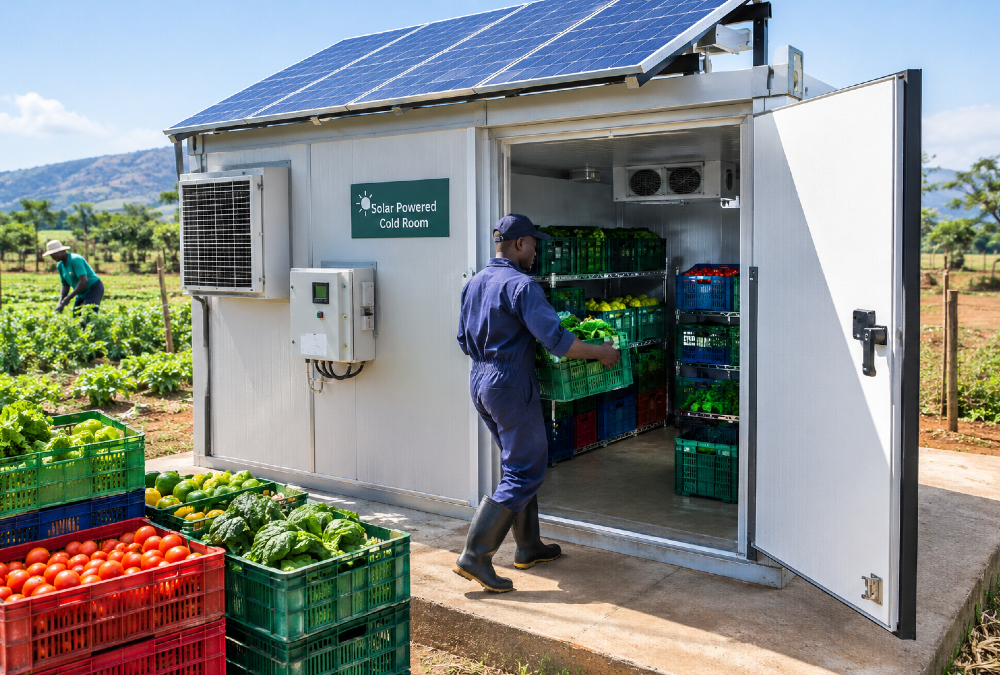
Nigeria’s ColdHubs shows what customer-centered design looks like. It installs solar-powered cold rooms at farms and markets and charges a daily fee per crate stored, so farmers can buy preservation without buying a refrigerator. Infrastructure becomes useful when customers can afford it in quantities that suit them. It lasts only if paying demand, competent operation and maintenance funding keep pace.
Power and Paperwork also Need to Move
Logistics involves more than roads. Warehouses need light and refrigeration. Factories need stable power. Digital systems need electricity and connectivity to track stock and reconcile payments. Where supply falters, firms turn to generators, batteries and solar panels, which protect deliveries but consume capital and management time, and whose costs are scattered across ledgers that obscure the true price of serving a customer.
Paperwork poses a similar trap. An electronic form helps little if several agencies still demand repeated checks or separate physical submissions. A truck may carry the best tracking technology while its cargo waits for a certificate another authority refuses to recognize. East Africa’s one-stop border posts, such as the one at Busia between Kenya and Uganda, tackle this by putting agencies under one roof and ending duplicate clearance on both sides. But a new building is merely an input. Predictable crossing times are the outcome.
Payments close the loop. A distributor who has sold stock but not yet collected the cash cannot replenish. Commercial velocity depends on completing the whole cycle: order, delivery, confirmation, payment.
Ingenuity is Evidence, not a Solution
Businesses are adapting. Distributors stage inventory closer to customers, carriers consolidate loads and hunt for return cargo, and local traders knit together short journeys that big networks cannot serve profitably. Digital platforms match freight to trucks, distributed storage shortens restocking runs and hybrid energy systems protect essential operations.
Such improvisation deserves scrutiny rather than romance. An insulated box is not a validated pharmaceutical cold chain. A freight app can find a truck without vouching for its roadworthiness, punctuality or payment terms. Several small warehouses bring stock closer but raise security and control costs. Nor does an “asset-light” model erase the need for capital: someone still finances the trucks, fuel, inventory and customer credit. Investors should ask who bears that risk, especially when a platform promises cheaper delivery.
Informal operators reveal where demand lives and which services customers prize. Policy can build on that knowledge. What adaptation must not become is an excuse to leave the underlying constraints untouched.
Spend Where Reliability Breaks
Big projects still matter. Ports, railways, highways and power grids can transform what an economy can produce. The challenge is to pair them with the smaller fixes that let firms actually use them. A congested junction can cripple a long corridor. Poor drainage can repeatedly cut off an industrial estate. A missing testing laboratory can stall exports on a flawless road. A cold store can sit half-empty because nobody can reliably collect from it.
The best intervention is a matter of evidence. Sometimes it is major construction. Often it is maintenance, coordinated inspections, smarter scheduling or dependable electricity that unlocks capacity already paid for.
Executives should tally what disruption costs them: emergency freight, stockouts, spoilage, excess inventory, backup energy and lost sales. That reframes “routine” operating spending as investment worth comparing. Lenders and development finance institutions should weigh the same costs against projected demand, since a promising market does not automatically yield a viable logistics service. Freight density, seasonal volumes, maintenance skills, affordable tariffs and payment discipline decide that. Governments, for their part, should publish corridor performance, including crossing and clearance times and their variability. Averages hide the rare severe delay that forces every firm to carry costly insurance against it.
The Promise Customers Buy
Africa’s markets move at different speeds. Digital access is uneven and some physical networks outperform others. Still, the ability to discover demand increasingly exceeds the ability to serve it.
For James, finding a buyer was only the beginning. His opportunity hinges on collection, handling, onward transport and a delivery promise that survives the journey. The same holds for a manufacturer supplying a neighboring country or a distributor restocking village shops. Customers buy goods, but they are really buying expectations about availability, condition and timing.
Africa’s industrial ambitions will advance when firms can make promises with confidence. The markets have already accelerated. The task now is to make delivery dependable enough to keep the business they create.
Raymond Chimhandamba is a Johannesburg-based consultant, writer, and speaker specializing in African industrial development, manufacturing value chains, and investment opportunities. He is director of Handas Consulting and founder of Kunakisa Recycling, with expertise in market entry, manufacturing localization, due diligence, absorbent hygiene products, nonwovens, recycling, and the commercial use of agricultural waste. He has contributed more than 40 articles to Nonwovens Industry Magazine and writes for International Fiber Journal. He has also spoken at international industry events organized by INDA and EDANA. Raymond is currently writing Asymmetric Africa, a book examining overlooked opportunities in African markets.
