
Opinion
What a $385,000 Cow Reveals About the Poverty of Value
Uganda has the cattle. South Africa built the market. The difference is trust, and trust is something we can choose to build.

By Apollo Buregyeya
On October 3, 2026, a cow named Queen Arusha went under the hammer at Phala Phala, a farm near Bela-Bela in South Africa’s Limpopo province. The price was R6.4 million, about Ush1.53 billion, or roughly US$385,000.
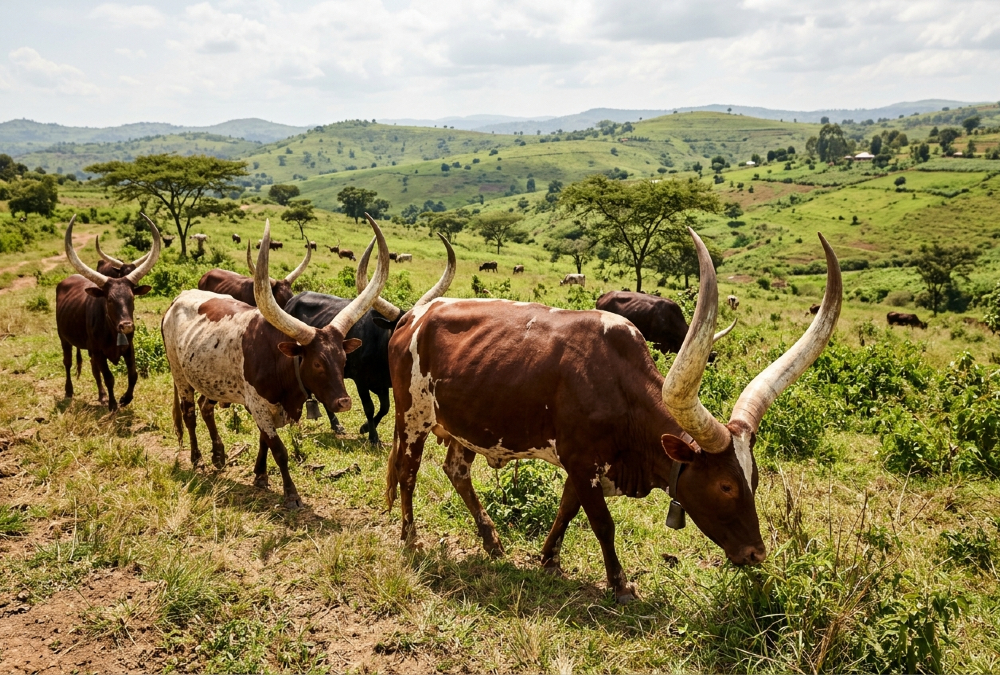
She is a Nkore, the long-horned breed known elsewhere as Ankole, and it belongs to the grasslands of southwestern Uganda. The animals that gave the breed its name still graze there. A good Nkore cow in a Ugandan market may fetch about Ush2 million (US$513). By that measure Queen Arusha sold for roughly 765 times what her Ugandan cousins command.
Africa’s economic debate has long had a familiar rhythm. We produce the raw material, someone else adds the value, and we convene a workshop on poverty. The cow is a rare case in which the numbers fit on a single line.
Why Was Queen Arusha So Valuable?
It would be easy to answer with sentiment: she was a beautiful animal, an exceptional specimen, a one-off. Perhaps she was. But beauty alone does not command US$385,000. Four things stood behind her price, and none of them is mysterious.
First, her bloodline came with a story. Buyers knew where she came from and what she carried. Second, her breeding was managed, so her lineage was not a matter of rumor. Third, her ownership was clear. Nobody wondered whether someone else would turn up claiming her. Fourth, and most important, serious buyers trusted the auction. They believed the bidding was honest, the paperwork real and the transaction final.
That is the whole point. A cow becomes valuable when a serious society builds serious value around it. The animal is the smallest part of the price. The records, the rules, the reputation and the institutions make up the rest.
The Tax We Refuse to Call a Tax
Compare that with the environment in which our own livestock, and much else, changes hands. Records disappear. Standards bend for those with the right connections. Money moves under the table. And then we express surprise that our assets attract village prices.
We tend to talk about corruption as something stolen from the government: the missing road budget, the inflated contract, the ghost worker on the payroll. That is real, and it is serious. But it is only the visible part. Corruption is also a tax on everything we own. It is levied on every cow, every kilo of coffee, every acre of land and every wrong diagnosis in an under-supervised hospital. Nobody collects it, nobody issues a receipt, and nobody votes on it. It simply shows up in the price.
Think about what a buyer does when they cannot trust a seller’s claims. They discount. They assume the pedigree might be false, the title might be disputed and the weight might be wrong. They protect themselves by offering less. Multiply that discount across millions of transactions in an economy and you get a country that sells valuable things for ordinary prices.
Uganda is not Poor; It is Underpriced
This is where I want to be blunt. Uganda is not a poor country in the sense that matters most. We have fertile land, a young population, a famous coffee, extraordinary wildlife, abundant water and a livestock heritage that other nations have found worth building businesses around. What we have too often failed to do is make these assets trustworthy to the people who would pay most for them.
A country that cannot make its papers, laws and promises reliable cannot make its cattle, coffee or tourism expensive. Trust is not a soft virtue sitting alongside the real economy. It is infrastructure, as real as a bridge or a power line, and its absence shows up in every invoice.
Consider the questions a premium buyer asks before paying a premium. Is the origin verifiable? Is the quality certified by someone who cannot be bought? Will the contract be enforced if the other side defaults? Can I resell this with a clean record? Each “no” removes some of the price. Each “yes” returns it. Queen Arusha’s buyers were able to say yes.
What Serious Value Looks Like
None of this requires inventing something new. The ingredients are familiar:
- Records that cannot vanish. Registries for livestock, land and produce that are digital, auditable and hard to alter quietly.
- Standards that do not bend. Grading and certification that mean the same thing for a smallholder as for a politically connected exporter.
- Ownership that is clear. Titles and brands that hold up in a dispute, so that an asset can be sold, financed or inherited without a fight.
- Auctions people believe in. Transparent markets in which the best price is public and the payment is real.
- Stories that are true. Provenance and bloodline backed by evidence, because a story only commands a premium when buyers can verify it.
The farmers who raise Nkore cattle in Uganda already hold the hardest part of the equation, which is the animal itself. What they lack is the surrounding system that turns an animal into an asset. That is a failure of institutions, not of effort or talent.
Why this Should Disturb Us
The Queen Arusha sale should unsettle us, but not because South Africa has a cow worth Ush1.53 billion ($385,000). Envy is a poor guide to policy. It should trouble us because it forces an uncomfortable question: how many things do we own whose value we have never organized?
There are the cattle, of course. But there is also the coffee sold green and cheap, to be roasted, branded and sold dear elsewhere. There are the acres of land that cannot be mortgaged because the title is uncertain. There is the tourism that sells landscapes without selling the experience around them. Each is a Queen Arusha waiting for a serious society to notice her.
From Grievance to Ladder
It is tempting to treat all this as a story of injustice, and parts of it are. Colonial borders, unfair trade rules and global price structures have all cost Africa dearly. But grievance does not raise prices. Institutions do. A nation that waits for the world to value its assets fairly will wait a long time. A nation that builds the systems that make its assets credible can start to capture value at home.
That is the argument I make in my book, The Five Levels of Economic Power: How Nations Capture Value and Why Africa Must Climb the Ladder. Countries do not become rich by luck or by sentiment. They climb, one level at a time, from selling raw things to selling trusted things, and from there to selling things that others cannot easily copy. Queen Arusha stands at a rung many African economies have yet to reach, and the ladder is not locked.
We have the cattle. What remains is to build the country around them.
Apollo Buregyeya, Ph.D., is a civil engineer and entrepreneur focused on developing sustainable African industries that leverage local mineral resources to improve living standards. He is the founder and CEO of Eco Concrete Ltd, a construction company specializing in innovative solutions tailored to the African environment. Committed to resource ownership and appropriate technology for value creation, he also teaches at Makerere University in Kampala, Uganda.
